


 Photography by THE AUTHOR
anny Santoro doesn’t talk much—not because he’s hiding anything but because he’s like many men his age in these times. You spend decades defending your decisions, opinions, work, and reputation, and eventually the words dry up. The silence becomes its own armor. He sits back on the leather couch in his Upland shop, arms folded, eyes somewhere between the floor and the gold 1955 Chevy parked 10 feet away. Pulling taffy is easy by comparison, but eventually we get the story out of him.
That’s how the story starts—one of those purchases that looks smart until the first wrench hits the first bolt. The supposed turnkey gasser turned out to be a teardown. When the motor came out, the front end measured incorrectly, so Danny hauled it to his friend Ron Blanchard at Performance Carb in Ontario, California. Blanchard cut off the entire front clip and started over. “[Blanchard]’s the one who made it look right,” Danny says. “There are a lot of gassers out there that don’t have the right look.”
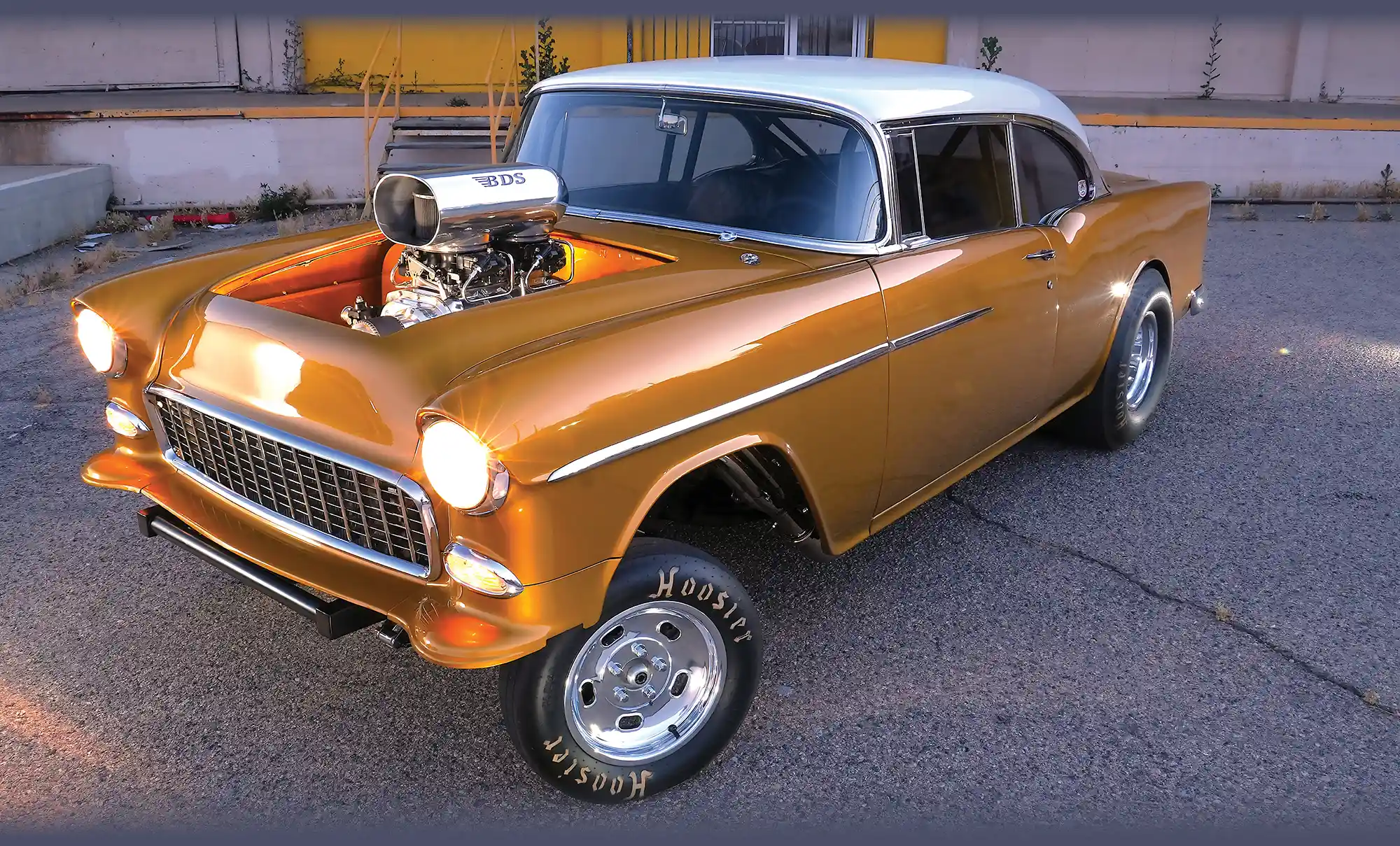
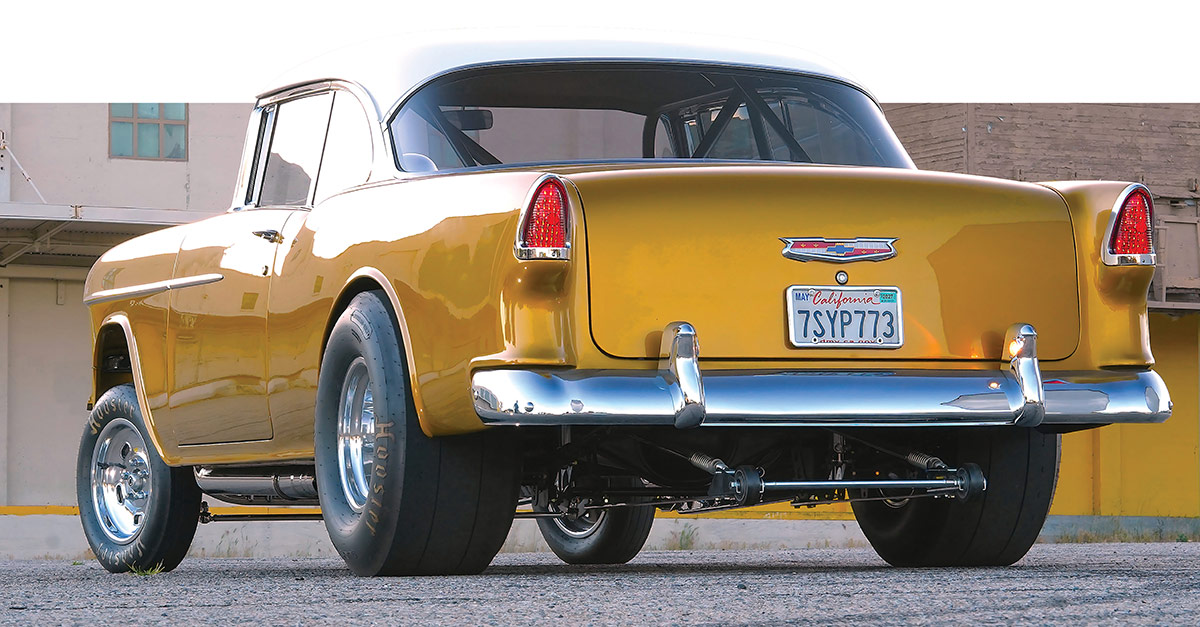
Blanchard’s fingerprints are all over the car: the rollcage, the rear suspension, and the stance that makes the Chevy look like it’s ready to leap off the line, even when it’s parked. Up front, Danny made a deliberate choice—a 2‑inch‑drop WAC Customs solid‑axle conversion instead of a traditional straight-axle. He wanted the gasser attitude without the blind‑spot‑from‑hell driving position. The drop axle gives him better sightlines and street manners while still delivering the nose‑high posture the genre demands.
And that posture isn’t just nostalgia. Gassers looked the way they did because physics demanded it. The high nose and rearward rake were all about weight transfer—shoving mass onto the slicks at launch, planting the rear tires, and letting the front end rise. It’s a style born of necessity, not fashion, and Danny wanted that geometry nailed.
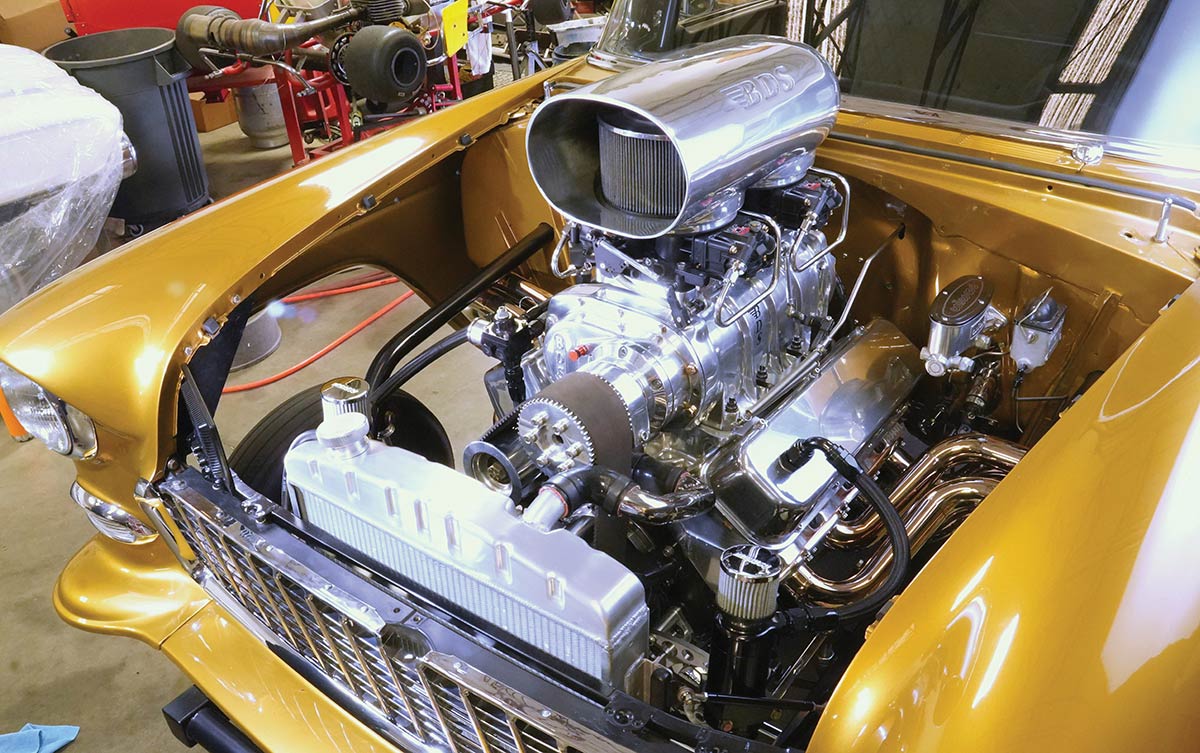
The donor car’s original blown 496 big‑block was junk, so Danny went hunting. He’d been eyeing a black Corvette gasser with a 6‑71 BDS‑blown 427 but couldn’t swing the price. Six months later, the Corvette’s owner called: he was pulling the motor for an LS swap. Danny jumped. “I bought the motor already done,” he says. “Don’t want to say where.” The heart of Bad Idea is a 427ci big‑block Chevy topped with a polished BDS 6‑71 supercharger and dual PC Performance 1,050‑cfm Dominators. Running 8.0:1 compression and 10 psi of boost, the combo makes a dyno‑proven 750 hp on pump gas. Brodix aluminum heads, a mild hydraulic roller cam, and MSD ignition keep it street friendly, while the gold‑painted bay and mirror‑finish blower turn raw horsepower into sculpture. Fuel comes from a Holley 170‑gph mechanical pump via a Magna Fuel regulator; spark from MSD. Custom 1-7/8‑inch fenderwell headers feed into a hand‑built 4‑inch dual exhaust that runs tight along the rocker panels—top craftsmanship by James Crosby. The polished tubing mirrors the car’s gold finish and gives the blown 427 Chevy a voice worthy of its 750hp punch, barking through twin pipes that look as serious as they sound.
The transmission is a close‑ratio, clutchless Midwest Muncie N24 crashbox with straight‑cut gears, a dual‑disc clutch, and a Long V‑gate shifter. “You lift off the gas and just pull it back,” he explains. “You don’t need the clutch. Around town I’ll use it—it’s easier—but when you’re up in the rpm, you just slam it. My hand hurts because I’m ‘boom, boom.’ Loud and obnoxious. Just what I want.”
He laughs at the absurdity of it all—the money, the time, the paint. “You buy a car for decent money, you’d think you wouldn’t have to tear it all apart,” he says. “You could buy a $10,000 car and tear it apart, but this one was really nice. The body was good. We sandblasted it to bare metal and started over. You think you’re gonna spend $50,000? Double it.”
The paint ordeal alone could fill a chapter. The first painter in L.A. sat on it for eight months. Danny pulled it out, sandblasted again, and took it to another shop. “He had it 2-1/2 years,” Danny says. “Supposed to be a $12,000 job, six months. Ended up $22,000 and 3-1/2 years.” The result, though, is stunning—PPG two‑stage gold pearlescent that glows like molten metal under the sun. They call it “paint jail” for a reason. The sentence is long, but the parole looks good. Up front, the WAC Customs 2‑inch‑drop solid axle sets the classic gasser rake—nose up, tail down—without killing street visibility. Combined with the Hoosiers stuffed deep into the radiused quarters, the stance gives the car a defiant, ready‑to‑launch attitude that feels straight out of a mid‑’60s pit side lineup.
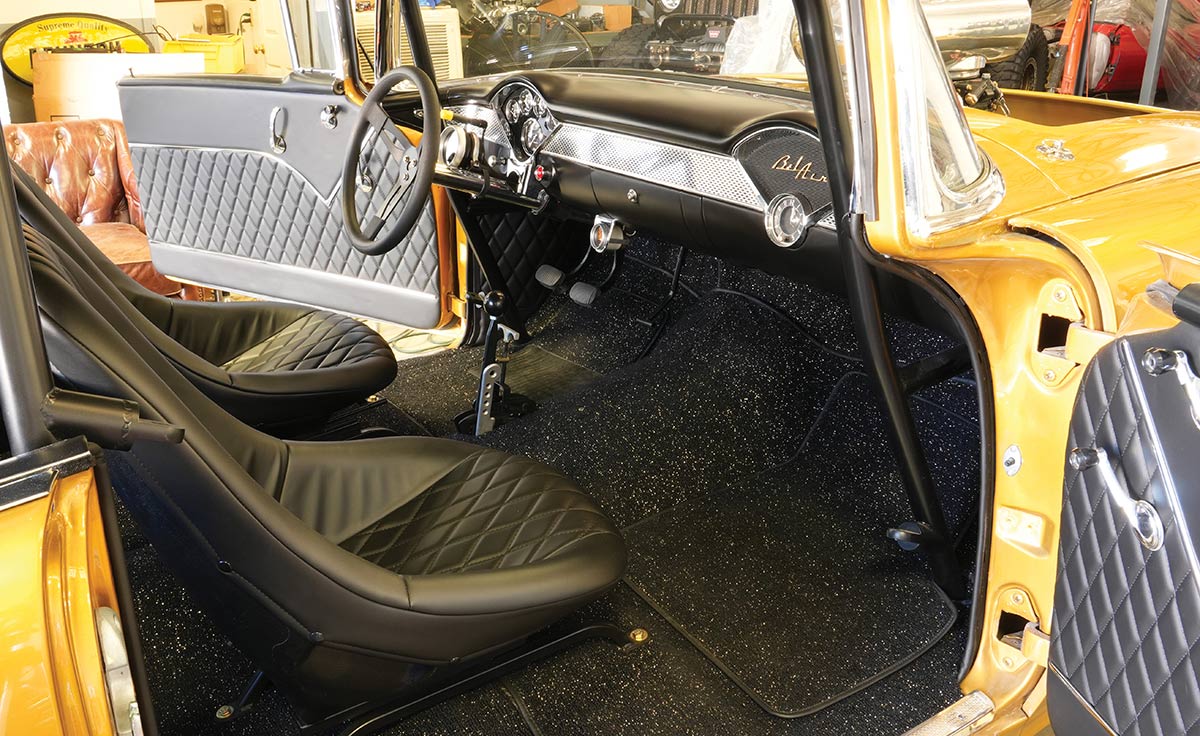
When the body finally came home, Santoro assembled everything himself. “Every nut and bolt,” he says. Wiring came courtesy of Carlos Rodriguez at Art of Sound in Upland; upholstery by Mark Lopez at Elegance Auto Interiors. The interior blends mid‑’50s Chevrolet simplicity with the unmistakable mid‑’60s competition look. A Speedway Motors column, Auto Meter gauges, and a Long V‑Gate shifter lock it firmly into the drag‑era vibe—all framed by the original Bel Air brightwork that keeps the heritage visible. The fact that you’re reading those names means Danny abides. It’s clean, functional, and built to survive the abuse of a clutchless four‑speed and 700‑plus horsepower.

Danny’s been around cars since he was 15, wrenching in the backyard with his dad. “He’s still around,” Danny says. “Grumpy old man.” You can tell the apple didn’t fall far. His first car was a 1961 Volkswagen his father restored, then a 1955 Ford truck, then a 1964 El Camino. “One thing after another,” he says. “Just kept building them and selling them.” The gasser itch came later, courtesy of Blanchard’s own 1955. “I wanted to buy his car,” Danny admits, “but I couldn’t. Everyone knows that’s [Blanchard]’s 1955. I didn’t want to be the guy driving [Blanchard]’s car around, so I built my own.”
He thought he’d just tweak a few things and drive it. “Do a couple little things, have fun,” he says. “Didn’t even drive it 10 miles. Took it all apart.” The fenders weren’t cut, the wheelwells were stock, and the look was halfway there. “It took me three weeks to decide to cut the wheelwells,” he says. “Didn’t know if I wanted to. As soon as we cut ’em, I was like, now it looks like a real gasser.”
That’s the moment the car found its identity—when hesitation gave way to commitment. From there, it was all‑in: new rearend, new motor, new everything. Eight years later, Bad Idea became the best kind of bad idea—the one that works out.
He built it to drive to Irwindale, make a few passes, then drive home. “That was the whole thing,” he says. “Now Irwindale’s closed.” He shrugs. “I’ll enjoy it this year, then go to Bakersfield. Should be 10s, maybe 9s.” He’s done that before; his old Camaro was a 10‑second car. The gasser should be quicker, louder, and meaner.
Danny’s demeanor never really changes—steady, dry, a little amused by the chaos he’s endured. You get the sense he’s not chasing trophies or validation (even after a Builder’s Choice Top 10 pick at Goodguys Del Mar). He just wants the car to be right, to look right, to sound right. “Just fabricating the gasser look,” he says. “It’s hard to get the right look.” He’s right. Most miss it. His doesn’t.
