

 PHOTOGRAPHY BY THE AUTHOR & COURTESY OF HOLLEY PERFORMANCE
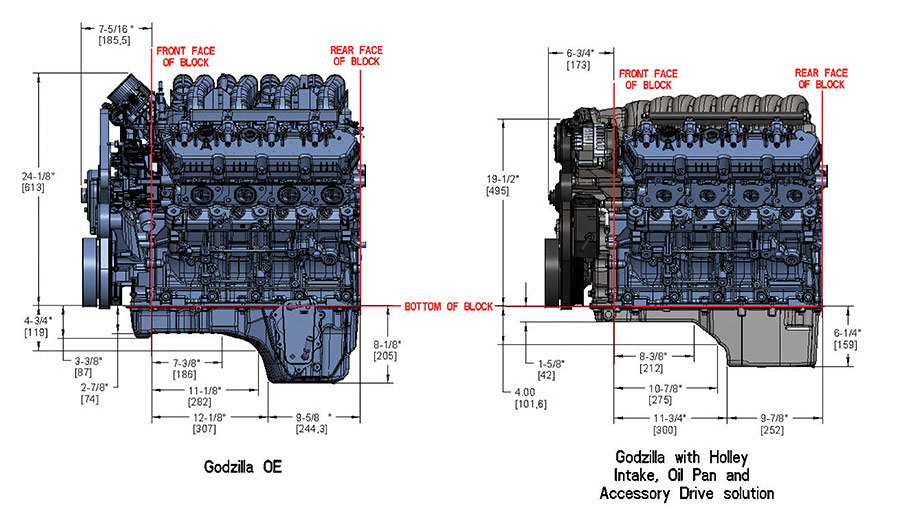
ord’s Godzilla 7.3L V-8 gas engine is a prime candidate for engine swaps—but there’s an inherent problem that can stop you in your tracks. This issue lies in the stock intake manifold inlet, which is angled upward at a severe angle. And that 45-degree-angle inlet is basically a guarantee that you’ll run into hood clearance issues when fitting a Godzilla into a passenger car.
Thankfully, Holley Performance Products has a solution to resolve any hood clearance issues. As you probably figured out, Holley offers a unique Godzilla intake manifold—and swapping it for the stock unit is a breeze.
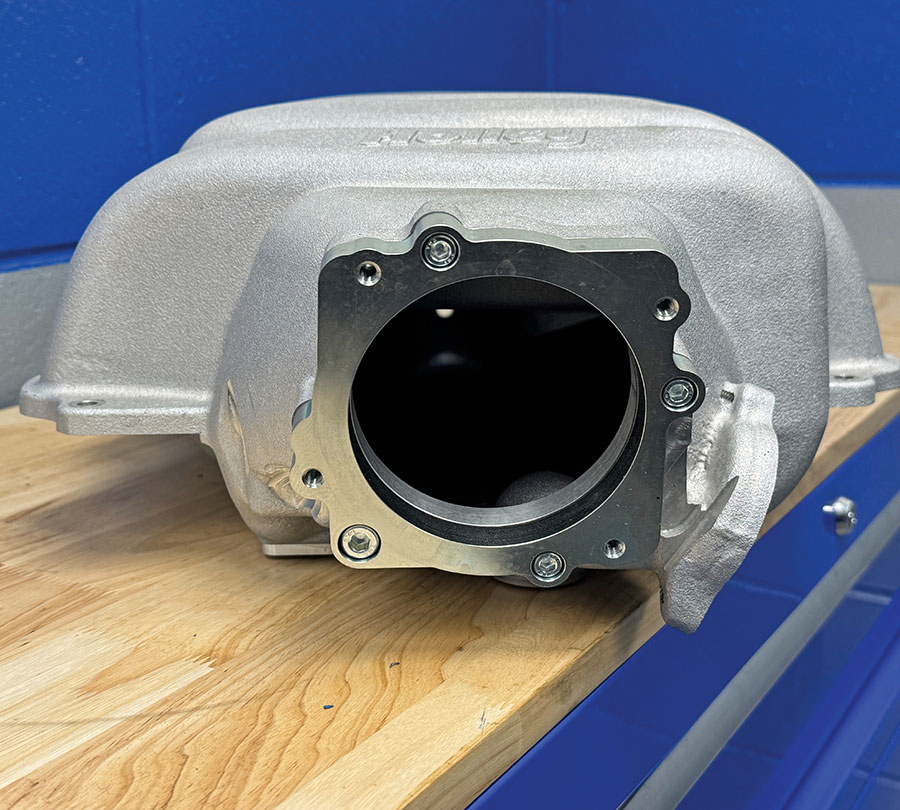
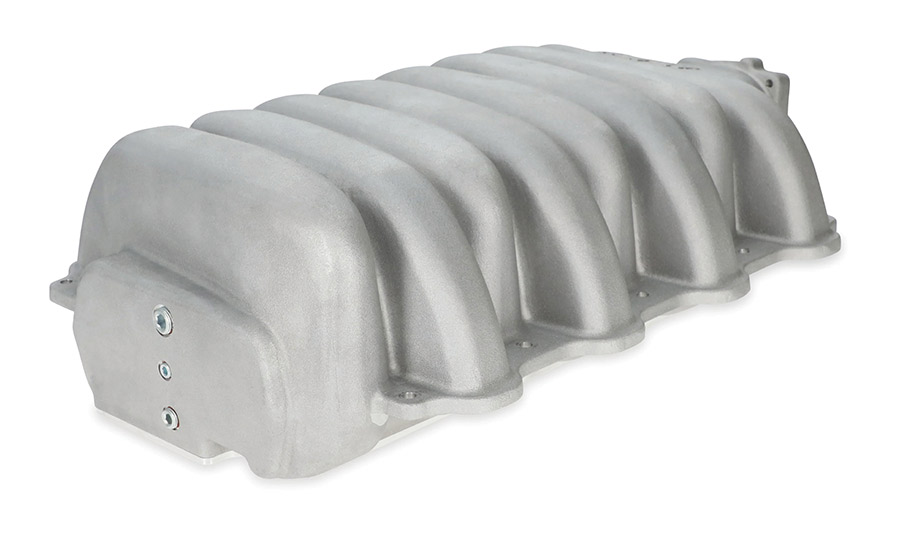
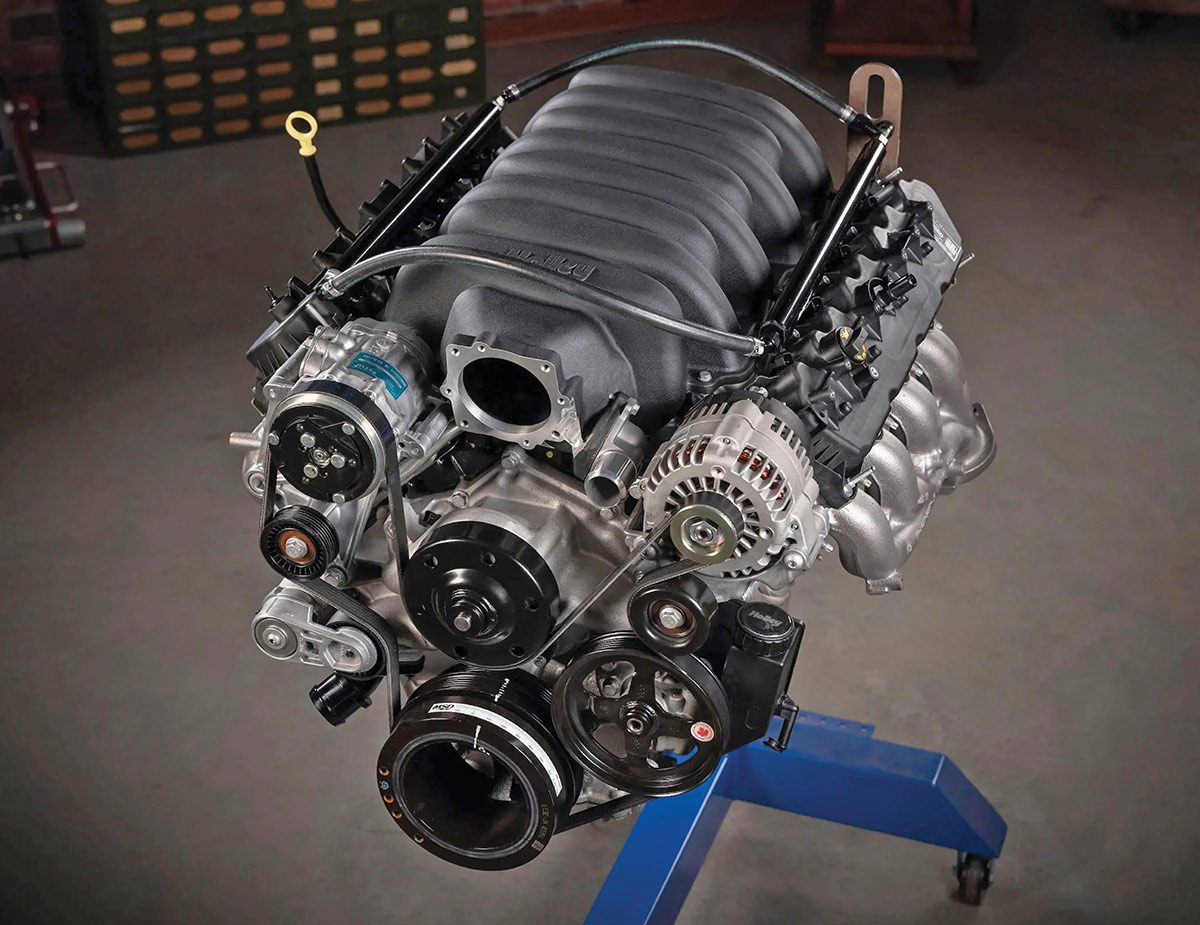
The Holley manifold (PN 300-900, and PN 300-900BK for powdercoated black) is a direct bolt-on aluminum manifold. It’s designed for high flow, and its sturdy construction allows it to handle high levels of boost or nitrous. Most importantly, it was designed with a straight inlet flange, so the throttle body now faces directly forward, and the overall height is 2 to 3.5 inches lower than the stock intake.
It’s important to note that the intake is compatible with OE or Holley accessory drives, OE or Holley fuel rails, and the kit includes a throttle body gasket along with all necessary O-rings, adapters, and fasteners to mount it to the engine. But the features don’t end there.
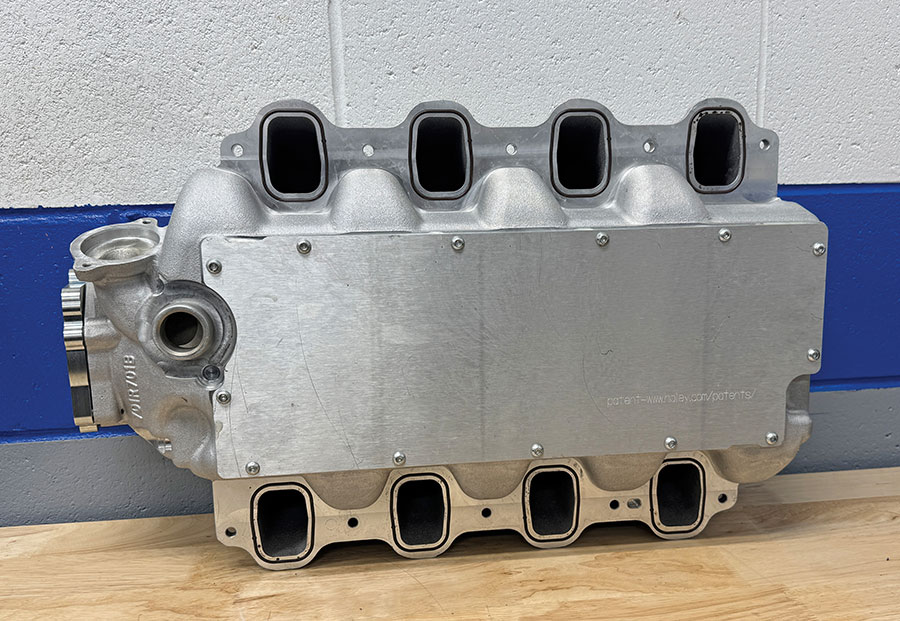
Holley cleverly designed the intake with a removable lower panel that can be taken off for extra porting or to install a nitrous system. Plus, the kit includes the right fittings, vacuum lines, and hardware for an easy setup.
According to Holley, “Runner design was optimized for horsepower and torque in upper-rpm range.” While it may not be as efficient as long-runner intakes at low- and midrange speeds, it will perform better when the engine can breathe with upgraded components, like a better throttle body, cam, and ported heads.
Holley also offers three throttle body options: OE 7.3L Drive-By-Wire, Fox Body cable-driven style, and 2020-22 Shelby GT500 (PN 300-903). And if you’re looking for a little more pizzazz, Holley offers front dress kits and oil pan kits, too. The front dress looks great and improves the front engine appearance, while the oil pan kits provide extra clearance for swaps into passenger cars and trucks. You can see all these parts at Holley.com.
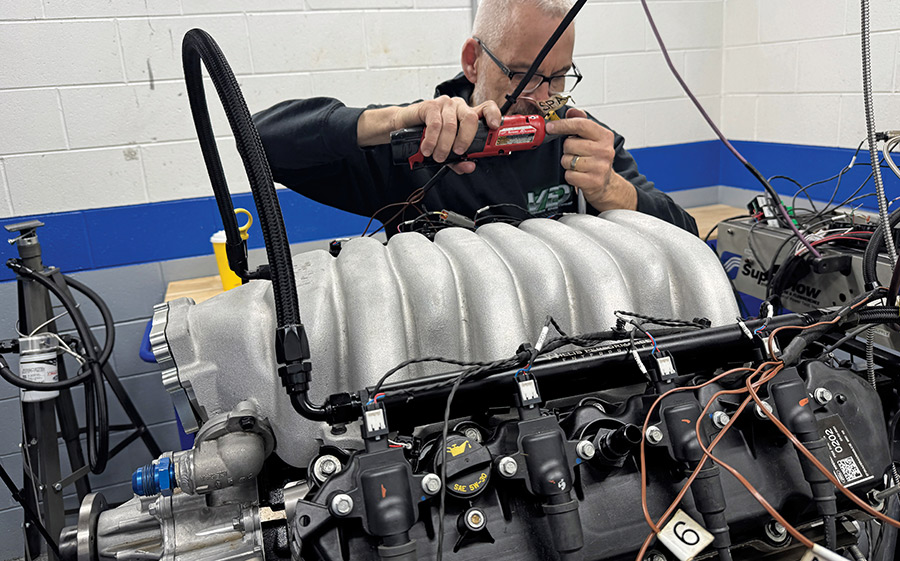
To test the unit, we got with renowned Godzilla expert Brian Wolfe of Willis Performance Enterprises who was testing a basic bolt-on Godzilla on his dyno. Wolfe has used Holley parts on many builds, and as luck would have it, he had a Godzilla on the dyno so we could run one in real-world conditions.
In this case, the real world was a stock 7.3L Godzilla fitted with a Brian Tooley Racing (BTR) U-321 camshaft and Ultimate Headers Godzilla Mustang headers. The BTR cam features 0.663-inch intake/exhaust lift, 231/244 degrees of duration at 0.050 inch, and a 110 lobe center angle. By comparison, lift on the factory cam is 0.539/0.595, duration at 0.050 inch is 201/212, and the LSA is 120 degrees.
It’s important to mention that this is about the biggest cam you can run on a stock Godzilla engine; in fact, it’s not really recommended. However, this test was done under controlled conditions, so it was a nice experiment. A more typical cam for a stock engine would have 0.630-inch lift with slightly less duration.
One of the reasons this is not recommended is that it requires higher engine rpm so you may want stiffer valvesprings to run about 6,200-6,300 rpm. Exceeding about 6,500 rpm is pushing the stock rod and piston combination, so we kept this test at 6,300 rpm. Not that it won’t make power at higher rpm, but you may find a reduction in durability as engine speed escalates above that.
With that, we removed the stock intake and installed the Holley unit. This is a simple process, and you don’t have to deal with fuel or coolant lines. The manifold sits flush on the heads (actually a flange for each port), and O-rings ensure a good seal. No RTV is used.
Wolfe then installed the throttle body, a 95mm Ford DBW unit, and checked for proper actuation to ensure we had wide-open throttle. This process took less than 15 minutes.
He then warmed the engine, bringing the water and oil to operating temperature, and then spent time fine-tuning the electronic variable cam timing (VCT) to optimize it for the intake and cam combination. With that set, he unleashed full power pulls. The chart shows a three-run average, and we were impressed with the results. It should be noted we used an OBR Systems EFI for engine control and Love’s Truck Stop 93-octane fuel.
We ran the engine from 3,000 to 6,300 rpm and observed a maximum output of 627 hp and 609 lb-ft of torque. Peak power occurred at peak rpm (6,200-6,300), while peak torque was at 4,500 rpm. Notably, Godzilla produced over 600 lb-ft of torque from 4,200 to 4,900 rpm and exceeded 500 lb-ft from the start of the pulls to redline! Higher rpm likely would have yielded a few more horsepower, and with stronger valvesprings and a more robust rod and piston we might have explored that. Overall, this intake worked well, though it might be better suited for ported heads and increased compression. Still, its low-profile design makes it a good choice for any swap where hood clearance is a concern.
Additionally, the removable bottom provides access for porting, allowing you to upgrade the manifold for higher performance if you want more flow later on. It’s also quite affordable at under $650 as of this writing. In fact, Summit Racing lists it at $632.91 for the satin version, with the black powdercoated version priced higher. Overall, the Holley intake is an excellent choice for anyone doing a Godzilla swap. It was easy to install, looks great, and offers a lot of performance potential. Our setup produced over 620 hp and 600 lb-ft of torque, which is a lot of power for not much money.