
 PHOTOGRAPHY BY THE AUTHOR & BRIAN “SPARKY” BRENNAN
iTech is a leader in electronic fuel injection (EFI), offering self-learning systems in a variety of configurations, including throttle body and port-injection configurations. Here, we will be looking at FiTech’s popular throttle body systems, specifically the Go EFI, Easy Street, and Go EFI Classic that use “four-barrel” throttle bodies, all of which are rated at 850 cfm (a Go EFI 500-cfm two-barrel is also available for single or really cool tri-power applications). With the exception of the Go EFI Classic, the ECU and all sensors, except the O2 and coolant sensors used by the Go EFI and Easy Street systems, are housed in the throttle bodies. The Go EFI Classic has the old-school look of a carburetor and uses an externally mounted ECU.
Over the years, there have been many bench-racing sessions at the Modern Rodding headquarters about the impact of technology on hot rodding. One such conversation began with Brennan telling yours truly that the love for a row of carburetors on any engine was a sign of being stuck in the past. Admittedly, the counter that carburetors can be fixed on the side of the road was lame, but that’s all that came to mind, and it was better than admitting he was right.
Something that has made aftermarket EFI viable is self-learning technology. Essentially, the ECU (electronic control unit) reads data from various sensors: a wideband oxygen sensor, a throttle position sensor (TPS), a manifold absolute pressure (MAP) sensor, and a coolant sensor. The ECU uses this input to continuously adjust the air/fuel ratios based on established fuel maps for idle, wide-open throttle, acceleration, and cruise. Over time, as the system “learns” the demands and necessary adjustments, the air/fuel ratios are optimized.
When it comes to choosing a FiTech system, there are some differences to consider. The Go EFI series can provide ignition timing and engine cooling fan control. The Easy Street and Go Street series do not offer timing control, but they do offer fan control and an input that increases idle speed when the A/C is turned on.
Another consideration when selecting a system is the horsepower rating. Throttle bodies are typically rated for 400-, 600-, or 800hp applications (the Classic Series is rated at 650 hp). But don’t let those numbers scare you. A system rated at 400 hp is suitable for engines from 100-400 hp; a 600hp system handles 200-600 hp. The difference between the two ratings lies in the size of the injectors: 400hp systems use four 62-pound injectors, and 600hp systems use four 80-pound injectors. For engines producing 800 hp, there is the Mean Street system with eight 62-pound injectors, and for supercharged engines or those equipped with nitrous there is the Power Adder series. FiTech also offers several dual-quad systems with a pair of GO EFI throttle bodies.
For any FiTech throttle body system to operate correctly, two things are required. First is a fuel system with a high-pressure pump capable of providing 58 psi (two barrels require 43 psi). Inline pumps are available, but a FiTech in-tank pump is preferred. Another option is a FiTech Force Fuel system. These assemblies have a supply tank fed by the original low-pressure fuel pump (mechanical or electric). The EFI system is then fed by an internal pump. Three systems are available: the Force Fuel System for up to 800 hp with a 340-LPH fuel pump, the Dual Pump System with twin 340-LPH pumps capable of feeding 1,600 hp, and the Mini with a 255-LPH pump (still capable of feeding 600 hp).
The second requirement is an appropriate ignition system. A FiTech EFI may work with a point-operated ignition system, but it won’t work as it should. The problem is that the ballast resistor in these ignition systems produces a “dirty” tach signal that disrupts the ECU’s proper operation. The cure for that is an electronic ignition system. (See the sidebar on page 48 that addresses Mopar ignition solutions.)
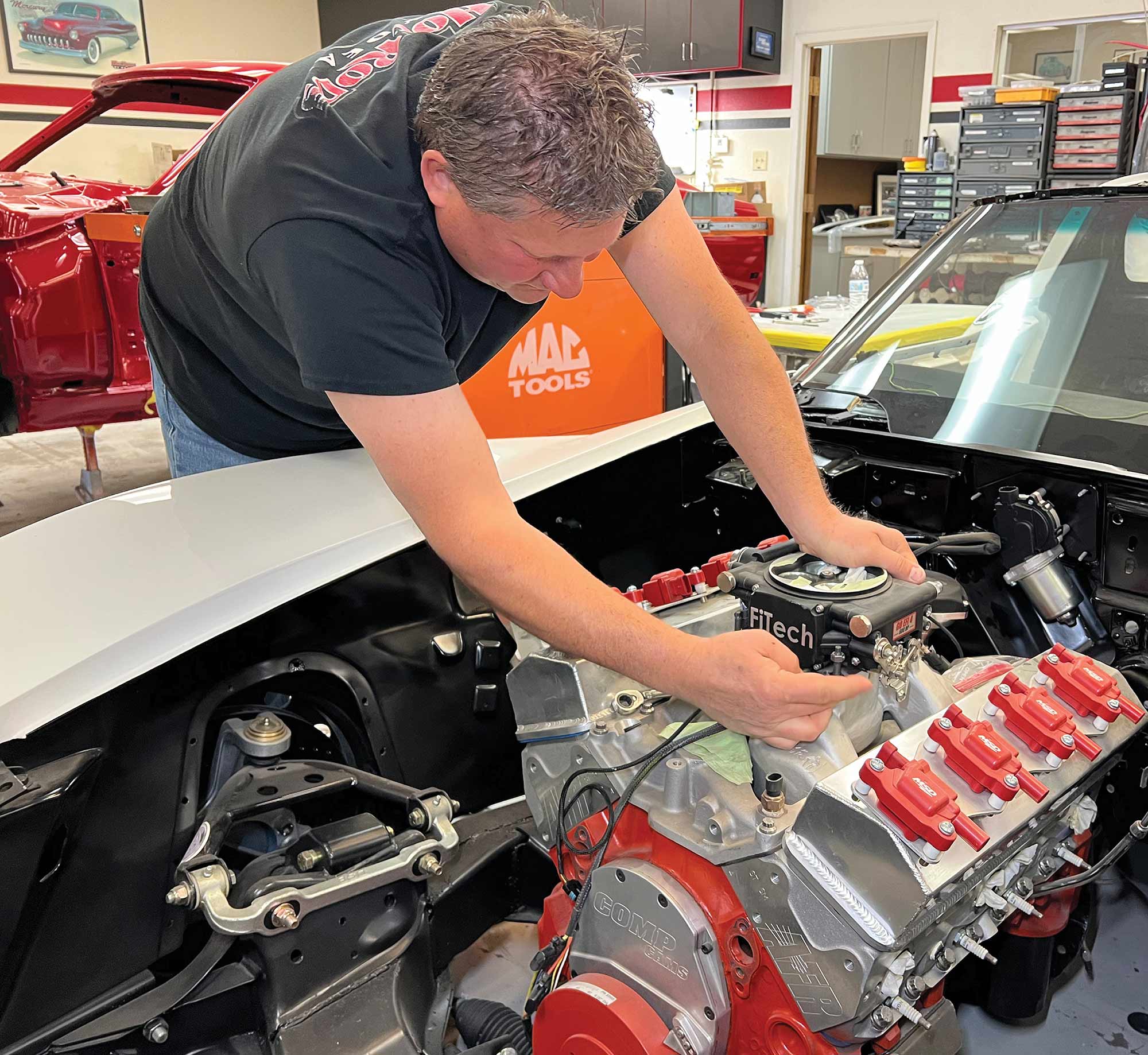
Recently, our very own champion of technology, Brian Brennan, decided to equip his 383 small-block Chevy–powered 1971 Corvette with a FiTech EFI system. He chose a Go EFI 4 Matte Black system (PN 30002) rated at 600 hp. It’s perfect for everything from an everyday driver to a weekend racer. Like all Go EFI systems, it offers spark control without the need for an external control box or a special distributor and accepts the same-size air cleaner normally found on four-barrel carburetors.
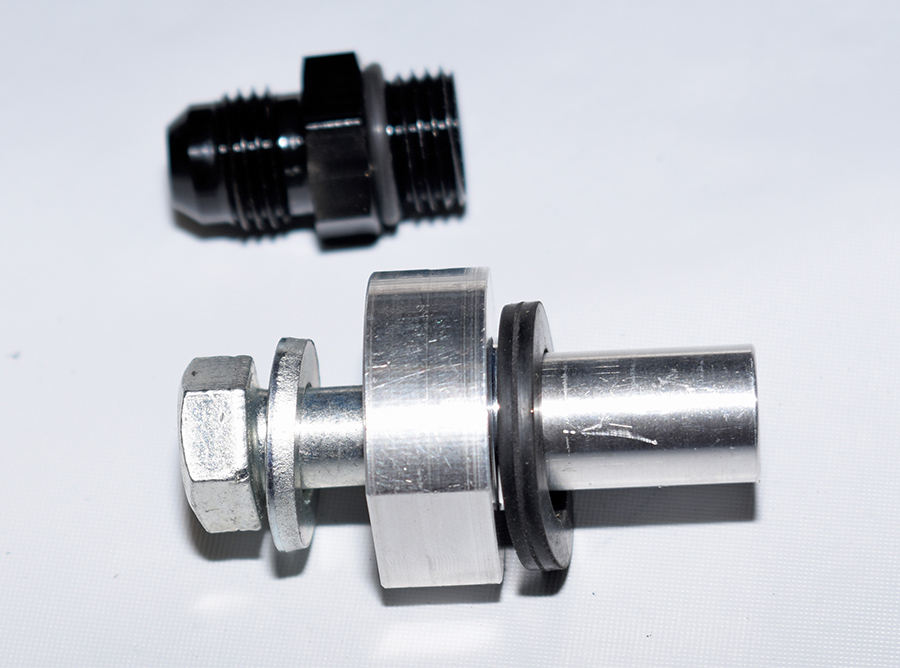
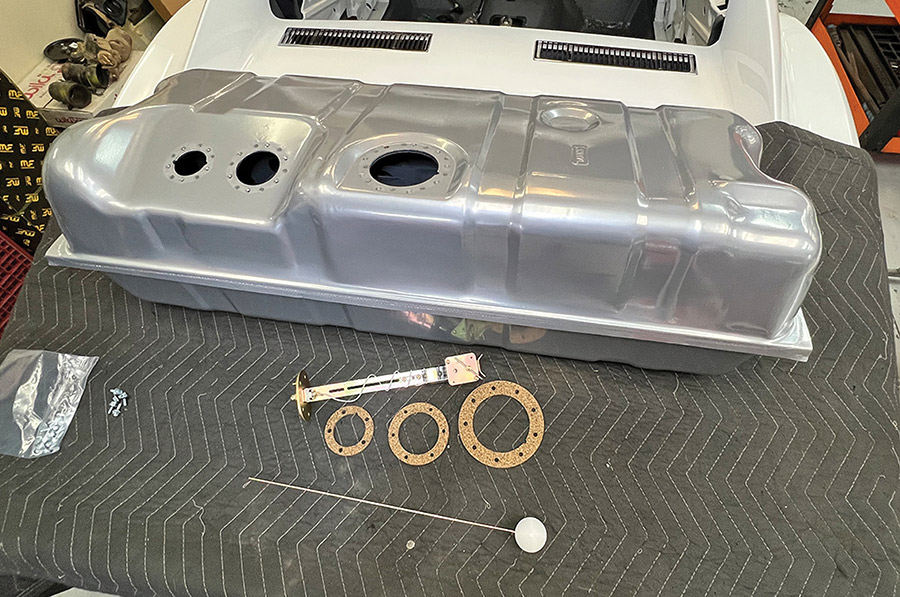
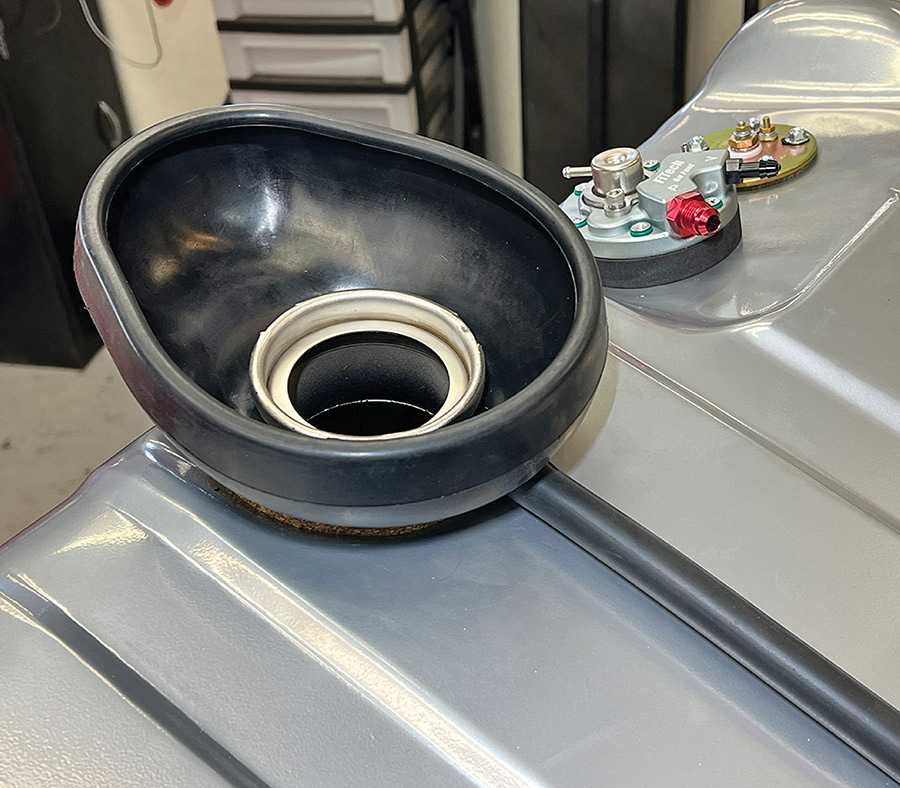
To upgrade the stock fuel system, Brennan chose to install a FiTech replacement with an in-tank pump and a braided fuel line kit. To simplify the process, FiTech now offers complete EFI packages for several popular vehicles, including a throttle body, a direct-fit fuel tank with a fuel pump, a steel braided hose kit, a filter, and various fittings.
Installing FiTech’s throttle body EFI isn’t much more complicated than replacing carburetors. There are some electrical connections to make, and the fuel system will need updating, but while resisting the urge to say, “If Brennan can do it, anyone can,” the truth is it’s something the average do-it-yourselfer can handle.
There is no questioning the effectiveness of EFI, and thanks to FiTech, it can be installed on virtually any engine. FiTech’s EFI systems eliminate tuning guesswork by “learning” the parameters initially programmed into the hand controller and will then continue to refine them for optimum performance. All things considered, EFI is without a doubt the way to go when choosing a fuel system—just don’t tell Brennan you heard it from me.











classicinstruments.com

fitechefi.com

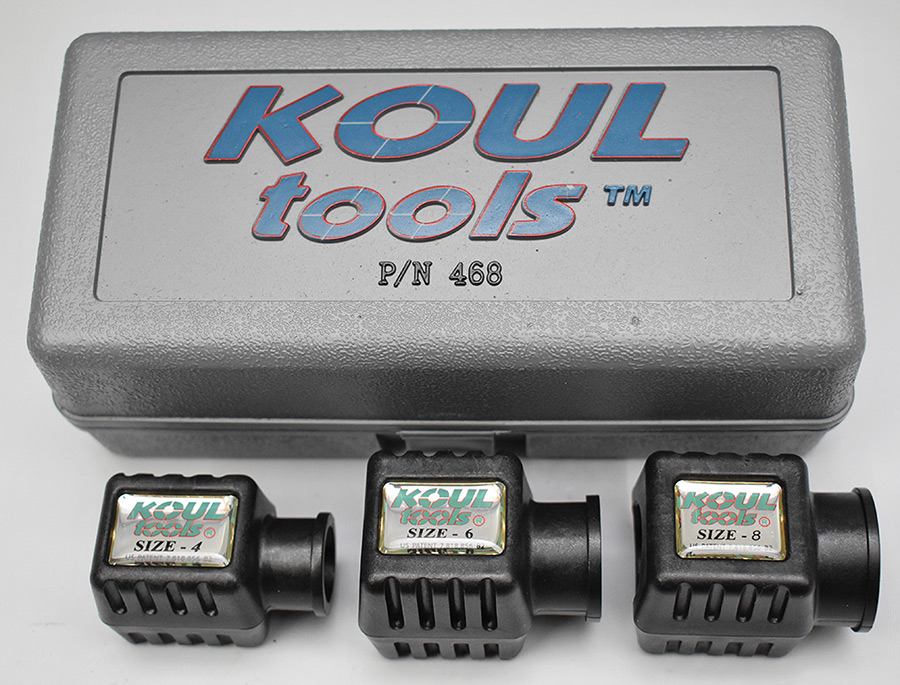
koultools.com

notchead.com

purechoicemotorsports.com

summitracing.com
hile electronic ignition is recommended for the proper operation of FiTech’s EFI systems, unfortunately Mopar ignition systems are the exception.
Like a point operated ignition system, Mopar electronic ignition systems also use a ballast resistor. As a result, they also produce a poor-quality tach signal. To cure that issue, FiTech now offers proper replacement electronic distributors for Mopars and other popular engines with point-equipped distributors.