


 Photography Courtesy of Mecum Auctions
or the true hot rod purist, the 1966 Dodge D-Dart Super Stock isn’t just a car, it’s a bona fide gateway to weekend drag racing—and today, to the world of ultrarare factory builds. Born from Dodge’s Factory Dart program and built specifically for the strip, this Dart GT in disguise meant business from day one—and still does, decades later, spoken by Mopar lovers everywhere, but just not about its wins but rather about its rarity.
The car you’re imagining is rare by any measure. The stock-appearing white Dodge Dart GT (D-Dart) present on these pages was sold as part of the Ellis Collection at Dana Mecum’s 2009 Original Spring Classic Auction. It crossed the block for $40,000, a price that barely hints at the car’s pedigree yet speaks loudly to the collector who recognizes a genuine factory hot rod when they see one. This D-Dart was no mere performance badge; it’s a purpose-built drag racer packaged as a compact, street-leaning Dart GT. Dodge rated the 273 V-8 at 275 hp, a stout bump from the standard 273’s 235 hp. Weighing just over 2,900 pounds, the D-Dart carved out a legitimate NHRA D/Stock class presence, proving that horsepower in a light shell translates to real acceleration. As history would prove rather quickly, the D-Dart was a true lightweight, and that also carried over to somewhat of a “beat me if you can” appearance in the NHRA D-Stock category.
What makes the D-Dart’s performance believable (not to be confused with the Hemi or big-inch Wedge-head-equipped V-8s)? The D-Dart package was a well-thought-out presentation. The Dart came with true speed shop accessories, such as Racer Brown valvesprings, a 284-degree, 0.500-lift cam, Doug’s Headers, and a Holley 4160 bolted to the stock intake. Power flowed through an A833 four-speed operated by a Hurst shifter, while Weber clutch components formed the drivetrain’s handshake with the rear axle, which came via an 8-3/4 Sure-Grip with 4.86 gears. Clearly, the intent was to leave the line with brutal, retina-ripping acceleration. Well, for D-Stock, that may have been the case.
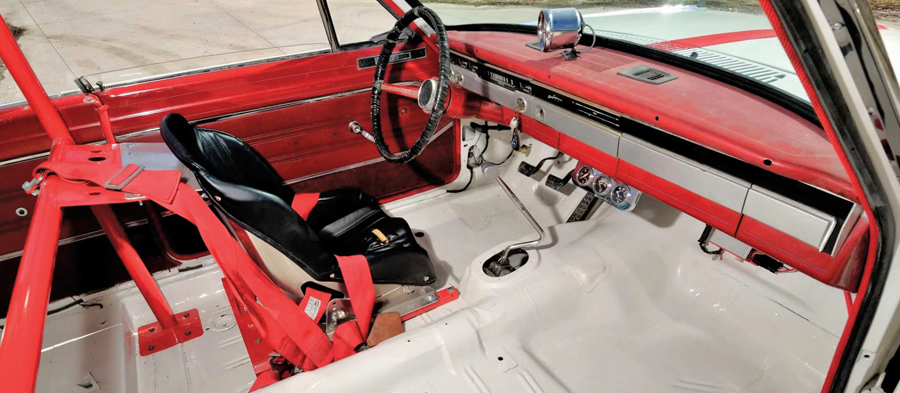
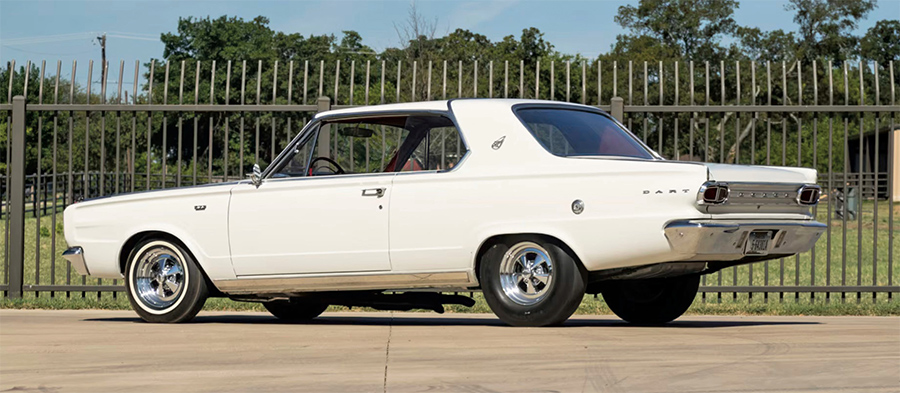
Back in the day, car magazines like Car Craft were able to pull off 14.33-second runs at 92.21 mph. The D-Dart GT was outfitted with Cragar S/S mags, giving it a performance image that matched its performance results. However, the fact remains that the 14-second runs just didn’t make the grade. So much so that Dodge pulled the plug on this superstock D-Dart package after 50 were made. (The red and white one shown on this page gives you an example of what it could look like as a true race car.)
What did these 50 Darts have in common? All of us like to decode the Vehicle Identification Number (VIN) plate. So, let’s see what the D-Dart offered from the factory. First, the VIN should begin with L023, and the build sheet should show other codes such as: 699 (Special Order—Super Stock Dart), 409 (Special Order Axle), 364 (Super Stock), 624 (heavy-duty suspension), 32 (engine code), 554 (delete rear seatbelts), 393 (four-speed transmission), 21 (6.95×14 BSW rayon two-ply tires), 408 (Sure Grip), P4H (trim code—red), and WW1 (paint code—white).
The white Dodge D-Dart shown here, based on its VIN decoding, was built on April 17, 1966, as a special-order assembly in Hamtramck, Michigan, and was specifically designated as a Dodge Super Stock D-Dart. That is the “Holy Grail” of provenance. What we have learned is that this is truly only 1 of 50 built, and in 1966, Chrysler produced no other true Super Stock vehicle.