


 PHOTOGRAPHY BY THE AUTHOR
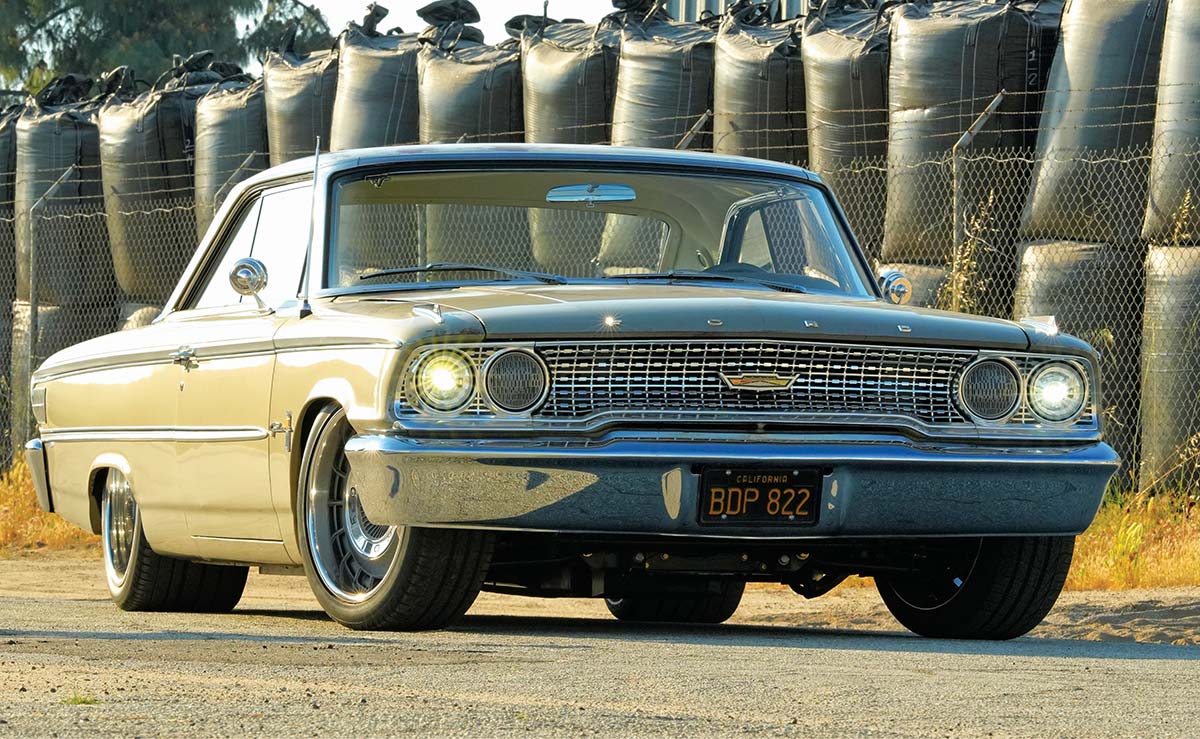
ome cars deceive you from across a parking lot. Others do so when you get close. Then there’s Mike Dauster’s 1963-1/2 Ford Galaxie Sports Hardtop—a car that completely flips the script. It’s what we call a reverse 20-footer, a visual trick where the closer you get, the more impressive it looks, with details sharpening and your desire to drive it increasing. Part of that effect comes from the paint itself: the patina is authentic not fake. No fake rust, no spray-on fade, no artificial aging. It’s the original 1963 finish, and it looks honest whether you’re 1 foot or 20 feet away. That instinct is exactly what guided this build: a Pro Touring–style, patina-preserved, 940hp fastback that honors Ford’s Total Performance heritage while embracing the modern reliability and power of a Nelson Racing Engines Coyote topped with a 3.0L Whipple. Before anyone gets worked up, let’s be clear: this is not an original R-Code car, nor was it even a 427 machine. No rare piece of Ford racing history was altered in creating this monster.
Mike, a 43-year-old engineer from Bakersfield, California, grew up at the dragstrip and in the stands at Bakersfield Speedway. “I have been a car lover since I was a little kid,” he says. “My dad started taking us to Bakersfield Speedway for the dragstrip. I’ve been going to hot rod shows and races my entire young life.” His first hot rod was a 1967 C10—built by the same shop that would later transform this Galaxie—an immaculate, award-winning truck that became too nice to enjoy. “I ended up selling it because I just didn’t get to enjoy it. It was too nice,” he says. That experience became the turning point. He wanted something he could lean on, drive daily, park without fear, and still feel proud of.

The 1963-1/2 Galaxie is a historically significant model. Introduced midyear with the new fastback “Sport Roof,” it was designed specifically for NASCAR aerodynamics. Ford’s Total Performance program was in full swing, and the fastback roofline was the company’s response to increasing competition on high-speed ovals. The results were immediate: 427-powered Galaxies swept the top 5 spots at the 1963 Daytona 500, establishing the model as Ford’s flagship fullsize performance car. Production numbers were substantial—134,370 two-door hardtops overall, with 18,551 in 500XL trim—but true R-Code 427 cars were rare, built in small quantities to homologate Ford’s NASCAR effort. That heritage is part of what attracted Mike. “I was never really a super-big Ford guy,” he admits. “But this car—the look of it, the history behind the racing in this car and then what this meant to the NASCAR world—was built basically as a race car.”
Enter builder Kamaka Pocock of Born Vintage Hot Rods in Bakersfield—a guy who spends his weekends piloting a 4,000hp nostalgia Funny Car. Big power doesn’t scare him; it’s his native language. “We built a 1967 C10 for him roughly 5 years ago,” Pocock says. “He gave us free rein on making that truck what it was. But he never drove it; it was too nice. So, he ended up selling that truck with dreams of building something he could just thrash on, lean up against, not have to worry about anything, and in comes the Galaxie.”


Below, however, nothing is old. The Galaxie is built on a Roadster Shop Fast Track chassis with independent front suspension and a four-link rear, connected to a Ford 9-inch with 3.73 gears. A Bowler-built 4L80E gearbox manages the power—of which there is plenty. The Nelson Racing Engines Gen 3 Coyote, topped with a 3.0L Whipple supercharger, produces 940 dyno-verified horsepower. “We knew we wanted big power,” Pocock says. “At first, we were talking twin turbos.” The final setup channels air through an acrylic-machined headlight inlet, one of many custom touches. Pyramid-optimized, 3-D–printed stainless badges replace the Whipple logos, reading “Galaxie” across the blower. The side badges now say “Galaxie 5.0,” subtly nodding to its modern heart.
The exhaust is a custom oval-tube X-pipe system with Valvetronic mufflers—loud when you want it, louder when you don’t. “These Coyotes, they really make a lot of noise,” Mike says. “With those open headers, it’s even louder.” He laughs when he calls it “too much power for what it could put to the ground,” but that’s part of the charm. “It’s not meant to be a track car. It’s meant to go have fun.”


What makes the car special, though, is how it’s used. Mike drives it constantly. “I love the fact that I can drive a nice, new, modern car or I can drive this old car that’s super reliable,” he says. “I take it to work multiple days a week. I can drive this like any other car, man. And it’s just an old car, which I love.” He’s adamant he’ll never sell it. “I love this car. I love the way it drives. I think it drives amazing.”
Pocock smiles when he talks about Mike as a customer. “When you look for a customer in this industry, he’s the epitome of it,” he says. “Best dude, best attitude, never complains. He just wanted something he could drive the crap out of, lean on, put a soda can on the top, not worry about rock chips. That clarity made the build fluid. “One hundred percent, that’s the car we built for him.”
That’s the magic of this Galaxie. It draws you in—20 feet, 10 feet, 5 feet, 1 foot—until you’re close enough to see the work that went into it. That’s the distance Mike built it for, and the one where the car makes the most sense.