

 PHOTOGRAPHY BY NOTSTOCK PHOTOGRAPHY
 PHOTOGRAPHY BY NOTSTOCK PHOTOGRAPHY
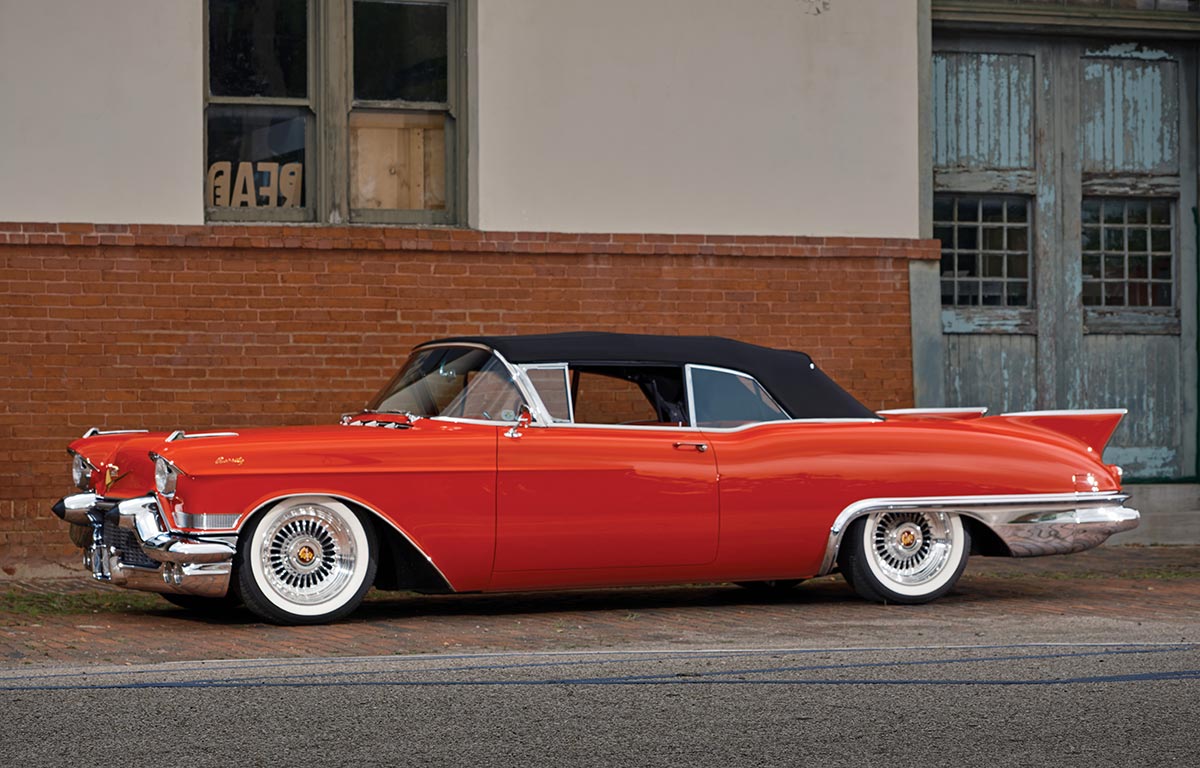
he 1957 Cadillac Eldorado Biarritz, belonging to Doyle and Karen Thomas of Texas and built by Mike Goldman of Mike Goldman Customs (MGC), has an interesting backstory—as do all Eldorados. The nameplate “Eldorado” came about through a serendipitous corporate function that met the perfect place to land. Only 1,800 coach-crafted Cadillac Eldorado Biarritz convertibles with Fisher bodies were produced in 1957. According to Cadillac enthusiasts, only a few hundred remain. We are fortunate that the Thomases found one of these nearly 5,000-pound beauties available for the custom touch from Goldman and his crew at MGC.


The 1957 Eldorado (third gen) received new styling with a distinctive rear end sheet metal design, featuring a low, downswept fender line, crowned by the pointed inboard fins resting directly above the single-lens taillight on each side. One of (if not) the most distinctive features of the Eldorado is the sculptured stainless steel beauty panels located just behind the rear wheelhousings. From here, the beauty panel continues to wrap around, serving as the “home” for the backup light and the exhaust pipe. They are so distinctive as to immediately alert the viewer to the year of the Eldorado being viewed. The rest of the body is pretty much as Cadillac designer Harley Earl intended. There are a handful of “beneath the skin” sheet metal changes to accommodate the chassis and powertrain swap. Dan Baker built the custom cowl grille (CNC action), another styling cue on the Eldorado. Other MGC fabrication work includes the custom firewall, radiator core support, engine bay panels, and engine cover. All finished sheet metal and bodywork were performed by MGC, and the Axalta ChromaPremier basecoat/clearcoat in Victory Red paint was also applied at MGC. The pair of Deka Intimidator batteries, located in the trunk, and the custom 22-gallon Rick’s Tanks gas tank, is located beneath the sheet metal in the stock location.


The chassis is based on an Art Morrison Enterprises (AME) GT Sport chassis that uses AME’s Sport IFS with tubular control arms, Wilwood ProSpindles, adjustable Ridetech coilovers, an adjustable antiroll bar, and Wilwood disc brakes. The brake package uses 14-inch Wilwood rotors at each corner, with six-piston calipers in front and four-piston calipers in the rear. The Wilwood pedal assembly and master cylinder are used along with a CPP HydraStop for the power brake application. Surrounding the Wilwood brakes are a set of one-of-a-kind wheels by Mike Curtis, evocative of the original factory wheels, measuring 18×8 in front and rear, all wrapped in Diamond Back Classics rubber (244/55R18) with 2.75-inch-wide whitewalls. The sidewall lettering was buffed off from Diamond Back.
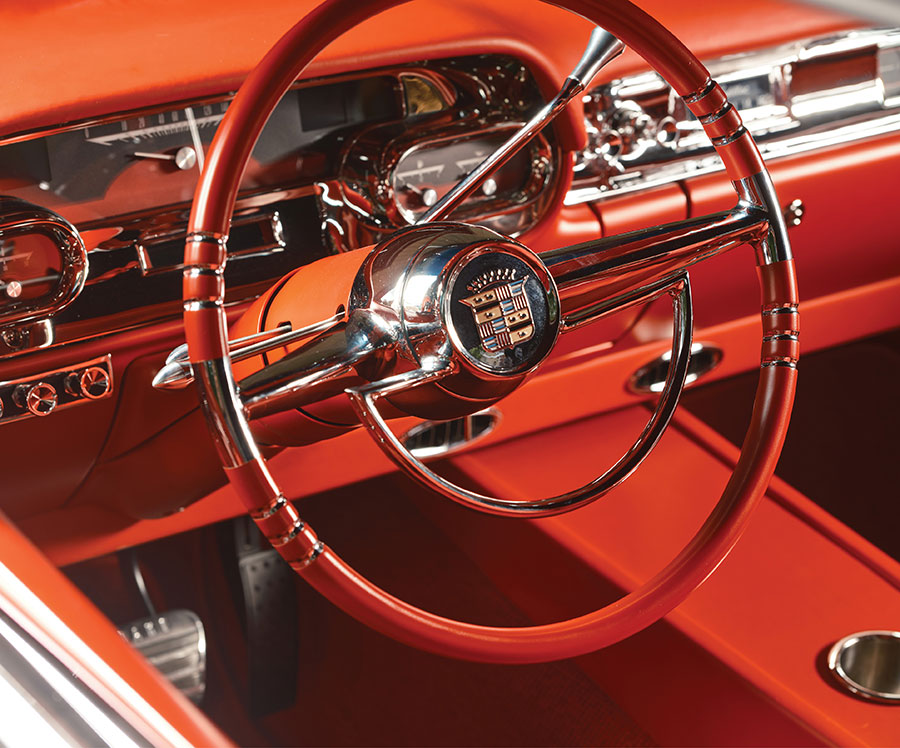
The modern ride performance is complemented by an original-style interior featuring several enhancements. The matte blood-red leather padded dash houses Dakota Digital instruments that mimic the original factory look. From there, an Ididit tilt steering column is used, topped with a Mike Curtis one-off wheel that is reminiscent of the original factory piece. Vintage Air Magnum A/C is used in the front, a VA Super Cool in the rear, and a fabricated sub-dash panel houses the A/C registers. An Easy Wire system is used for all the car’s electrics, installed by MGC. Paul Atkins of Paul Atkins Interiors received the nod for the stitchwork, using Blood Red leather for the front buckets, rear bench, doors, various panels, and center console. The center console houses the power window controls, which are factory units with new motors from Auto City Classic, along with all-new glass. A red German square-weave carpet was also stitched into position by Atkins. Atkins also made the seatbelts fore and aft.
We think the Thomases have found the “lost city of gold” in their 1957 Cadillac Eldorado. Spending time in the southern seaside community of Biarritz, France, is as good a vacation as many of us could hope for. Of course, having this drop-top to drive around would just about make it perfect.