







A Pontiac
428 Tri-
Power vs.
Four-Barrel






COLUMNS

SYSTEMS


SELECTION ONLINE
800-648-8022

By Brian Brennan, Photography by Chris Gray & Elia Daoud
By Brian Brennan, Photography by Michael Christensen
By Dale Moreau, Photography by NotStock Photography
By Brian Brennan, Photography by Wes Allison
By Brian Brennan, Photography by NotStock Photography
By Barry Kluczyk, Photography by the Author
By Ron Ceridono, Photography by the Author
By Mark Ehlen
By Ron Covell, Photography by Anton Lanesky









BRIAN BRENNAN
bbrennan@inthegaragemedia.com
TIM FOSS
tfoss@inthegaragemedia.com
YASMIN FAJATIN
yfajatin@inthegaragemedia.com
SARAH GONZALES
sgonzales@inthegaragemedia.com
ROB MUNOZ
rmunoz@inthegaragemedia.com
PATRICIA LUDI
pludi@inthegaragemedia.com
Wes Allison, Rodney Bauman, Gerry Burger, Tommy Lee Byrd, Ron Ceridono, Michael Christensen, Ron Covell, Grant Cox, John Drummond, Eric Geisert, John Gilbert, Joe Greeves, Ken Gross, John Jackson, Chadly Johnson, Barry Kluczyk, Scotty Lachenauer, Don Lindfors, Ryan Manson, Josh Mishler, Dale Moreau, Don Prieto, Todd Ryden, Jason Scudellari, Chris Shelton, Tim Sutton, Chuck Vranas, John Winter — Writers and Photographers
Travis Weeks Advertising Sales Manager
Patrick Walsh Sales Representative
ads@inthegaragemedia.com
ModernRodding.com
AllChevyPerformance.com
ClassicTruckPerformance.com
InTheGarageMedia.com
subscription@inthegaragemedia.com
(714) 985-9171
InTheGarageMedia.com “Online Store”
For bulk back issues of 10 copies or more, contact store@inthegaragemedia.com


Copyright (c) 2025 In The Garage Media Inc.
Printed in the USA.
The Modern Rodding trademark is a registered trademark of In The Garage Media Inc.

Cleveland, OH
(216) 281-8777


 by Brian Brennan
proudly hold the untouchable record for attending major street rod events nationwide with one hand gripping an ice cream cone and the other clinging to a steering wheel. Alright, maybe someone else has hit more events than I have, but when it comes to feasting on ice cream from East to West (coast to coast) and North to South (Canada to Mexico!), I’m the reigning champion of cold, creamy goodness. Sure, it may not rival moon landing fame, but I take great pride in it.
I’ve discovered that indulging in ice cream is a serious responsibility, not a solo mission! You can’t just waltz into an ice cream parlor alone; you need a witness to validate your accomplishments. That’s right, you need a “designated driver” on ice cream runs—a prerequisite for any culinary adventure I embark upon. Luckily, I’ve had my trusty sidekicks: Rick Love from Vintage Air, John McLeod of Classic Instruments (now part of Holley’s crew), and the camera wizard Robert McGaffin, aka Wheel Hub. They might argue about who takes the back seat for dessert adventures, but this is my story and they’ll have to deal with it.
Every epic tale has a beginning, sometimes a bit humbler than others, and my ice cream saga is no exception. It all started in good ol’ Shoney’s in Memphis, Tennessee. Sure, there was ice cream, but their strawberry pie tingled my taste buds. Shoney’s, originally a Big Boy franchise, became an independent gem later. Back in Southern California in the 1950s, Bob’s Big Boy was the hot spot for car enthusiasts with car hops on skates. When I hit my first NSRA Street Rod Nats in Memphis I discovered Shoney’s—a midwestern duplicate of what I cherished back home. They supplied the pies for the NSRA pie-eating contest, and while it wasn’t about quantity, it was about speed (how fast can you eat a strawberry pie?); duh, I was the quickest strawberry pie-eating hot rodder the world has ever had. The prize was a coupon for more strawberry pie. Just one slice? I battled through my disappointment and still made nightly pilgrimages for dessert.
 BY BRIAN BRENNAN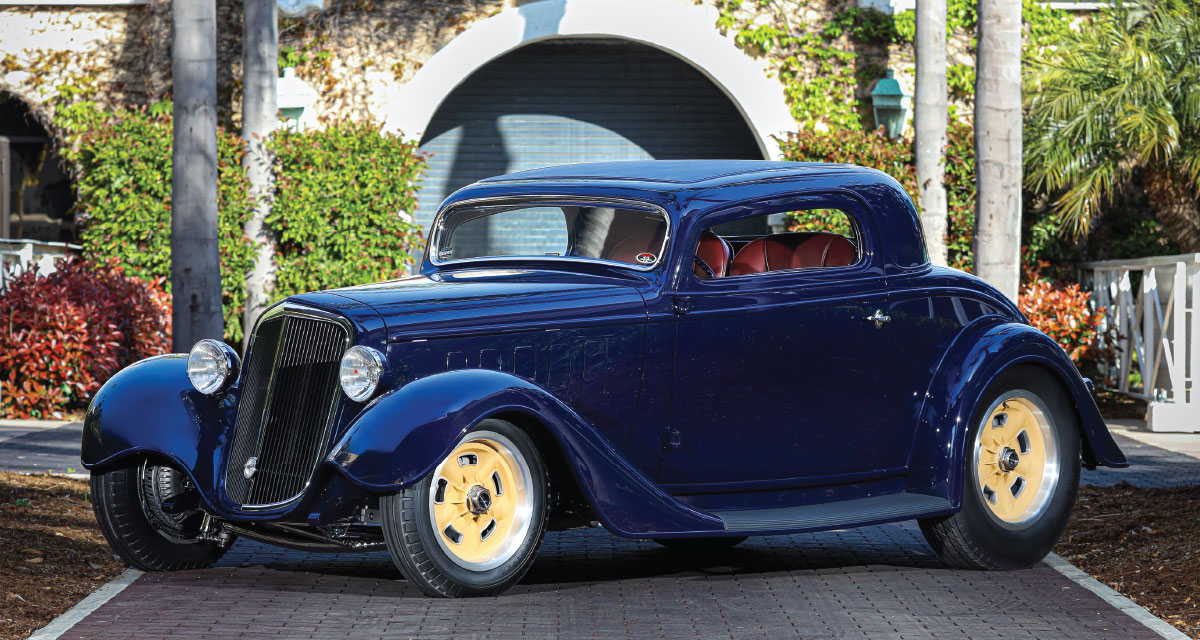
 Goodguys’ 2025 Meguiar’s West Coast d’Elegance Winner
Heinrich partnered with Rodger Lee and the Ironworks Speed & Kustom crew to bring his vision for the Chevy coupe to life. Having previously collaborated with Lee on a custom 1955 Chevy that received numerous accolades, Heinrich’s latest project promises to achieve similar success.
Every aspect of the 1935 Chevy has been meticulously crafted, featuring a custom frame with an extended wheelbase, a chopped top, and a uniquely sectioned body. The original taillight lenses remain intact among a stunning array of modifications, including a machined firewall, custom hood sides, and one-off wheels. Underhood, a smooth, detailed small-block Chevy is enhanced with a vintage eight-stack injection system connected to a modern electronic fuel injection system.

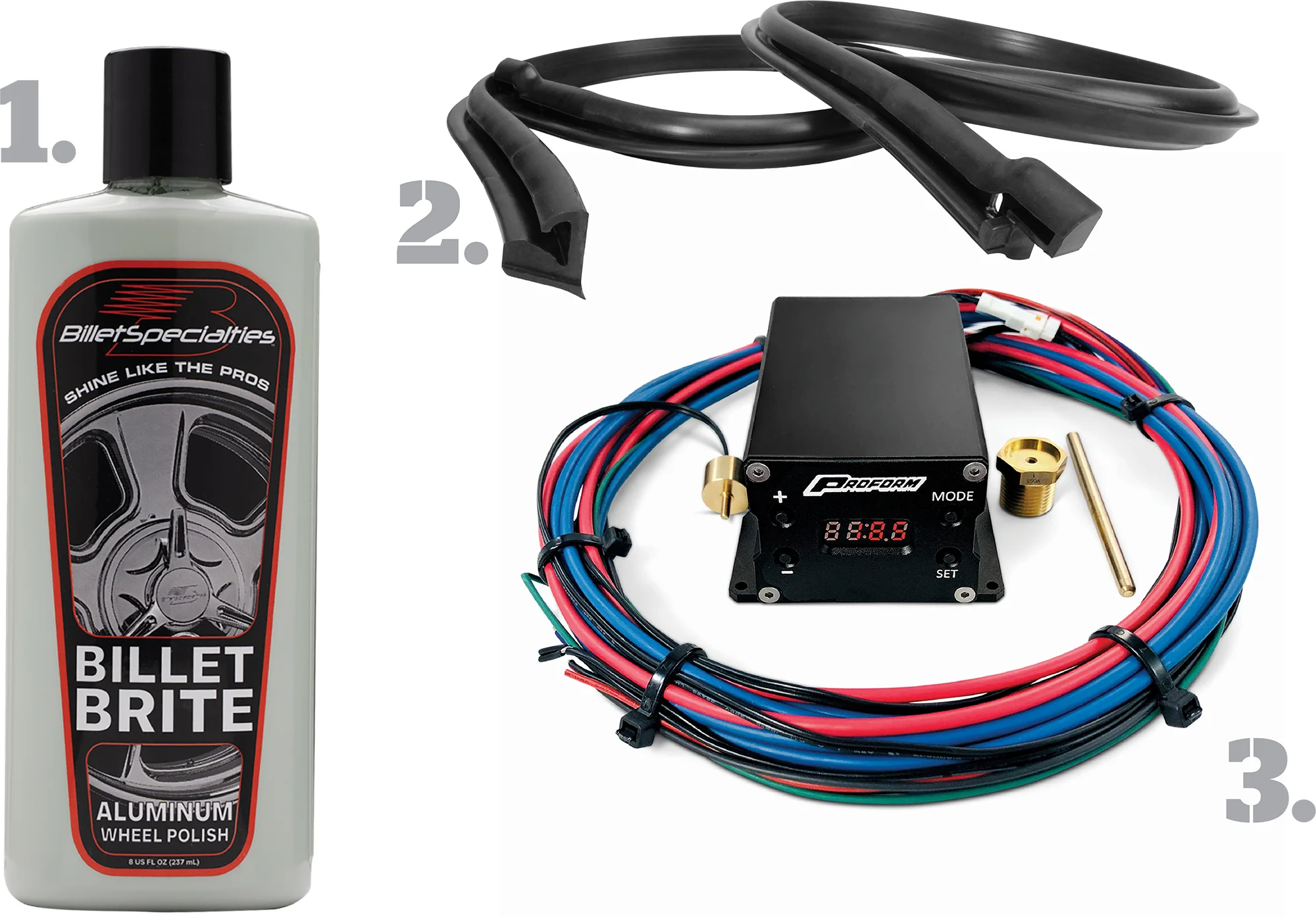
Billet Brite enhances the appearance of your wheels and protects polished surfaces, delivering a long-lasting, eye-catching finish. The Billet Specialties final detail department tests and uses it on every polished wheel, making Billet Brite the trusted choice for those who demand the best for their vehicles.
With a fresh watermelon scent, Billet Brite is easy to apply and remove, making it a convenient addition to any car care routine. It is available in an 8-ounce bottle (PN 98015). Please note that the dealer minimum order quantity is 12 pieces.


 Photography by Chris Gray & Elia Daoud
n the world of automotive enthusiasts, few names resonate as strongly as the Chevrolet Chevelle, particularly the iconic 1970 model. This classic muscle car holds a special place in the hearts of many. For Brent Schieder, a passionate cabinet maker from Pleasanton, California, it represents a lifelong journey steeped in the love of car building. His automotive adventure began in high school, ignited by his father’s 1969 Nova, and has grown into a remarkable dedication to building modern-day hot rods.
Brent’s latest masterpiece is a stunning 1970 Chevelle (made from a Malibu survivor car), constructed by the talented team at Roadster Shop (RS), with contributions from Avant Garde Interiors and Goolsby Customs. With a clear vision, Brent created a comfortable yet powerful vehicle to accommodate his family while turning heads on the road. The Chevelle was a fitting choice, reflecting iconic aesthetics and nostalgic ties to his youth, where car culture thrived among he and his friends.

 Photography by THE AUTHOR
f all the iterations of Pontiac’s V-8 engine family, the 428ci version doesn’t get much attention. That’s not without reason, as the 389, 400, and 455 mills were admittedly the “hot ones” to borrow a classic Pontiac tagline.
The 428 also had a relatively short shelf life, produced only for the 1967-69 model years, which means they are quite rare finds these days. While rated at up to 390 hp, they were designed to deliver low-end torque for the heavier fullsize cars and weren’t installed in the GTO or Firebird. However, numerous dealer-sponsored swaps to the larger engine were made in the traditional muscle cars.


John Mumford’s Last 1932 Ford Roadster Build
Photography by Michael Christensenany have heard or said, “This is my last project.” Such is the case for John Mumford from the Bay Area in California. John tells us that this is the last 1932 Ford he will build. When speaking with John’s collaborator on many of these projects, Roy Brizio of Roy Brizio Street Rods, he tells us John has said the same thing to him. Brizio has built 20-plus hot rods for John, including several AMBR contenders, and in 2013 took home the perpetual America’s Most Beautiful Roadster 9-foot trophy. We don’t doubt John’s sincerity, however, we have heard these sentiments. Given John’s passion for hot rods, we will reserve a spot for a future “table of contents” entry for another effort. Brizio agrees!


 Photography by THE AUTHOR
lthough the hobby we all know and love is steeped in tradition, hot rodding has always embraced technology. Early examples include aluminum heads for Flathead Fords; today, it’s electronic fuel injection systems like those offered by FiTech.
We cannot often conduct long-term testing on hot rod components, but we’ve accumulated nearly 50,000 trouble-free miles using a FiTech throttle body system. So, when it was time to select an induction system for a new project, we again chose the same system we used earlier: a Go EFI 4 600hp system. Although this system is rated for up to 600 hp, it is appropriate for engines producing 200 hp and above.



 Photography by NotStock Photography
t’s always an intriguing story about how any hot rodder embarks on building their current project. Todd Stamm of Texas is no exception. His 1965 Buick Riviera mild custom is just such a project. Todd’s passion for the 1965 Buick Riviera began around 10 years ago when he spotted one at a Mecum Auction in Houston.
Todd and Jason Smith of the Hot Rod Garage (HRG) discussed whether to start with an original car or a project that already had some work completed. The two considered building a mild custom restomod. Todd wanted a cruiser, but one that had plenty of “oomph.” However, he made it clear that the final appearance had to retain much of the original Riviera factory’s beauty. With a longstanding passion for European cars from the 1950s and early 1960s, especially Porsches, Mercedes-Benz, and others from the era, the 1965 Buick Riviera’s black over green color combination was an easy choice for Todd. Initially agreeing to start with a once-started-but-now-abandoned project, they later found a donor that had been recently restored with a Connect and Cruise LS3/525 and 4L70E. They both will tell you they should have started from “scratch.”



 Photography Courtesy of THE MCR Staff
t’s no secret that few untouched E-bodies remain spared from nature’s wrath. Barn finds emerge now and then, but the vast majority of restorable ones are ready for a second go-around. This is beneficial in many ways, as it has prevented them from being parted out and scrapped. However, the downside of many of these cars is that their original restoration was often more akin to collision repair rather than an accurate restoration; the aim of the work was to make them look good but not necessarily correct. Often, correcting them would have required significantly more time, effort, and skill than was available for what might have been seen as minimal additional benefit.
Muscle Car Restorations (MCR) frequently encounters this situation in their restoration work. Previously repaired areas must now be redone to restore them to factory specifications. Naturally, the rest of the body hasn’t remained unchanged. Sections that may have been perfectly fine during the initial restoration may now require repair



 Photography by Wes Allison
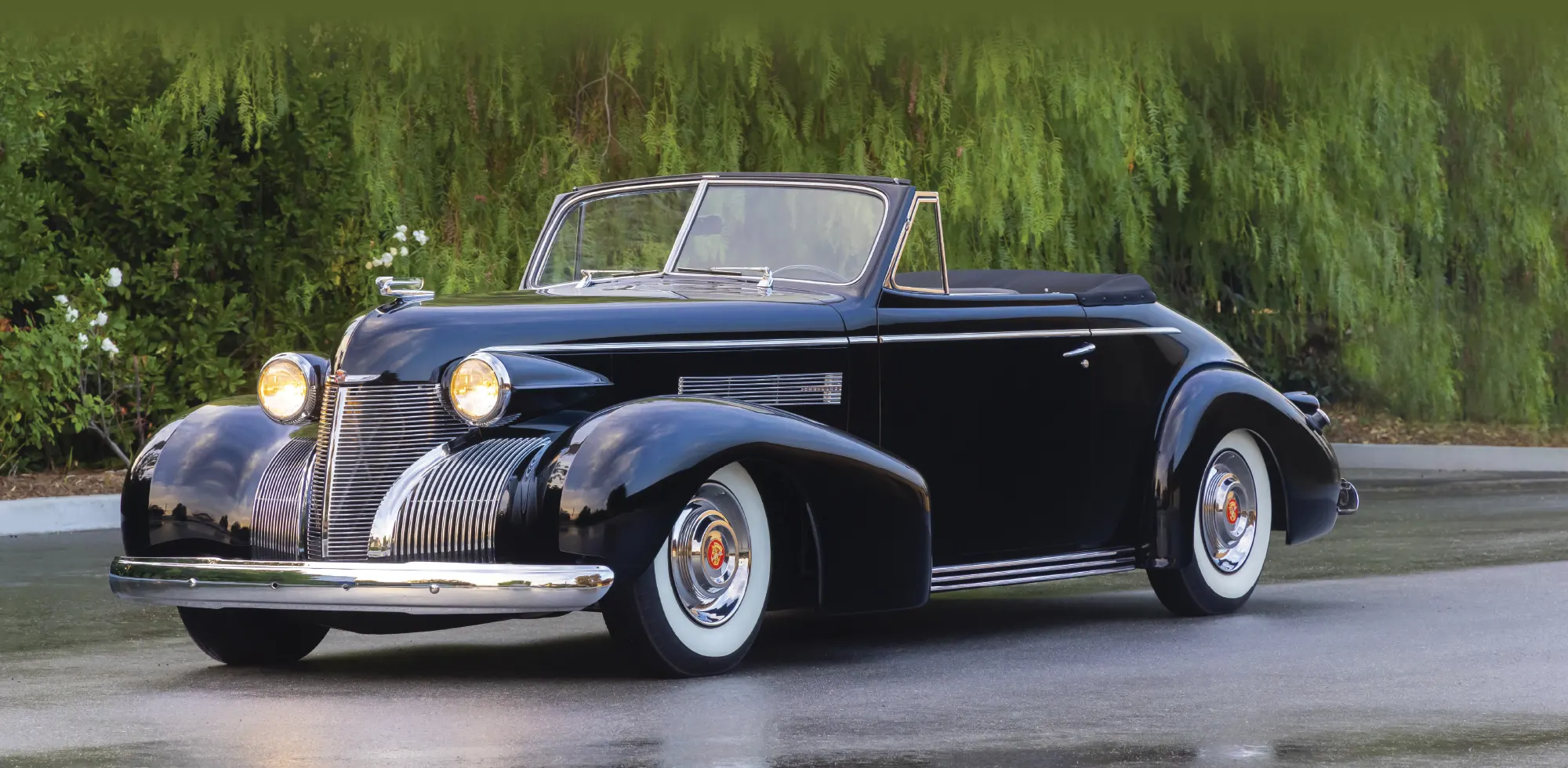
teve Norin of SoCal was with his cousin, who restores old Cadillacs, when they found themselves at Steve’s auto mechanic’s garage. The mechanic mentioned having an old Cadillac in pieces, stored in a container behind the shop. Steve’s cousin Mark entered the storage container and said, “I think this is a 1939 Cadillac Series 61 two-door convertible.” Steve’s mechanic asked what it was worth, and his cousin replied, “In its current condition, probably $10,000 to $20,000.” It turns out that was just what the mechanic wanted to hear: “I will sell it to you for $10,000,” and Steve said, “Done.” Initially, Steve planned to patch it back together and sell it to make a few bucks. However, after discussing it with his collector friends Bill Grant and Terry and David Stoker of Stoker’s Hot Rod Factory (SHRF), he decided to go all in and pursue a first-class restoration. It took three years to complete, but it was worth the effort.


 Photography by Anton Lanesky
nton’s Hot Rod Shop in Hiram, Ohio, has created an impressive series of exceptional builds. In this article, we will closely examine how aftermarket patch panels can help restore one in poor condition) to modern-day standards and offer a solid foundation for future modifications.
This 1963-1/2 Ford Galaxie project serves as a good example. Although the car they started with appeared decent, it didn’t require much investigation to realize that replacing the floors, quarter-panels, and several other panels with high-quality reproductions was wise. This car will include a Roadster Shop RideLine chassis with fully independent suspension designed for a supercharged Coyote engine prepared by Roush Performance.





Photography by NotStock Photography
idway through the model year, in February 1963, Ford made waves by offering the Fairlane’s robust 164hp “Challenger” 260-cid V-8 engine for the first time in the Falcon lineup, sparking excitement among performance enthusiasts. However, Grant Smith’s Falcon didn’t start there; it had to come a long way to reach its current standard.

View Index
- AFFORDABLE STREET RODS
- AMERICAN AUTOWIRE
- ART MORRISON ENTERPRISES
- AUTO METAL DIRECT
- AUTOMETER PRODUCTS
- AUTOMOTIVE RACING PRODUCTS
- BOWLER PERFORMANCE TRANSMISSIONS
- CLASSIC INSTRUMENTS
- CLASSIC PERFORMANCE PRODUCTS
- CLASSIC PERFORMANCE PRODUCTS
- COKER TIRE
- CRUISIN THE COAST
- DAKOTA DIGITAL
- DETROIT SPEED
- EATON DETROIT SPRING, INC.
- FITECH EFI
- FLAMING RIVER INDUSTRIES
- FLAMING RIVER INDUSTRIES
- GOLDEN STAR CLASSIC AUTO PARTS
- GOODGUYS ROD & CUSTOM ASSOCIATION
- GRANATELLI MOTOR SPORTS, INC.
- HAYWIRE
- HEINZMAN STREET ROD SHOP
- HOT HEADS RESEARCH
- LOKAR
- LOKAR
- NATIONAL STREET ROD ASSOCIATION
- NEW PORT ENGINEERING
- PHOENIX MACHINE PRODUCTS
- POWERMASTER PERFORMANCE
- PURE CHOICE MOTORSPORTS
- RARE PARTS
- RJAYS SPEED SHOP
- ROADSTER SHOP
- SALTWORKS
- SCOTT’S HOTRODS
- STEVE’S AUTO RESTORATIONS
- SUMMIT RACING EQUIPMENT
- THAT’S GREAT NEWS
- TRIPLE CROWN OF RODDING, LLC
- VINTAGE AIR
- WHEEL SMITH
- WILWOOD ENGINEERING
- WINTERS PERFORMANCE



 This picture was taken of Ed in March 1974. He was about to receive recognition from SEMA. (Photo by Mike Brenner)
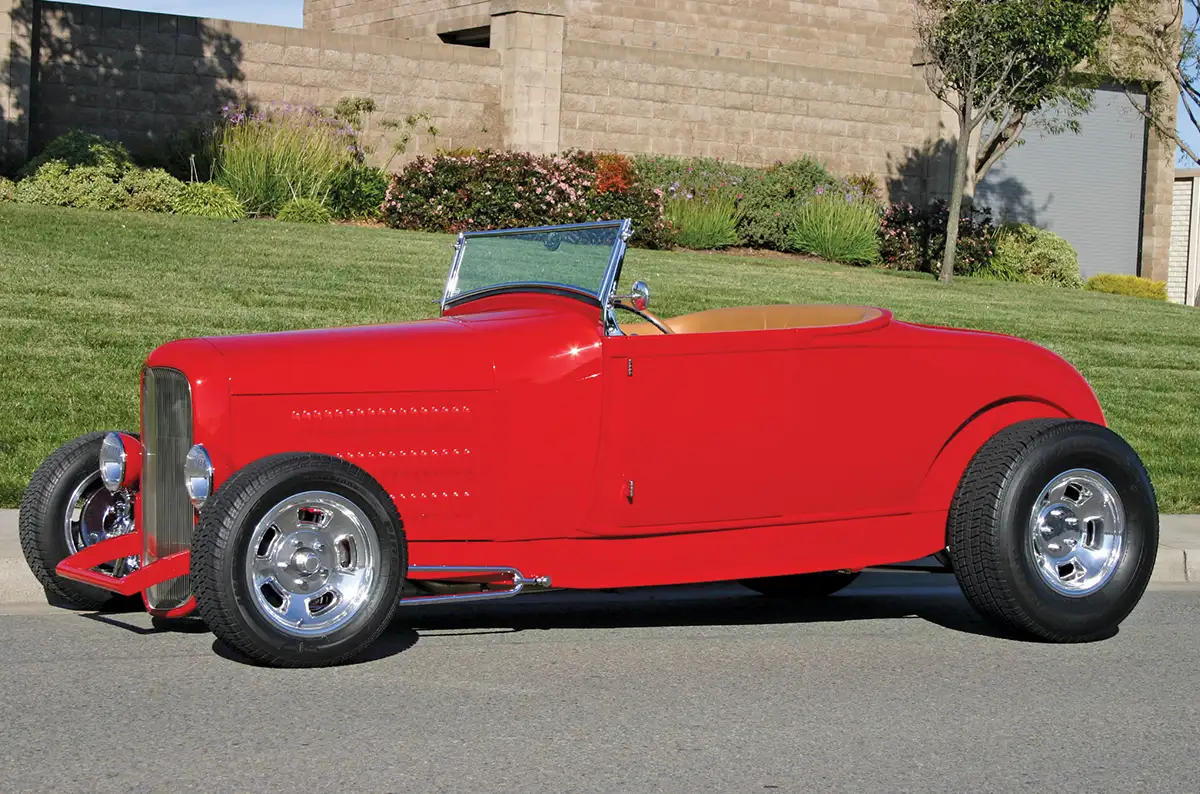 Ed Pink’s ride, driving it often and long distances during the last decade of his life. His 1929 Ford highboy roadster was built by Roy Brizio Street Rods after a conversation between Ed and Roy about finishing an unfinished project brought about by Vic Edelbrock Jr.
d Pink, renowned in the racing world as “The Old Master,” was born in Los Angeles in 1931. Almost as soon as he could drive, he began participating in lakes racing on Southern California’s El Mirage dry lakebed in the Mojave Desert in a 1934 Ford coupe.
By 1961, Ed Pink Racing Engines (EPRE) focused on engine building full time, with the early support of drag racer “TV Tommy” Ivo. EPRE gained fame for its expertise with the 426 Hemi engine in Top Fuel racing and established a formidable reputation in Indy racing, where Pink developed the Buick V-6 program and enhanced Cosworth Racing efforts, leading to numerous IndyCar victories with multiple drivers.
His talents with the 426 Chrysler Hemi are legendary. They contributed to its development as the engine of choice among Top Fuel and later Funny Car teams in the growing NHRA drag racing series. Pink and rival Keith Black elevated drag racing through their dominant efforts within the sport.
