






Gauge
Install
On A Chevy
G-Body
Fresh Front End
Sheetmetal
For A/C Controls
Preview Issue













By Brian Brennan, Photography by NotStock Photography
By Chuck Vranas, Photography by the Author
By Grant Cox, Photography by the Author
By Brian Brennan, Photography by NotStock Photography
By Brian Brennan, Photography by NotStock Photography
By Curt Iseli, Photography by the Author & Evan Iseli
By Ron Covell, Photography by Chris Gray
By Ron Ceridono, Photography by Cody Barnes
By Ron Covell, Photography by Camren Beattie
Photo by NotStock Photography





378 E. Orangethorpe Ave. Placentia, California 92870




#ClassicPerform



BRIAN BRENNAN
bbrennan@inthegaragemedia.com
TIM FOSS
tfoss@inthegaragemedia.com
YASMIN FAJATIN
yfajatin@inthegaragemedia.com
SARAH GONZALES
sgonzales@inthegaragemedia.com
ROB MUNOZ
rmunoz@inthegaragemedia.com
PATRICIA LUDI
pludi@inthegaragemedia.com
Wes Allison, Rodney Bauman, Gerry Burger, Tommy Lee Byrd, Ron Ceridono, Michael Christensen, Ron Covell, Grant Cox, John Drummond, Eric Geisert, John Gilbert, Joe Greeves, Ken Gross, John Jackson, Chadly Johnson, Barry Kluczyk, Scotty Lachenauer, Don Lindfors, Ryan Manson, Josh Mishler, Dale Moreau, Don Prieto, Todd Ryden, Jason Scudellari, Chris Shelton, Tim Sutton, Chuck Vranas, John Winter — Writers and Photographers
Travis Weeks Advertising Sales Manager
Mark Dewey National Sales Manager
Patrick Walsh Sales Representative
ads@inthegaragemedia.com
ModernRodding.com
AllChevyPerformance.com
ClassicTruckPerformance.com
InTheGarageMedia.com
subscription@inthegaragemedia.com
(833) 985-9171
InTheGarageMedia.com “Online Store”
For bulk back issues of 10 copies or more, contact store@inthegaragemedia.com


Copyright (c) 2024 In The Garage Media Inc.
Printed in the USA.
The Modern Rodding trademark is a registered trademark of In The Garage Media Inc.

Cleveland, OH
(216) 281-8777


 by Brian Brennan
found myself staring into the abyss (traditionally referred to as my garage) and noted that while I have plenty of hot rods and stuff, there are no projects that require the talent of “working” … fabricating. As is often the reality in my life, tech personality Ron Ceridono immediately pointed out, “You have no talent. When was the last time you’ve done any work?” While a brutal retort, it pains me to say, “There is a modicum of truth in his words.” Ugh!
I’m sure each of us spends time removing and replacing, servicing, and, of course, the obligatory dusting and polishing or waxing, but could it be that less time is spent with a grinder in hand? Based on the very tech stories we do and the garages we visit, plenty of engines and trans tinkering continue, and the likes of power windows, air conditioning, stereos, gauges, wiring, and a little upholstery here and there are still to be installed.
But what about fabricating, bending metal, making motor or tranny mounts, and so on? You know, actual building. Well, that seems to have slowed down for many at-home hot rodders. Now, before you run off and pitch a fit or have an episode, I’m sure “you” and all your like-rodding buddies still do your share of welding and hammering. But it seems like I am seeing less than I used to. Maybe we are truly getting a bit older. Maybe the cars we are working on don’t need this phase, and maybe there just isn’t a new project in our rodding life. We all eventually get to the time of our existence when things slow down.
 BY BRIAN BRENNAN
 Ed Pink: The Old Master
Published by Coastal 181, Ed Pink The Old Master: The Remarkable Life and Times of Racing’s Most Versatile Engine Builder is packed with motorsport history, pictures, and behind-the-scenes, firsthand accounts of Ed Pink’s seven decades of building high-performance racing engines.
For the Old Master, his hot-rodding journey started in 1945 when a chance meeting led to a friendship with cam-grinder Ed Iskenderian. By 16, Pink worked at Lou Baney’s Golden Eagle gas station, where he “hopped up” Ford Flathead V-8s. As post-war hot rodding accelerated in Southern California, Pink set the standard for performance on and off the racetrack. Seven decades later, Pink retired from engine building as one of the most decorated craftsmen in the high-performance and racing industry with multiple Hall of Fame inductions immortalizing him amongst motorsport’s greats.


The entire unit is set up and managed through an app available on the App Store or Google Play. Configure which gauges are in the dash, how each gets its signal, view values being received by Zeus-Link, and verify correct outputs and wiring all through the app.

 Photography by NotStock Photography
e can trace our passion for hot rods to something that occurred, we saw, or influenced us in one way or another when we were kids. Such was the case for Mike Tyskiewicz when he was a youngster living in the Danbury, Connecticut, area. His hot rod “church” was the Danbury Race Arena, a 1/3-mile oval, which he visited frequently as a kid on Saturday nights. Saturday night was reserved for Flathead Fever, and this excitement made its mark … forever. It would take some time, but in the end he found this ’31 Ford roadster pickup with a ’53 Ford Flathead. As these projects often are, they were rough, but they were enough to get the dream moving.
Once Mike retired from the Danbury Fire Department, he began working on his Model A. The project started in earnest in 2018. He began working on a custom frame, but as is usually the case, life got in the way and things slowed down. During this time, he met Scott France, a metal fabricator with significant talent working in Florida. France understood Model As, so it wasn’t long before they devised a plan and became good friends.


 Photography by THE AUTHOR & Evan Iseli
he hot rod aftermarket offers many parts and modern amenities that make driving our old cars infinitely more enjoyable. But sometimes, you must put some extra thought and effort into incorporating those amenities without disrupting the car’s aesthetic. Such was the case with the Vintage Air heat and A/C system in my ’41 Buick.
Vintage Air has been providing climate control for hot rods since 1976. Over the last nearly half-century they’ve developed components tailormade for a wide range of cars and trucks from the ’50s-80s in their bolt-in SureFit series. These systems integrate all the necessary components both under the hood and in the cabin without requiring that the dash or underhood sheetmetal be significantly altered. But as expansive as the SureFit line is, there isn’t a kit for everything, which is where their Builder Series comes in.
Builder Series kits are essentially custom climate-control systems. They comprise individual components, like the compressor and condenser, which are mounted in the engine compartment, an evaporator, usually installed behind the dash, and all the necessary hoses, louvers, brackets, wiring, and other incidentals that keep the system running and the cool (or hot) air flowing. We don’t have the space to cover all the component options Vintage Air offers but suffice it to say that whatever car you’re building and whatever style you’re building it in, they’ll have something that fits the bill—and their knowledgeable tech staff can help every step of the way. We’ll explain how we arrived at the best system for the Buick.



 Photography by THE AUTHOR
reating something truly unique is one of the many elements of hot rodding distinguishing it from the rest of the automotive hobby where much of the concentration focuses on restoration and preservation. When it comes to styling, there’s plenty to be recognized from the early years when builders on the East Coast claimed their own look by channeling their cars while maintaining both chopped and un-chopped roof lines. The dramatic ’32 Ford channeled roadster laid out across our pages belonging to Keith Goettlich of Berkley, Massachusetts, celebrates its East Coast heritage with a nod to tradition.
There’s something to be said about the home builder when it comes to designing, fabricating, and turning out a noteworthy hot rod that’s ready to hit the street and start laying down the miles. Over the decades, there have been plenty of wicked rides rolling out of Keith’s home shop, including a heavily chopped-and-channeled ’33 Ford pickup followed by an equally hammered ’31 Ford sedan and eventually a Westergard-styled ’37 Chevy tail dragger. One of the most unique features of all was that they were all powered by his signature 401ci dual-quad Nailhead V-8, apart from his small-block Chevy-powered ’37 Ford drag truck that consistently ran in the 8s on the quarter-mile.
 Photography by Chris Gray Illustration By Eric Black/eBDCo
erry Kerna is an avid gearhead with an eclectic collection of outstanding cars. She, yes, Ms. Kerna, wanted to build a state-of-the-art Model A sedan in the mildly channeled style and when she found a suitable ’30 Ford sedan body, the project commenced.
Cornfield Customs chopped the top 4-1/4 inches and then sent it to Roadster Shop to have the chassis built, along with an extensive list of body modifications. This car has so much special work that it will take a several-part series to cover the project in sufficient depth. Mark Giambalvo of Creative Rod and Kustom was charged with the final build and assembly.


 Photography by THE AUTHOR
he echoes of engines and the glossy pages of car magazines had always surrounded Lonny Moore. His father, Lynn, had spent a lifetime admiring classic cars, nurturing a particular fascination for the Henry ’32 Ford roadster. This passion wasn’t just a hobby, it was a legacy waiting to be passed down.

1. Our case for considering a G-body Chevrolet for hot rodding is this ’84 Monte Carlo SS. Fat wheels and tires, lowered suspension, an LS underhood, and a five-speed manual—would all that make it qualify?

1. Our case for considering a G-body Chevrolet for hot rodding is this ’84 Monte Carlo SS. Fat wheels and tires, lowered suspension, an LS underhood, and a five-speed manual—would all that make it qualify?
Photography by Cody Barnest one time, old-timers (read Brennan and Ceridono) applied the term hot rod to vehicles produced before or shortly after World War II that had been modified to increase performance. However, as time has passed, the term hot rod has come to have a broader definition and is often being applied to many later cars that have been “hopped up.” Is the change in definition due to the lack of raw materials, as earlier cars have become harder to find? Could it be something as simple as later model cars are more affordable to buy and modify? This brings up the question, could something like a G-body Monte Carlo SS with performance-oriented modifications be considered a hot rod, or should we say a modern rod? Let the conversation begin.
The ’78-88 Chevrolet G-bodies, including the Monte Carlo, El Camino, and Malibu, were some of the last cars to be built on a muscle car–style chassis—that is, a traditional front-engine V-8 with rear-wheel-drive platform, while most midsized cars had transitioned to front-wheel drive. As G-bodies are available and affordable, interest in these vehicles has grown, which has prompted companies like Detroit Speed & Engineering to develop high-performance front and rear suspension and steering components along with LS engine mount adapters and transmission crossmembers for overdrive automatics and five- and six-speed manual transmissions.


 Photography by NotStock Photography
t’s the backstory. How many times have we all heard that? Oftentimes, the backstory gets us hooked on a particular hot rod, which is the case for this ’65 Buick Riviera. Butch Yamali of Long Island, New York, has a fascinating story about how his father had this Rivi and a ’59 Chevy Impala convertible parked in a New York garage when Hurricane Sandy hit, causing a staggering amount of damage that included these two cars.
Both cars were sent to Martin Bros. Customs in Johnson City, Texas, for a thorough overhaul. The staff in charge of this project includes Joe Martin, who, combined with shop manager Chad Glasshagel, handled the fabrication and assembly. Others include Zach Becken, who handled mechanical, wiring, and tuning; and Bryan Spencer, who was instrumental in painting, trimming, and assembly.


 Photography by Camren Beattie
ust before World War II, most cars had fenders that stood proud of the main body structure in the style we now call “fat fendered.” When passenger car production resumed after the war, this style continued for a few years. Still, most manufacturers started tooling up for a new, slab-sided look where the fenders blended in seamlessly with the body. Ford made this transition in 1949, and the ’49-51 Ford is called the “shoebox,” reflecting this revolutionary styling feature. This car became immensely popular for car customizers and has remained in vogue ever since.
Scott’s Hotrods ’N Customs is building a custom Shoebox in the traditional style for Danny Rowe. The car is based on a ’50 Ford Tudor sedan, featuring a just-right chopped top. All the body modifications are geared toward a traditional look while adding sophisticated refinement. Ken DeKiserre is the primary craftsman on this project, and in this article we will take an in-depth look at the beautiful metalwork he is doing on the front end of the car.




 Photography by NotStock Photography
orvettes will always be viewed as the ultimate “factory hot rod.” Since its inception, the Corvette nameplate has been synonymous with performance. One only has to look at how many hot rods built in the late ’50s-70s featured early Corvette performance parts. Later-model Corvettes are still the standard-bearer for the ultimate engine performance with the LS and then LT V-8s, followed by all manner of suspension items that have now found their way underneath our hot rods. Alex Short of Utah’s ’66 Corvette convertible features what you would expect, plus additional later-model Corvette performance via powertrain and suspension enhancements.

View Index
- AFFORDABLE STREET RODS
- AMERICAN AUTOWIRE
- AMSOIL
- ART MORRISON ENTERPRISES
- AUTO METAL DIRECT
- AUTOMETER PRODUCTS
- AUTOMOTIVE RACING PRODUCTS
- BOLING BROTHERS EARLY IRON
- BOWLER PERFORMANCE TRANSMISSIONS
- CHEVS OF THE 40’S
- CLASSIC INSTRUMENTS
- CLASSIC PERFORMANCE PRODUCTS
- CLASSIC PERFORMANCE PRODUCTS
- CLEANTOOLS
- COKER TIRE
- CONTROL CABLES
- CRUISIN THE COAST
- CUSTOM AUTOSOUND
- DAKOTA DIGITAL
- DETROIT SPEED & ENGINEERING
- EATON DETROIT SPRING, INC.
- FAT MAN FABRICATION
- FITECH EFI
- FLAMING RIVER INDUSTRIES
- FLAMING RIVER INDUSTRIES
- GEARSTAR PERFORMANCE TRANSMISSIONS
- HAYWIRE
- HEINZMAN STREET ROD SHOP
- HEMMINGS
- HOT HEADS RESEARCH
- JJS ROD & CUSTOM
- LOKAR
- LOKAR
- MOSER ENGINEERING
- NATIONAL STREET ROD ASSOCIATION
- NOTCHEAD FASTENERS
- POWERMASTER PERFORMANCE
- RARE PARTS
- RJAYS SPEED SHOP
- SALTWORKS
- SCOTT’S HOTRODS
- SPECIALTY AUTO PARTS USA, INC.
- SPEEDWAY MOTORS
- THAT’S GREAT NEWS
- THE AMERICAN TRI-FIVE ASSOCIATION
- THERMO-TEC AUTOMOTIVE
- TRIPLE CROWN OF RODDING, LLC
- VINTAGE AIR
- WHEEL SMITH
- WILWOOD ENGINEERING


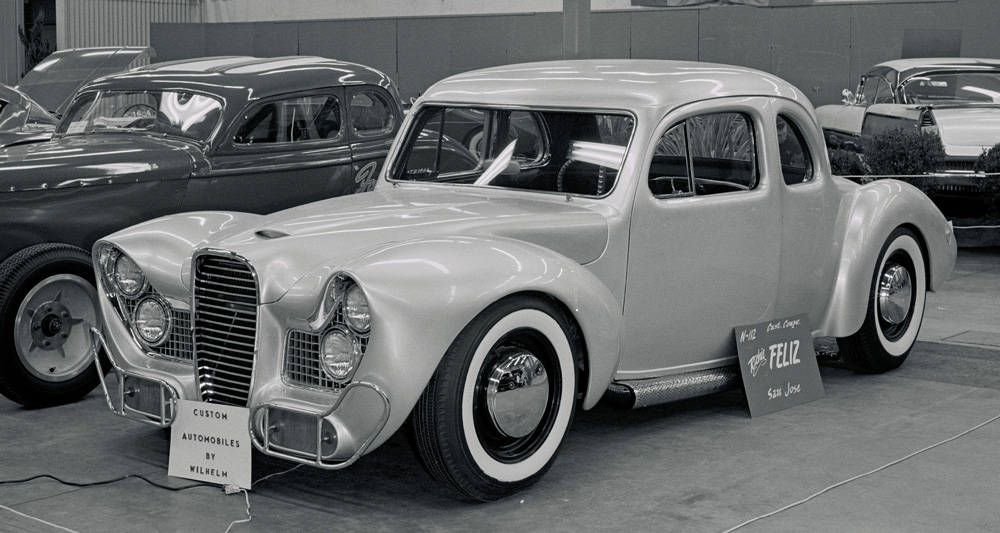
 Richie Feliz owned this custom silver ’36 Ford five-window built by Joe Wilhelm titled “Mark Mist” and shown at the 1959 Sacramento Autorama. It featured quad headlights, ’58 Corvette taillights, and nerf bars with a vertical grille (ala Edsel) and was chopped and channeled.
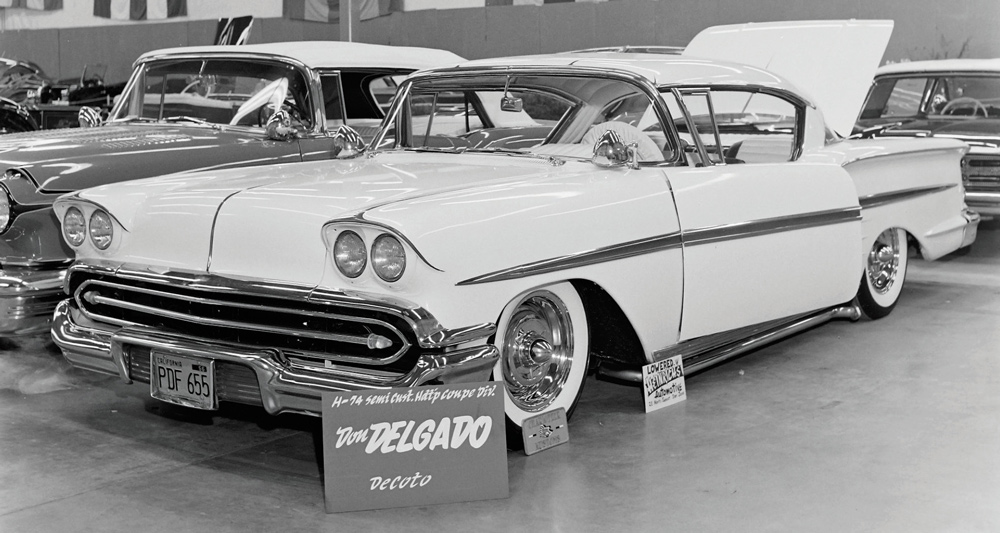 The ’58 Chevy was a custom right from the factory, but Don Delgado added a few touches that worked, such as the pinstriping, reworked grille and headlights, shaved hood and door handles, lakes pipes, Appleton spotlights, and the wide whites with chrome wheels. It’s another vintage shot from the 1959 show.
Photography by John Drummond & The Greg Sharp Collection
t’s magazine deadline time, so we only have time for this quickie Parting Shot, but the 73rd O’Reilly Sacramento Autorama has just wrapped up and here is a look at several of the big winners. We will have the “full” show coverage in next month’s issue by cub reporter John Drummond with his great photos and that of Carl Bredl. In the meantime, here are some vintage show photos to accompany and remind you of this show’s great history.
In my world, when it comes time to find old-timey photos and, more importantly, info on the people and the cars, there is only one person I go to: Greg Sharp. He has often been called an “encyclopedia of all things hot rods.” All of us around the offices are inclined to agree with that statement.