






Be Easier:
Roll-On Primer
Custom Underhood
Sheetmetal
Max Traction For
Weekend Fun

Preview Issue





COLUMNS

SYSTEMS


SELECTION ONLINE
800-648-8022

Brian Brennan
Industry News
New Products
Brian Brennan
Those Supporting Our Industry
Ron Michels’ 1968 Dodge Charger
By Brian Brennan, Photography by Michael Christensen
Mark McDonald’s 1932 Deuce Roadster
By Brian Brennan, Photography by NotStock Photography
Jon Hall’s XL57 Corvette
By Brian Brennan, Photography by NotStock Photography
The Chowansky Brothers’ 1937 Chevy Coupe
By Scotty Lachenauer, Photography by the Author
Third Time is the Charm
By Brian Brennan, Photography by the Author & Tommy Lee Byrd
Simplifying Laying Primer
By John Gilbert, Photography by the Author
Roadster Shop Turns Out a 1970 Chevelle
By Ron Covell, Photography by Chris Gray & Elia Daoud
What Pro Hot Rod Builders Do in Their Spare Time
By Ron Ceridono, Photography by Brian Brennan
Bolt-On Fadeaway Fenders for Traditional Customs
By Curt Iseli, Photography by Cody Walls









BRIAN BRENNAN
bbrennan@inthegaragemedia.com
TIM FOSS
tfoss@inthegaragemedia.com
YASMIN FAJATIN
yfajatin@inthegaragemedia.com
SARAH GONZALES
sgonzales@inthegaragemedia.com
ROB MUNOZ
rmunoz@inthegaragemedia.com
PATRICIA LUDI
pludi@inthegaragemedia.com
Gerry Burger, Tommy Lee Byrd, Ron Ceridono, Michael Christensen, Ron Covell, Grant Cox, John Gilbert, Ken Gross, John Jackson, Chadly Johnson, Barry Kluczyk, Scotty Lachenauer, Ryan Manson, Josh Mishler, Dale Moreau, Todd Ryden, Jason Scudellari, Chris Shelton, Tim Sutton, Chuck Vranas — Writers and Photographers
Travis Weeks Advertising Sales Manager
Patrick Walsh Sales Representative
ads@inthegaragemedia.com
ModernRodding.com
AllChevyPerformance.com
ClassicTruckPerformance.com
InTheGarageMedia.com
subscription@inthegaragemedia.com
(714) 985-9171
InTheGarageMedia.com “Online Store”
For bulk back issues of 10 copies or more, contact store@inthegaragemedia.com


Copyright (c) 2025 In The Garage Media Inc.
Printed in the USA.
The Modern Rodding trademark is a registered trademark of In The Garage Media Inc.


 Photography By Brenda McGill
search for humor in every nook and cranny of life. After all, when you metaphorically “live” or “die” by deadlines, having a sense of humor is like carrying a Swiss Army knife—handy, versatile, but with way more punchlines and far fewer sharp edges. One of the first lessons drilled into your head (and probably inked on your palms from frantic note taking) is this: “Deadlines cannot be missed—never, EVER!” You can’t miss them, you can’t change them (unless you’re Sarah Gonzales, our editorial overlord), and you sure as heck can’t say, “Oops, I forgot.” That’s basically the equivalent of feeding your goldfish to a cat and calling it “nature appreciation.”
When I hit up an event, my strategy blends “wishful thinking” with “hope for the best,” all while knowing that a deadline is lurking around the corner, grinning like a Cheshire cat eyeing a canary. Let me drop another irrefutable fact: “There’s always a Plan B, followed closely by Plan C.” Some would say I’ve got more backup plans than a conspiracy theorist at a UFO convention! It all sounds good—like a foolproof plan of action. You organize, stick to it, and voilà! You’re on track. “Plan your work and work your plan,” they say. Simple as changing your oil and filter—until it isn’t.
Usually, car features and tech stories can be handled with a few hiccups here and there, like a worn and tired hot rod that’s still good enough for a local doughnut run. Problems can often be resolved, sidestepped, or just lovingly ignored until later. Remember, you’ve got your Plan B and Plan C in your toolbox because you know the road ahead. But events? They’re the wildcards, the unexpected bumps in the road—like Aunt Vivian crashing your second wedding! Take, for example, this year’s Triple Crown of Rodding. The event was everything we’d hoped for—until an uninvited gully washer swept in on Saturday, a bit like an unwelcomed surprise visit from the in-laws, soaking our plans and forcing us to hit the brakes and rethink our route.
 BY BRIAN BRENNAN
 In Memoriam: Chris Raschke
Chris joined Automotive Racing Products (ARP) in 1996, bringing with him invaluable experience from his time working alongside master engine builder Kenny Duttweiler. In his role as director of sales and marketing at ARP, Chris connected with engine builders, engineers, designers, and competitors worldwide. His hands-on approach and remarkable ability to evaluate assemblies and designs from a practical perspective made him a trusted and respected figure within the industry. His depth of knowledge and experience were widely recognized. A familiar presence at performance industry trade shows and numerous racing events, Chris was always seen with a big smile, ready to help anyone in need of parts, instructions, or assistance. He forged friendships through his work that extended beyond the professional realm, thanks to his upbeat personality, positive attitude, and love for the sport. The news of his death has left all ARP employees and friends in shock, creating a noticeable void at all ARP manufacturing sites.
Chris’ passion for Land Speed Racing blossomed decades ago through his friendship with Steve Watt, the builder of the legendary “Speed Demon II” streamliner, owned and driven by the late George Poteet. Chris became part of the dedicated crew and aspired to drive himself, earning his racing license in the renowned White Goose Bar Modified Roadster. He proudly wore his “red hat,” awarded by the SCTA for achieving a record in excess of 200 mph with the Dodge Ram pickup owned by his close friend, Wayne Jesel. In 2024, Chris, Wayne, and a team of three friends won the SCTA points championship, driven by their record-setting performances at the historic El Mirage dry lake. When George Poteet decided to retire from driving the “Speed Demon” in 2023, he named Chris as his successor. Under Chris’ skilled guidance, the team set the B/BFS record at 459.734 mph and earned the prestigious Hot Rod magazine trophy for the fastest time of the meet, marking the 12th time the team had achieved this honor. This remarkable accomplishment also earned Chris his coveted “black hat” from the SCTA for setting a record exceeding 400 mph.


 Photography by Michael Christensen Illustrations By Tavis Highlander
hen we think of classic American muscle cars, few names spark as much excitement as the Dodge Charger. Among the various models, the 1968 and 1969 Chargers stand out, praised for their bold designs and powerful performance. Each has its own unique character, drawing passionate fans among car enthusiasts. Ron Michels, from the Bay Area in California, is a longtime Mopar fan, owning a very nice 1970 Dart. (To round out his collection, he also owns a 1937 Ford.) Armed with his natural enthusiasm for Mopar, he enlisted the help of a friend and masterful builder, Bill Ganahl, and the crew from South City Rod & Custom.
The 1969 Charger gained cult status, primarily due to its appearance on the television show. Culturally, the 1969 Charger gained legendary fame as the General Lee in the TV series The Dukes of Hazzard. This role catapulted it into pop culture, often eclipsing the 1968 model and creating a lasting legacy. Today, General Lee’s influence continues to drive interest in the 1969 Charger, making it a coveted item for collectors and enthusiasts alike. But before there was 1969, there was 1968, and this is the year that Ron opted for and the one you will see before you.

 Photography by THE AUTHOR
ome projects are more exciting than others. One such tedious project is bodywork leading to primer. While it’s exciting to reach that stage, it isn’t one of the more glamorous efforts. However, Eastwood has developed something that may make this task a bit easier, faster, and, arguably, more enjoyable: roll-on primer. To be accurate, Eastwood refers to this roll-on primer as OptiFlow. According to our fellow hot-rodding friends at Eastwood, this gray primer is a well-suited epoxy primer for frames, single panels, and other small projects. Once finished, you are ready for a basecoat/color.
When it comes to painting, whether custom painting a car or a house, I’ve always had a knack for leaving a big mess behind. I have a professional airless setup that I bought new and have only used once to spray inside a friend’s townhouse; I haven’t touched it since. The thought of observing the 16 steps recommended to clean an airless setup makes me revert to using a paintbrush or roller every time. After painting my entire house, I have mastered the art of achieving good results with a paint roller.

















 Next year, the Triple Crown of Rodding promises to fill the Nashville Superspeedway, as there is little space left.
Next year, the Triple Crown of Rodding promises to fill the Nashville Superspeedway, as there is little space left.

 On display all weekend, the awards made an impressive sight just before they were handed out. Thanks to ARP, LMC Truck, Classic Performance Products (CPP), and all of the specialty picks crafted by some of the industry’s top builders for supporting the Triple Crown of Rodding event.
 The Lt. Dan Band performing their 600th concert. The TCR raised $75,000 for the Gary Sinise Foundation.
The 2025 Triple Crown of Rodding Is Once Again the Show of Shows
Photography by The Author & Tommy Lee Byrdn its third year, the Triple Crown of Rodding (TCR) proves to be the show to attend the weekend after Labor Day, held at the Nashville Superspeedway in Lebanon, Tennessee (just outside of Nashville). The highlight of the TCR is the presentation of the elite six categories that showcase the best of the best. These include the Street Rod of the Year, Street Machine of the Year, Street Cruiser of the Year (all sponsored by ARP), followed by Truck of the Year Up to 1972, Truck of the Year 1973-1987, and Truck of the Year 1988-1998 (all sponsored by LMC). Open to all cars through 1972 and American-made trucks through 1998, it doesn’t end there. The TCR winners will also receive an invitation to the Barrett-Jackson Auction in Scottsdale, Arizona, where they will compete for the chance to win the Cup and $20,000. But there’s more. These six winners each received a personalized guitar with a floor stand, a gig bag, and a high-detail kit from Griot’s Garage.
Special thanks go to Classic Performance Products (CPP) for sponsoring the Top 30 and the Elite 10 awards yearly. Additionally, 19 more specialty awards were presented by 12 top builders, including Foose Design, Rad Rides by Troy, Roadster Shop, Goolsby Customs, Street Machinery/Patina Plantation, Johnson’s Rod Shop, Greening Auto Company, Big Oak Garage, Detroit Speed, Pete & Jakes Hot Rod Parts, Posies, and Classic Car Studio. Seven industry awards were also presented: the Corky Coker Museum Award, Art Morrison Enterprises Award, NotStock Photography Award, George Poteet Memorial Award, NSRA Driven Award, Goodguys Award, and the Gary Meadors Memorial Award.



By Brian Brennan Photography by NotStock Photography

ark McDonald from Central California proudly owns and built a stunning 1932 Ford roadster that has attracted significant attention at the hot rod show circuit. He quickly credits his father, Mark Sr., and Russell Zullim of Double Z Hot Rods for their contributions. At the 2025 Grand National Roadster Show, his roadster took First Place in the Street Roadster category. It also earned the 2025 Meguiar’s Magnificent Masterpiece award at the Goodguys Del Mar Nationals and was named the 2025 Best of Show 1st Runner-Up at The Classic at Pismo Beach.

 Photography by Chris Gray & Elia Daoud
hen building a car, decisions are made at every step of the process that affect the look of the finished project. Some cars have a very simple design, while others incorporate so much detail that it can be overwhelming.
It can be challenging to know how much detail to add, so today we’re looking at an example of a 1970 Chevelle built at Roadster Shop. We believe it has just the right amount of detail for this type of hot rod build.
The original Chevelle had a large open area between the grille and the radiator, and when the hood was open, it looked quite utilitarian. The first step in refining this area was to create a simple panel with a single lateral step. Although this was a significant improvement, the Roadster Shop team believed the panel would have a far more interesting look if a series of shallow indentations were added, giving the panel a “ribbed” appearance. While this kind of fabrication requires time and skill to execute, we think you’ll appreciate how this treatment transformed the panel into a real accent piece—one of the first things to catch your eye when the hood is opened.



 Photography by NotStock PhotographyILLUSTRATION by Eric Brockmeyer
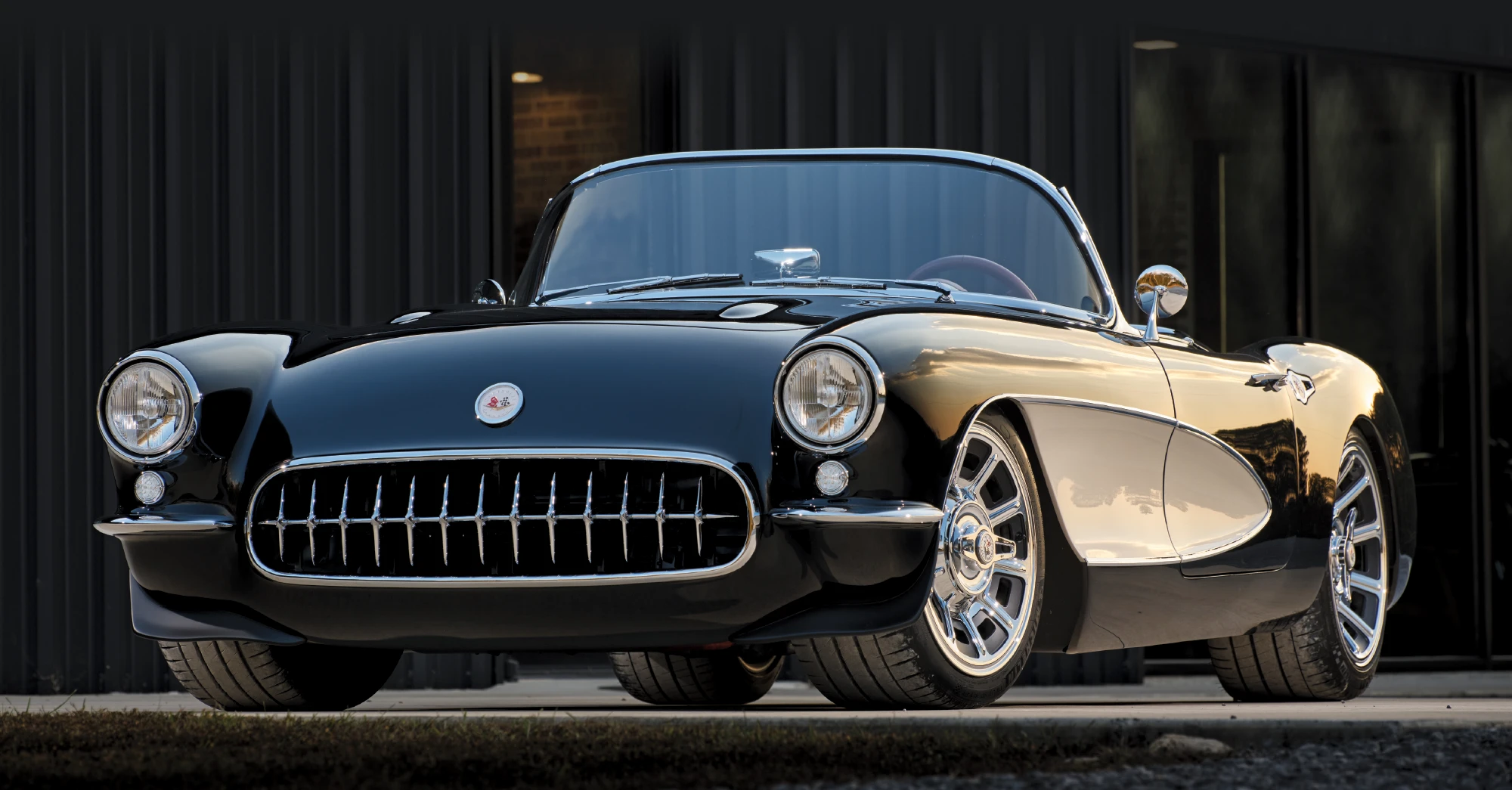
he name Jon Hall, a longtime hot rodder associated with Shadow Rods, and the well-known XL27, a freshly minted out of sheetmetal roadster body, should be familiar to many hot rodders. He’s no stranger to trying something new.
What you see isn’t what it might initially seem to be: a 1957 C1 Corvette. The owner is Jon Hall, and this “C1” is the prototype and first finished vehicle for the XL57 Corvette program, created by Steve Snow of Dynamic Corvettes (DC), Jon Hall of Shadow Rods, and Jesse Greening of Greening Auto Company (GAC). They combined their talents to build this one-of-a-kind vehicle from composite materials, with the intention of developing a future product line. Motor City Solutions (MCS) now owns the program and will be producing these XL57s moving forward. (Editor’s note: Look up Motor City Solutions online, a very interesting company. —B.B.)

 Photography by Brian Brennan
ean Livermore and the crew at Hot Rods By Dean (HRBD) have built some of the most well-known, award-winning hot rods in the country. So, what do these guys do in their spare time? They build a drag race car to have fun with on the weekends.
Starting with a moderately rough 1972 Chevy Nova that was a former race car, the HRBD team thumbed through the JEGS Performance Parts catalog to find the needed parts to update the chassis—first up was the rear suspension. Since the Nova used monoleaf springs, something would have to be done to control the axle wrap and wheel hop these suspensions are susceptible to. The cure for what ails these suspensions came in the form of Calvert Racing’s split monoleaf springs (PN 294-230-45) and their CalTracs Traction Bar Kit (PN 294-2380K1).
 Photography by The Author
rotherly love. Nothing compares to it. The Chowansky brothers understand this well. They not only work together, but they also play hard together. When siblings Rob, Dan, and Steve are not managing their family business, Fusco’s Auto Salvage in Watertown, Connecticut, they can usually be found having fun with a variety of motorized toys kept at the shop. Hot rods, motorcycles, muscle cars, and even snowmobiles have kept the brothers busy over the years, and you never know what you might see them riding on any given day.
However, during a recent trip to the hills in New York, the guys realized something was missing from their lives. “It had been a long time since we had a race car in the family. Steve is an accomplished driver and has won some regional titles. At that exact moment, as we were talking, we saw a car alongside the road. It was a 1937 Chevy coupe. We all thought, let’s build a hot rod together instead. We all agreed it was a great idea, so later that day I went back to talk to the owner,” Rob states.


 Photography by Cody Walls
here are a handful of customizing tenets that define the early, traditional custom style. The first and most obvious modification is to improve the factory design. Another approach is to adjust the stance and body lines to draw the viewer’s eye rearward to a distant vanishing point, creating a flowing, tail-dragging aesthetic. Finally, early customizers aimed to disguise more common, lower-cost cars by incorporating design elements of their up-model counterparts. Fadeaway fenders—modifying the fender lines of pre- and immediate postwar cars to connect the front fenders with the rears—check every one of those boxes.
Automotive design advanced rapidly from the early 1930s through the late 1940s. As that progress continued, fenders transformed from simple, bolt-on splash aprons into parts fully integrated into the body, like on the innovative 1949 Fords, whose design earned them the nickname “shoebox.” For much of that period, from around 1935 until new car design slowed for World War II, most American production cars had large, rounded fenders that covered only the wheels. These fenders curved into the passenger compartment just ahead of the doors and curved back out beyond them, creating an hourglass shape when viewed from above. But there were exceptions.


 Photography Provided by Mecum Auctions Inc. & John Gilbert
he world of custom cars experienced a significant loss on May 30, 2016, with the death of Gary “Chopit” Fioto, an exceptional talent from Long Island, New York. His career began with highly customized and carefully crafted automotive art that inspired many. Our first encounter with Gary was through our friend Bo Huff, who encouraged us to reach out after seeing the wildest bubbletop creation in Florida.
When we spoke to Chopit, his personality was as lively as Bo had described, which led to an invitation to visit him. It was here that many of us became good friends with Gary. The first of Chopit’s hot rods to be featured was his restyled 1932 Ford pickup, painted in a “blazing” fire red, notable for its chop, channel, and section metalwork. It was an incredible-looking hot rod with Gary’s signature flair.
It wasn’t until Gary fulfilled his dream of relocating Chopit Kustom to Southern California that we met him at Huntington Beach’s Donut Derelicts. There, Gary welcomed us to his shop in Stanton, California, just a block from the former site of Hot Rods by Boyd. Fast-forward to 2025 and his legacy lives on as his son, Nicholas, continues the family tradition of customizing cars in Allentown, Pennsylvania.

View Index
- AFFORDABLE STREET RODS
- AMERICAN AUTOWIRE
- AMERICAN RETRO
- ART MORRISON ENTERPRISES
- AUTO METAL DIRECT
- AUTOMOTIVE RACING PRODUCTS
- BOWLER PERFORMANCE TRANSMISSIONS
- CLASSIC INSTRUMENTS
- CLASSIC PERFORMANCE PRODUCTS
- CLASSIC PERFORMANCE PRODUCTS
- DAKOTA DIGITAL
- EATON DETROIT SPRING, INC.
- FITECH EFI
- FLAMING RIVER INDUSTRIES
- FLAMING RIVER INDUSTRIES
- GOLDEN STAR CLASSIC AUTO PARTS
- GOODGUYS ROD & CUSTOM ASSOCIATION
- GRANATELLI MOTOR SPORTS, INC.
- HAYWIRE
- HEINZMAN STREET ROD SHOP
- HEMMINGS
- HOT HEADS RESEARCH
- LOKAR
- LOKAR
- NATIONAL STREET ROD ASSOCIATION
- POWERMASTER PERFORMANCE
- PURE CHOICE MOTORSPORTS
- RARE PARTS
- RJAYS SPEED SHOP
- ROADSTER SHOP
- SALTWORKS
- SCHWARTZ PERFORMANCE
- SCOTT’S HOTRODS
- STEELE RUBBER PRODUCTS
- STEVE’S AUTO RESTORATIONS
- VINTAGE AIR
- WHEEL SMITH
- WILWOOD ENGINEERING
- WINTERS PERFORMANCE
