


 Photography by Jason Matthew
n the loud and stylish world of hot rods, the differences among manufacturers shape a unique culture of automotive enthusiasts. Before 1949, Ford reigned as the king of hot rods, captivating enthusiasts with its vintage styling and availability. However, by the time 1948 arrived, the tide had turned and Chevrolet emerged as the preferred choice for those building “modern” hot rods. This shift vividly illustrates the ebb and flow of automotive trends over the years. David Nilsen epitomizes the Chevy spirit, proudly owning a striking 1962 Chevy Impala hardtop, a stunning example of the era. But that brings us to the “war of words” on what’s more popular or better looking—the hardtop or the bubbletop. Well, that’s for each hot rodder to decide, but you’ll agree that David hit the mark with his 1962 Chevy Impala hardtop.
The primary distinction between the 1962 Chevrolet Bel Air bubbletop and hardtop models lies in the roofline. The bubbletop features a slim A-pillar, a thin C-pillar, and lacks a B-pillar, resulting in a rounded, greenhouse-like roof. In contrast, hardtops showcase a more traditional roofline with a thicker C-pillar and a formal roof that resembles a convertible top. This “convertible” top appearance endears the hardtop to its owners, as it is distinctive.
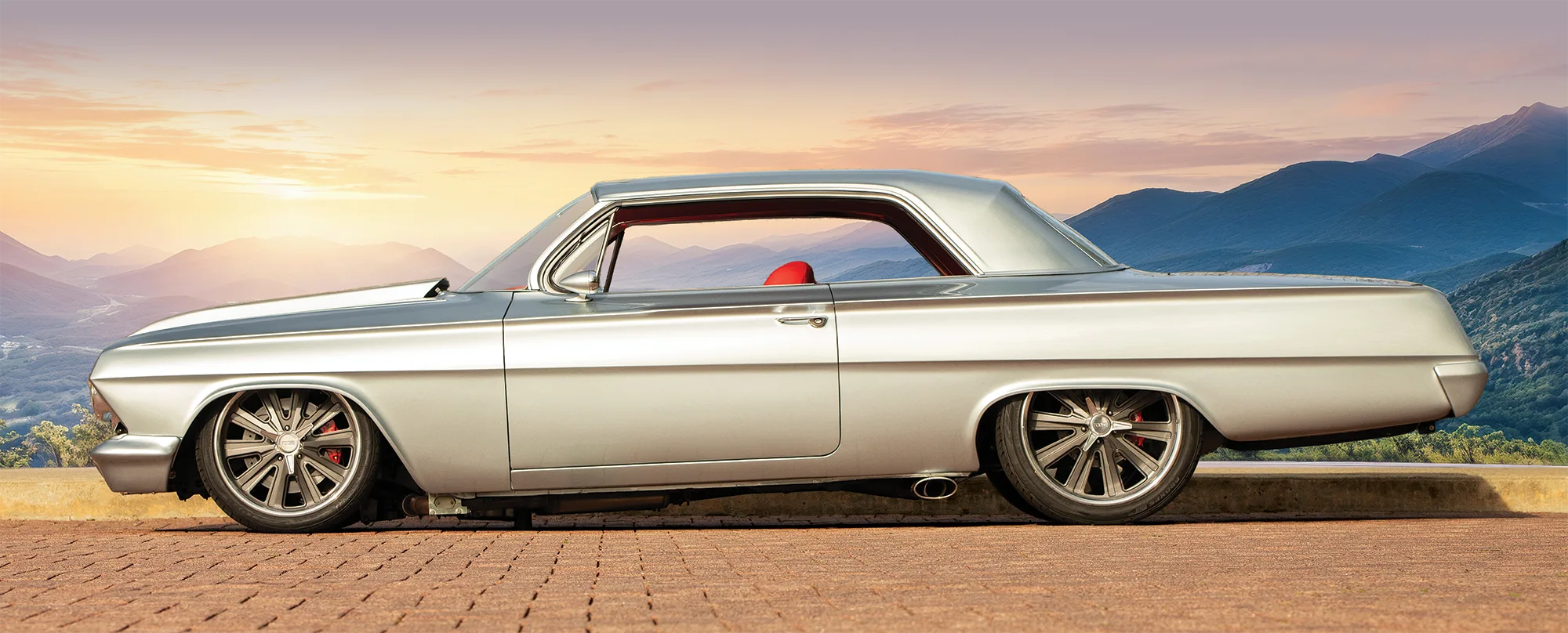

The 1962 Chevy frame has been upgraded by Yarusinsky with a full air-ride suspension from Ridetech, along with upper and lower control arms, shocks, and sway bars, providing the desired stance and improved ride quality. The braking system has also been modernized with the ubiquitous Wilwood system, which features an aluminum tandem chamber master cylinder with a combination proportioning valve, a mounting bracket, drilled-and-slotted 14-inch rotors with six-piston calipers in the front, and drilled-and-slotted 12-inch rotors with four-piston calipers in the rear. The eye-catching wheel-and-tire combination comes from MHT Foose Wheels, measuring 20×8.5 in the front and 22×12.5 in the back, fitted with Toyo radial rubber 255/35R20 radials and 295/35ZR22. In the rear, a C1 Corvette rearend filled with 3.73 gears is linked to the 6L80E transmission via a custom driveshaft. The Powertrain Control Solutions (PCS) billet aluminum gear select module (GSM) is an electronically controlled push-button “range” selector, concealed within the center console, that instantly manages the shift-shaft on the side of the 6L80E.


A look inside reveals what one expects, but there is more than meets the eye. While it appears to be a 1962, the dash is made from two 1962 dashes combined into one and is now equipped with Dakota Digital gauges. A new lower dashboard panel also houses the Speedway Motors tilt column and a custom half-wrapped red leather Forever Sharp two-spoke wheel. The center console extends from the lower panel between the bucket seats, reaching back between the rear buckets and up to the rear deck area. The center console holds air registers, the Vintage Air A/C controls, cup holders, GSM, electric e-brake, and a Sony touch screen stereo system supplemented with Skar Audio amplifiers and speakers. The e-brake is conveniently hidden in the center console and operated by a custom-fabricated electronic actuator. The pedal assembly (brake and throttle) is sourced from Scott’s Hotrods, featuring its drive-by-wire gas pedal. Bringing all the hot rod’s electrical needs together is a Painless Performance Products wiring system by Yarusinsky. The bucket seating was originally from a 2006 GTO, retaining only the power mechanism and framework, while the seats were then custom-built and covered in red leather by Javier, who handled all the interior stitchwork that includes the one-piece leather headliner, door and kick panels, and carpeting. The trunk is also fully detailed through upholstery and now houses the mechanics for the Ridetech system and the OPTIMA battery.


