
Modern Rodding TECH
BY RON CERIDONO Photography by The Author & COURTESY OF SPEEDWAY MOTORS

man holding a brake part while sitting next to a car elevated by jack stands
1. We’ve been running F-100 brakes on our Model A pickup for years; they were a big improvement over the previously installed 1940 Ford brakes. Thanks to the more sophisticated design, the Bendix self-energizing brakes increased stopping power dramatically compared to the Lockheed style, even though they are smaller in diameter.
drum brake update
Better Binders for Vintage Ford Hot Rods
S

ince the days of the Model T, hot rodders have been finding ways to make Fords go faster. Ironically, as those efforts became more successful, it became obvious that old Fords needed to stop more effectively as well.

Although Henry Ford’s mechanical intellect was staggering on one hand, on the other hand his conservative nature often influenced his decisions. When the Model As for 1928 were introduced, they were equipped with four-wheel mechanically operated drum brakes. Certainly, it was an advancement compared to the Model T, which only had a pedal-operated single brake band inside the planetary transmission and lever-actuated “emergency brakes” on the rear wheels. However, Ford continued to use mechanically operated brakes long after other manufacturers had made the change to hydraulics; Duesenberg introduced hydraulic brakes in 1921, and by the mid 1930s virtually all manufacturers had made the switch. Part of Henry’s hesitation to make the change to hydraulic brakes probably had something to do with the fact that the early systems were prone to leakage, so he felt more comfortable with mechanical linkages. However, an even more compelling reason may have been that the company would have had to pay royalties to the owners of the various brake patents and Henry liked total control of the vehicles he produced.

When Henry finally relented and switched to hydraulic brakes in 1939, two different designs were used: Fords and Mercurys used Lockheed-style brakes, while the upscale Lincoln used Bendix-style brakes. The Lockheed design has a pair of brake shoes, each anchored at the bottom of the backing plate. As a result, the shoes operate independently of each other. The Bendix self-energizing brakes use shoes that are hooked together at the bottom by a spring and adjuster and are held to the backing plates by pins, springs, and retainers. Mounted this way, they are free to move slightly on the backing plate. When these brakes are applied, the front brake shoe contacts the revolving drum and tries to rotate with it. That movement is transferred through the adjuster to the rear shoe, pushing it into the drum with increased force, making it more effective than the Lockheed design.

Over the years, there have been an untold number of brake adaptations for early Fords. Certainly, the most popular was the installation of 1939-and-later “juice” brakes on those early models equipped with mechanical brakes. Even the Lockheed brakes provided a noticeable increase in stopping power compared to the mechanical designs, particularly important with a hopped-up engine. Of course, the hot setup was the installation of Lincoln Bendix brakes. But not all Lincoln brakes were the same.

Between 1939 and 1948, Lincoln front backing plates had three different depth recesses where the spindles fit. The 1941 only had front backing plates and all the rear backing plates were almost flat, making them the easiest to install without spacers or modifications. But the reality is that as good as these brakes are, finding any original Lincoln components is extremely difficult, making the reproductions available from Speedway Motors the sensible choice. New components that work well and bolt on with no modifications are hard to beat.

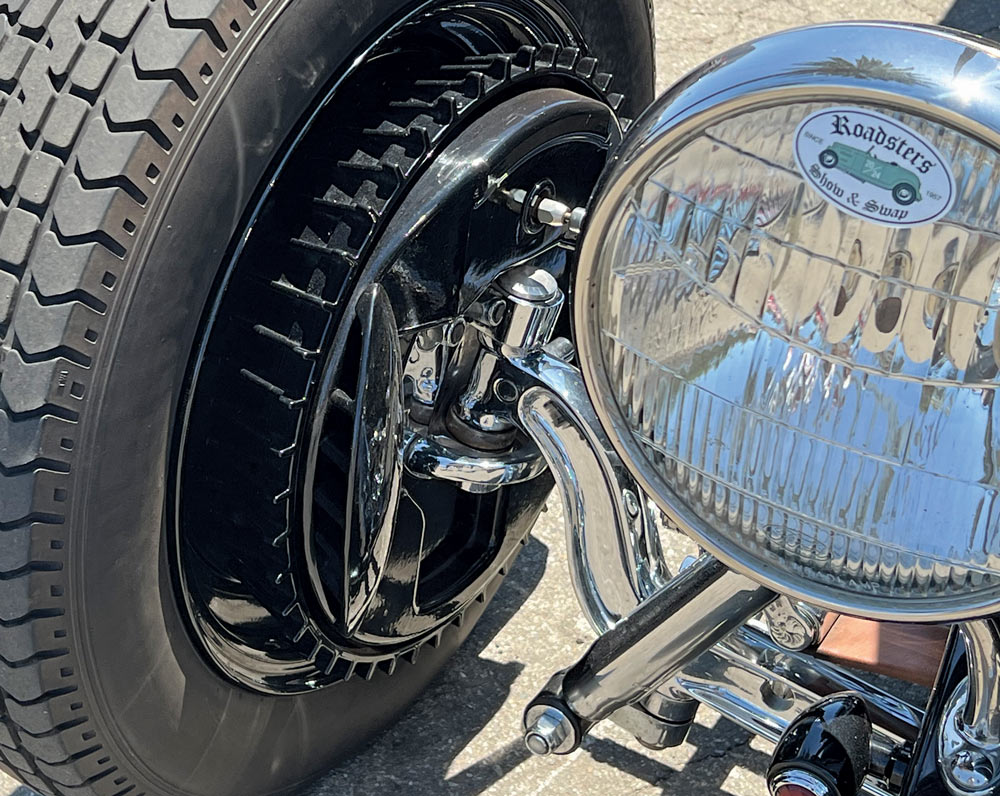
A popular addition that hot rodders often made to early Ford brakes was the installation of aluminum brake drums found on 1958 to 1970 Buicks. These cars used 12-inch, finned aluminum drums with iron liners (1958 through 1965 drums had 45 fins 1 inch apart; later drums had 90 fins 1/2 inch apart). The advantage of these brake drums is the finned aluminum outer surface dissipates heat much more effectively than a standard cast-iron drum, which helps prevent brake fade. While that may not be a huge problem in most cases, there’s no denying the visual impact. Like the Lincoln brakes, serviceable original aluminum Buick brake drums are hard to find. However, Speedway Motors once again comes to the rescue with new reproductions.

Another popular swap for early Fords is the use of 1953 to 1956 Ford F-100 brake assemblies. Assemblies from model year 1953 through 1956 will work. Other than pickup backing plates and hubs, the only additional parts needed are new inner bearings and seals. Early Fords and F-100s use the same outer bearings and cups (Timken PN 09067 bearing, Timken PN 09195 cup), but the inner bearings differ. F-100 spindles use a larger inner bearing, so a bearing with a smaller inside diameter is required. The replacement bearing needed is Timken (PN 14116). Its inside diameter matches that of the early Ford spindle with the correct outside diameter for the F-100 hubs. The stock F-100 inner cup (Timken PN 14276) uses a Victor seal (PN 49195 or CR PN 15761).

When it comes to stopping power, well-maintained and properly adjusted drum brakes are more than adequate for a lightweight early Ford hot rod. In operation, drum brakes can generate almost as much stopping power as disc brakes, but they can’t do it when repeated high-speed brake applications are involved. All brakes rely on friction between two surfaces to stop the car, and when those surfaces get hot, the coefficient of friction between them is reduced, and the brakes lose effectiveness; the term for this is brake fade. In this regard, disc brakes have an advantage over drums as many discs are exposed to air, which helps them cool. Compared with drum brakes, most of the friction surface is in contact with the brake drums, which leaves little surface area for cooling. As a result, drum brakes get hotter faster and stay hot longer.

Fade can be an issue in some circumstances, but it isn’t normally a concern for a street-driven, traditionally styled hot rod. When it comes to traditional hot rods, style is a critical factor, and for that, drums beat discs every time.

1931 ford brake model
2. Ford used mechanical brakes until 1938—this example is from a 1931 Model A. It took a while, but even Henry Ford had to admit hydraulic brakes were more effective and driver-friendly.
1953-1956 F-100 Ford Bendix-style brake and 1939-1948 Ford Lockheed brake
3. On the left is a 1953-1956 F-100 Ford Bendix-style brake; the 11-inch drums use 2-inch-wide shoes. On the right is a 1939-1948 Ford Lockheed brake that uses 12-inch drums with 1.75-inch-wide brake shoes.
1940s drum configuration
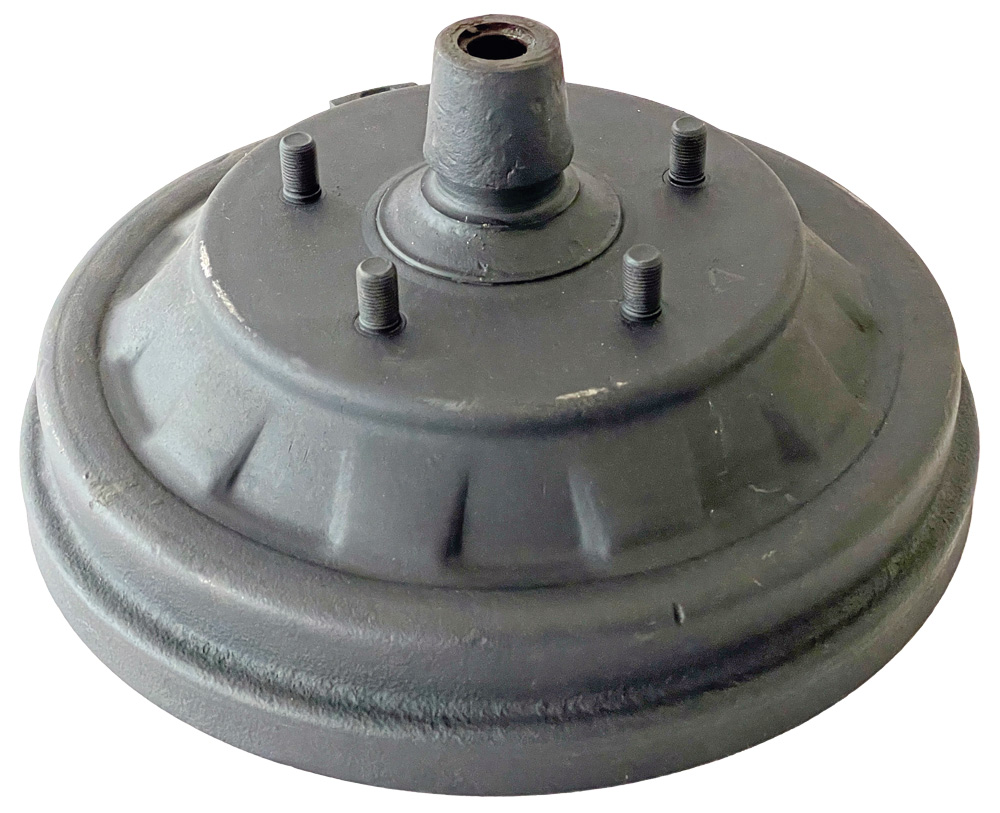
4. The 1940 and later drums can be found in two configurations; this style has the drum mounted to the outside of the hub—this example is a rear brake drum. The 1939 hydraulic brakes used the “wide-five” wheels and drums introduced in 1936.
brake hub
5. The hub can be seen inside the drum as in the previous photos; the drum is 12 inches in diameter and uses 1.75-inch-wide shoes.
front brake drum
6. Although this example is a front brake drum, it shows how the drum mounts to the back of the hub. When Ford made this change, it wasn’t clear, but the production of the two styles overlapped, as we found two original 1947 Fords: one had internal hubs, the other external hubs.
external style brake hub/drum
7. This is the external-style assembly viewed from the inside. Both hub/drum styles use 12×1.75-inch brake shoes. While the two versions look different, the complete drum and hub assemblies are interchangeable.
Speedway Motors 12x2-inch replacement brake drums
8. Speedway Motors offers 12×2-inch replacement brake drums (PN 91065400) for their Bendix-style brakes and reproduction hubs.
Speedway Motors self-energizing drum brake kit
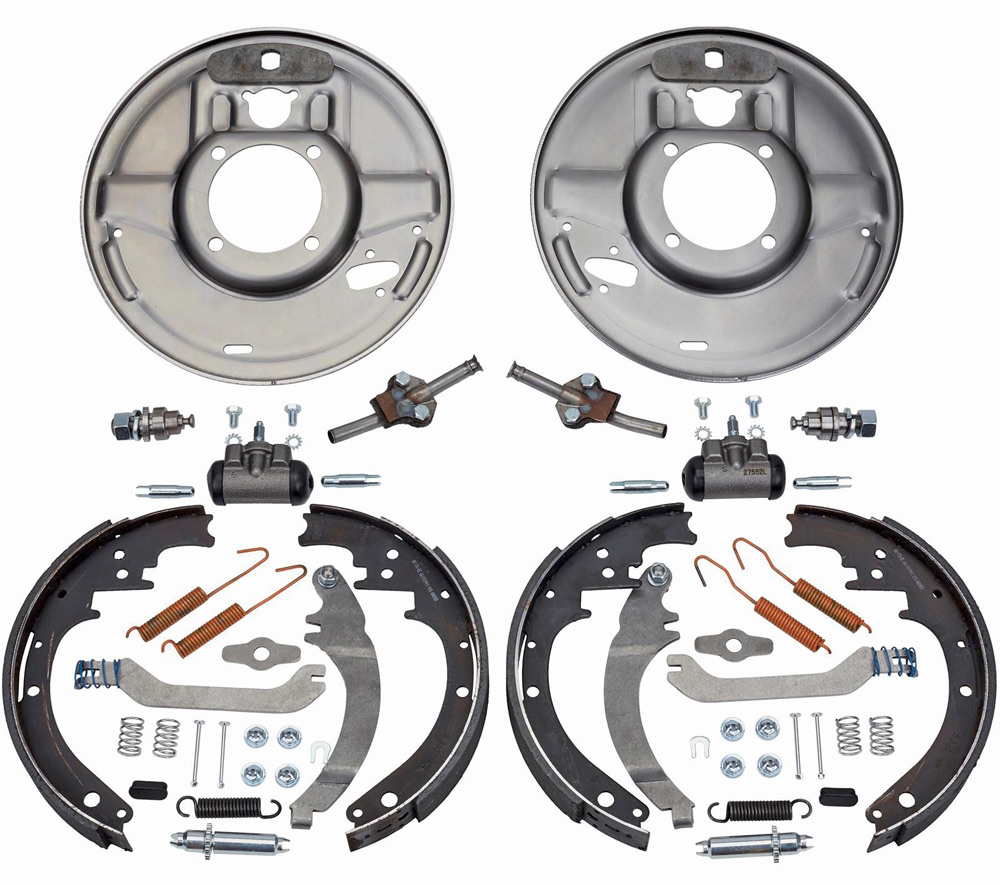
9. Speedway Motors offers this self-energizing drum brake kit (PN 91065423) with a period-looking “juice” backing plate for Fords from 1937 to 1948. It includes 12×2-inch drums and shoes with springs, hardware, adjusters, and 15/16-inch wheel cylinders.
Speedway Motors Bendix-style rear brakes (with emergency brakes)
10. Speedway Motors offers Bendix-style rear brakes (with emergency brakes). They are available with 12×1.75 backing plate assemblies (PN 91065430) or 12×2 backing plate assemblies (PN 91065440).
Lincoln-style Bendix brakes from Speedway
11. Lincoln-style Bendix brakes from Speedway are available with 12×1.75 brake shoes (PN 91065410) or 12×2 brake shoes (PN 91065410). Either can be used with Buick brake drums.
Speedway’s 1937-1941 round-style Ford spindles
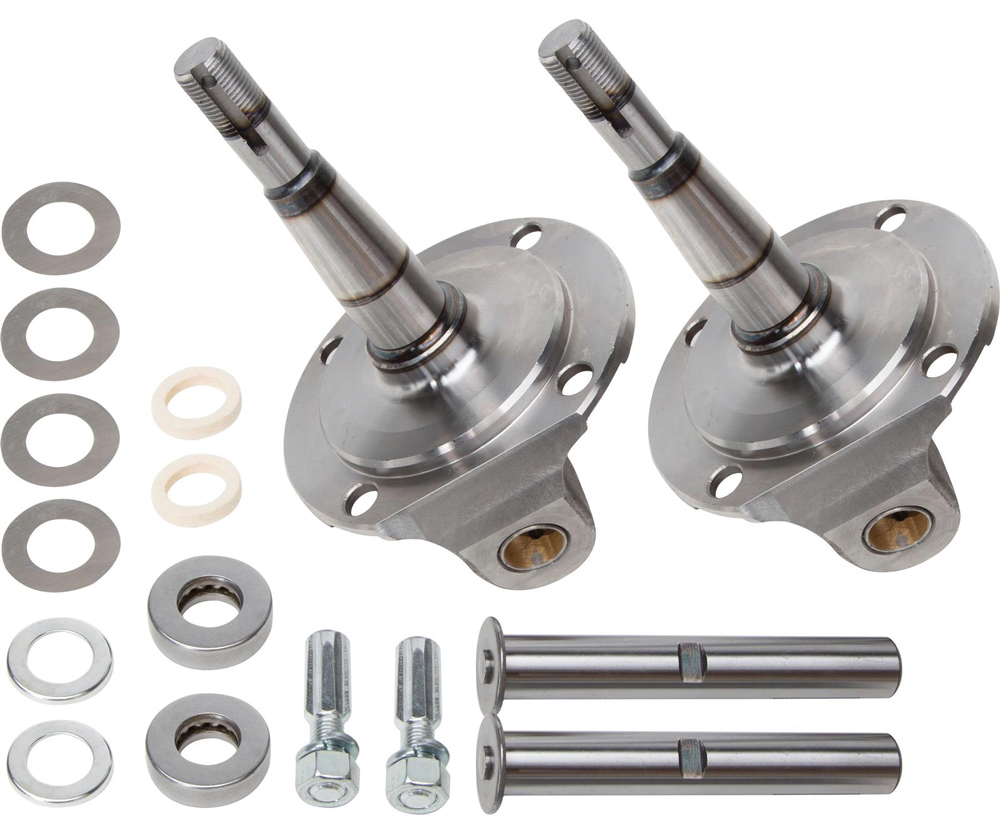
12. Speedway’s 1937-1941 round-style Ford spindles are drop forged and machined to accept their Bendix-style brake kits. Spindles come with kingpins and bushings sized to fit.
Speedway’s reproduction 45-fin Buick brake drum
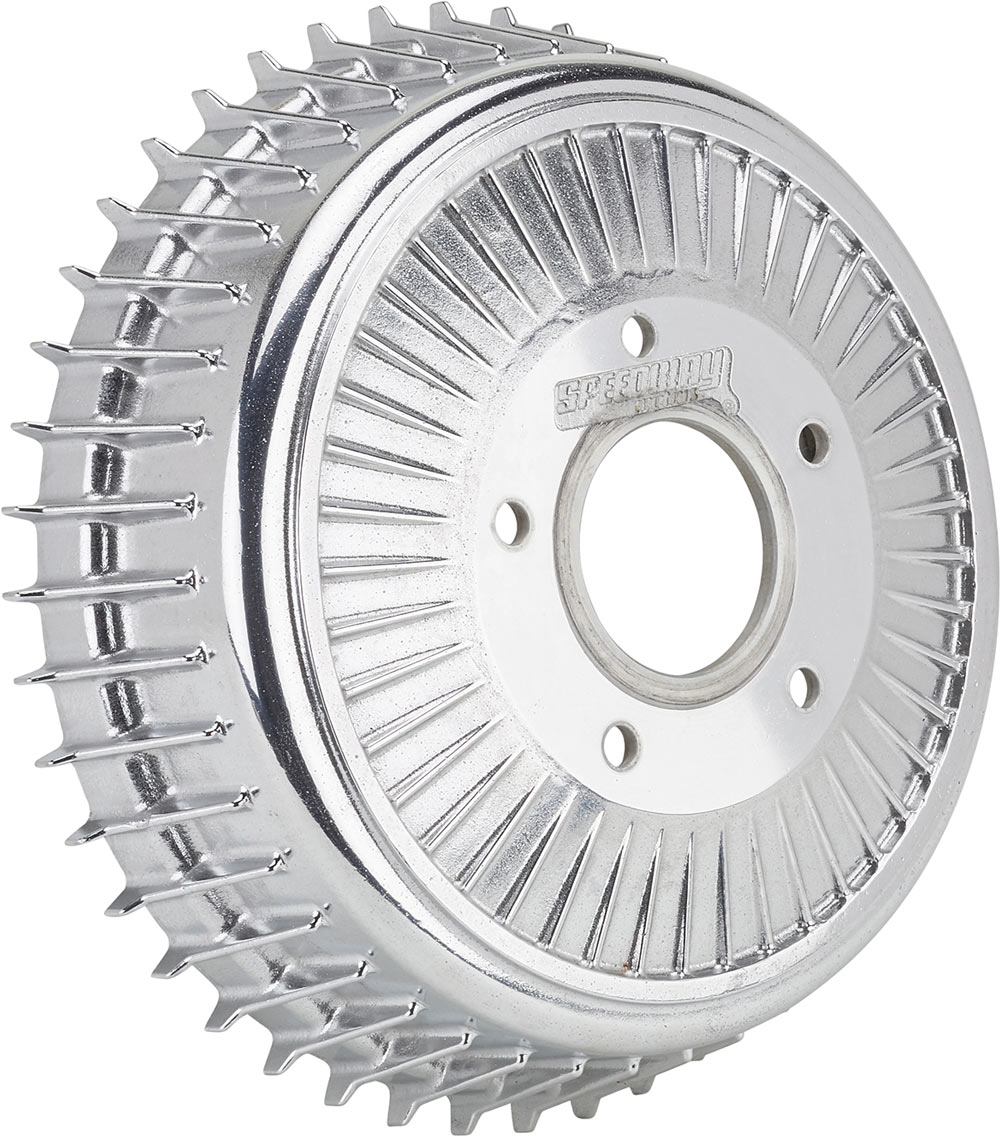
13. Speedway’s reproduction 45-fin Buick brake drums are available polished (PN 91065496) or as-cast (PN 91065495). These new aluminum castings have an integrated steel liner, are CNC machined to clear 1937-1948 Fords, and have the Ford 5-on-5.5 bolt pattern.
Speedway’s bolt-on Bendix brake kit
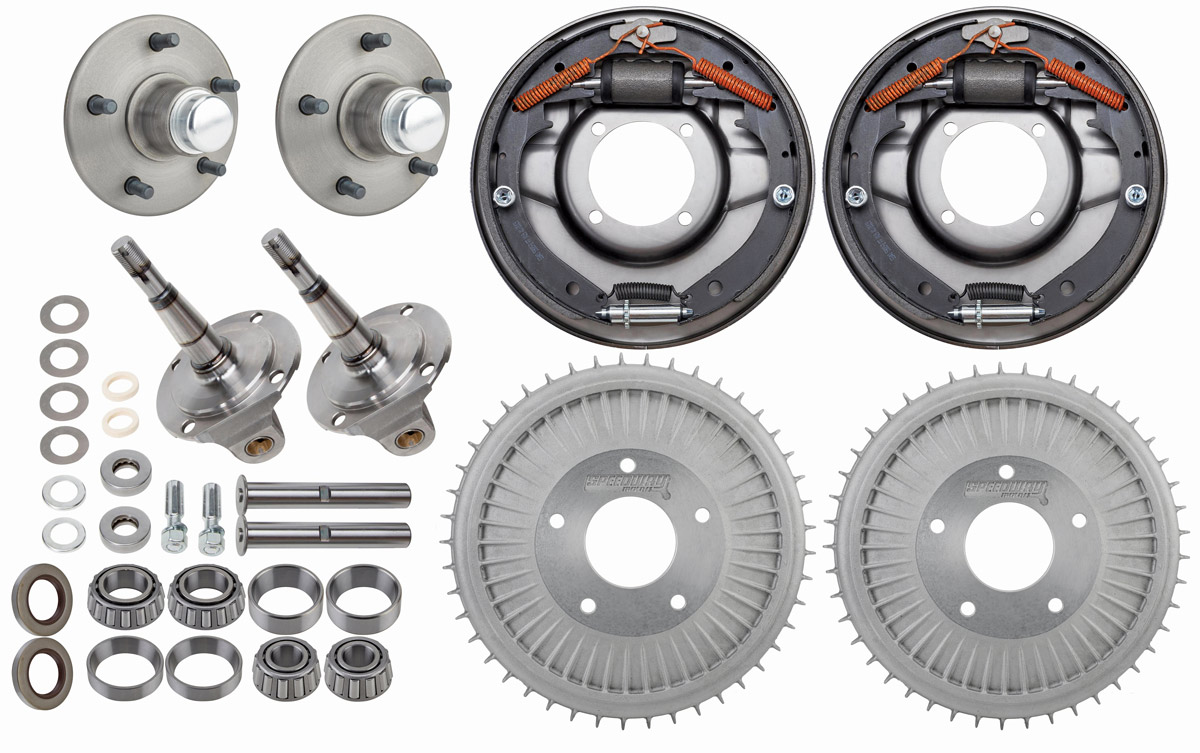
14. Speedway’s bolt-on Bendix brake kit includes forged spindles modified for backing plate clearance, complete backing plate assemblies, hubs, and brakes with the Ford 5-on-5.5 bolt pattern.
black and white photo of Ford F-100 Bendix brakes
15. Ford F-100 Bendix brakes are a simple, affordable upgrade for early Fords. The complete pickup backing plates, hubs, and drums are required.
black and white photo of spindle
16. On some spindles, the replacement bearings will not slide all the way on, so modifications are required (note the gap between the bearing and spindle).
black and white photo of die grinder sharpening edge of new bearing
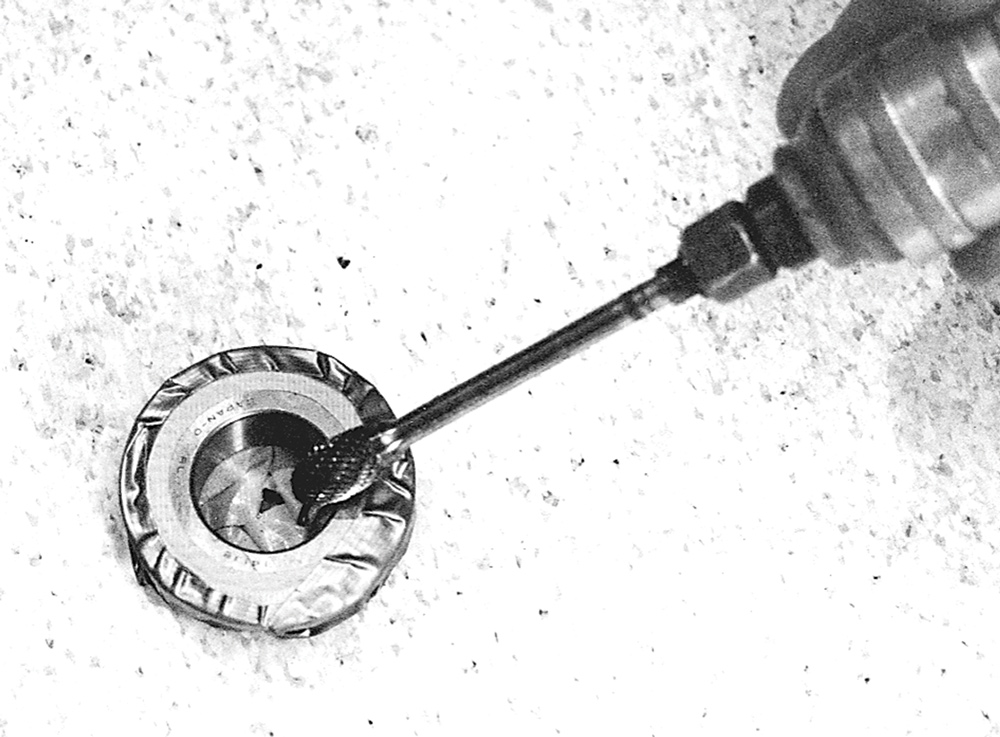
17. A die grinder and burr can be used to knock down the sharp edge of the race so the new bearing will seat on the spindle properly. Duct tape will keep debris out of the bearing while grinding.
black and white photo of hand using marker to mark where modifications need to be made on spindle
18. The only spindle modifications required are small reliefs to provide clearance for the F-100 wheel cylinders.
black and white photo of f-100 backing plates
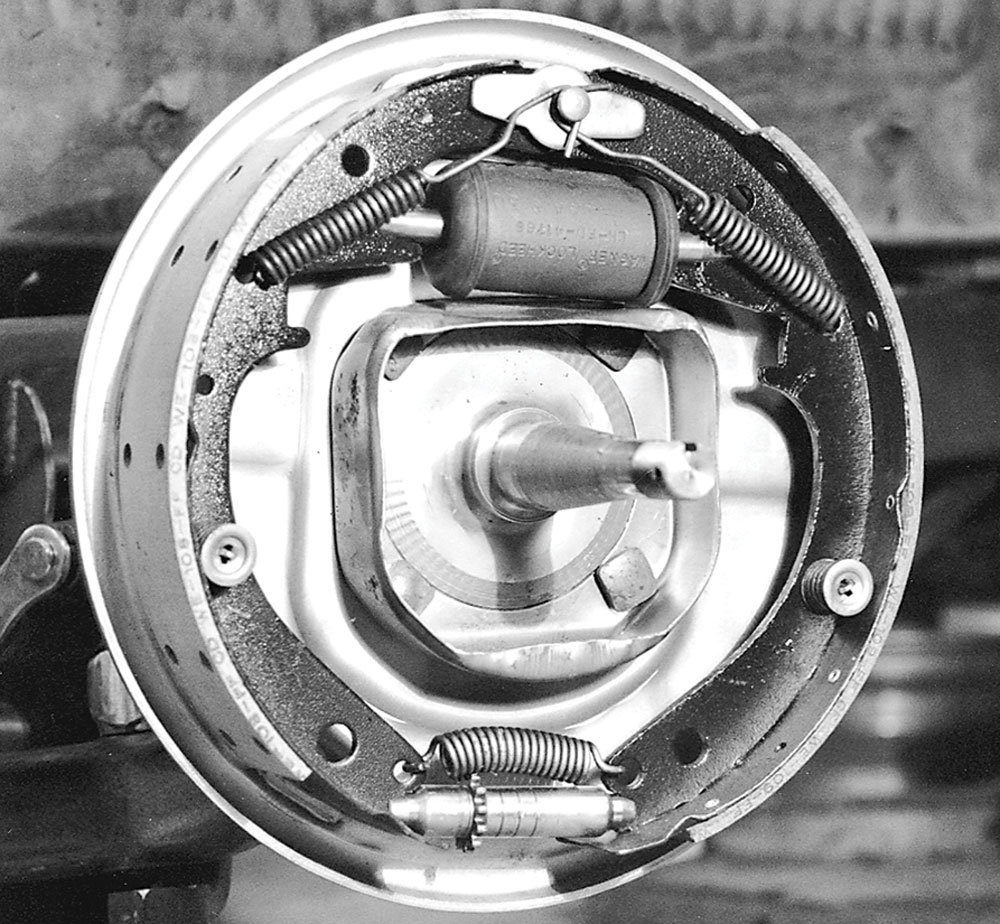
19. No modifications to the F-100 backing plates are required; they bolt in place.
black and white photo of Buick brake drum and backing plate
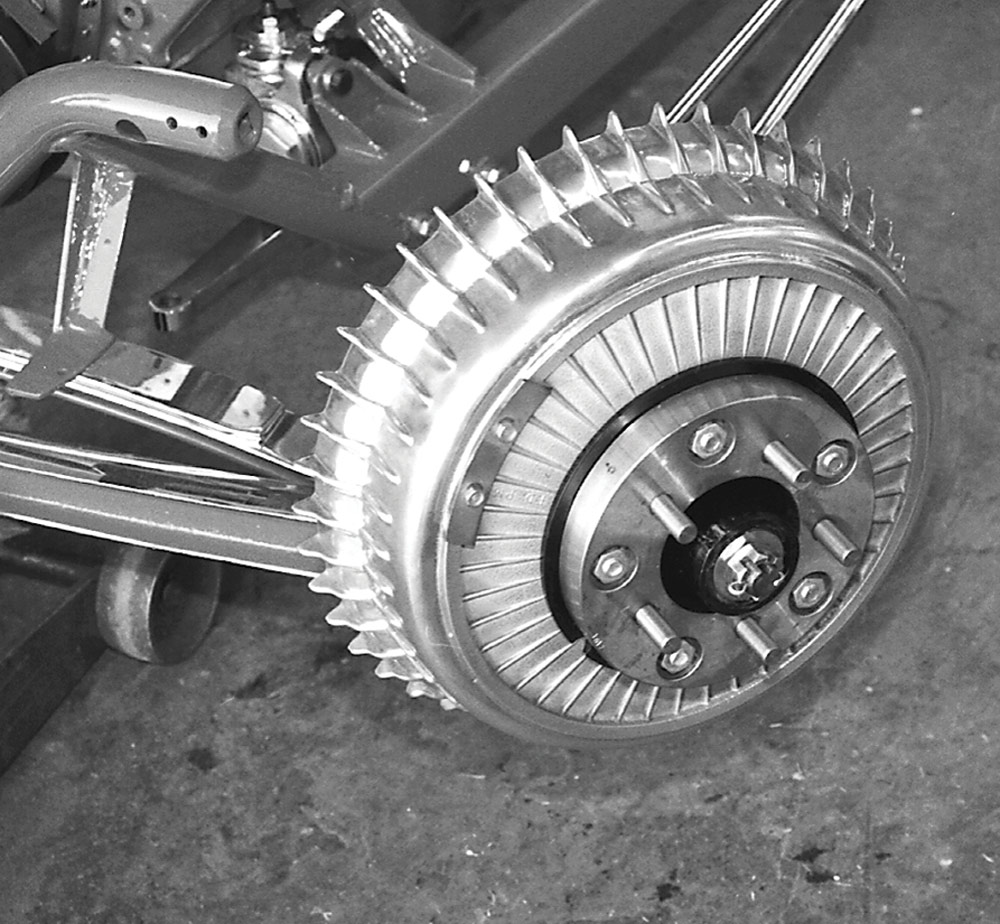
20. This brake swap used not only the Buick aluminum brake drum but also the entire Buick backing plate.
buick backing plate
21. Ace machinist Wayne Atkinson devised adapters to mount the Buick backing plates on the late-style (1942-1948) rectangular spindles.
custom adapter seen between spindle and backing plate
22. The custom adapter between the spindle and the backing plate can be seen. The brake drums were mounted to original Ford hubs.
12x2.5 buick brake assembly
23. Buick brakes are 12×2.5 inches. The backing plate holes were filled and redrilled for the Ford spindles.
Chrysler Total-Contact brakes with twin leading shoes installed on DeSoto
24. One of the more unusual Ford brake swaps was installing Chrysler Total-Contact brakes with twin leading shoes. This example is a 12×2 assembly on a 1956 DeSoto.
augmented Lincoln backing plates with Buick-finned aluminum drums and aluminum air scoops
25. In a stylish effort to keep his roadster’s brakes cool, this hot rodder augmented Lincoln backing plates with Buick-finned aluminum drums and aluminum air scoops.
Speedway Motors aluminum scoops
26. Speedway Motors aluminum scoops (PN 9102103) fit original or reproduction Lincoln backing plates (and F-100s with some massaging). The intake scoops face forward, with exhaust scoops that face the rear
SOURCE
Modern Rodding
VOLUME 5 • ISSUE 48 • 2024