
Modern Rodding Feature
Personification
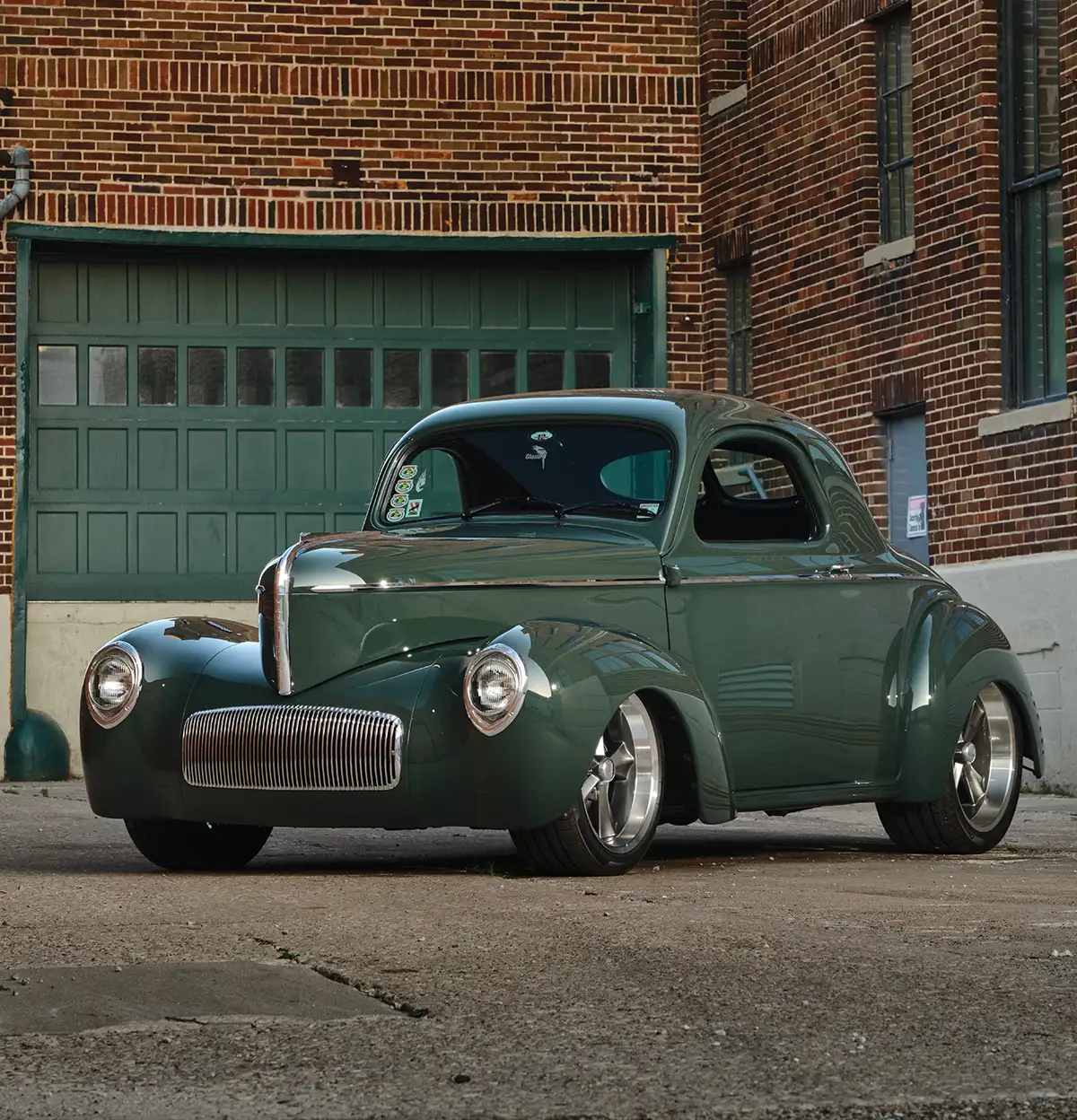
Lon Clouse’s 1941 Willys Americar Coupe is Pure Hot Rod Perfection
BY BRIAN BRENNAN PHOTOGRAPHY BY NOTSTOCK PHOTOGRAPHY
T

he Willys has been a staple in our hot rod world, both on and off the dragstrip. Lon Clouse’s 1941 Willys coupe is a sight to behold in the street rod world, but don’t underestimate the power underhood. To achieve this perfection, he enlisted the help of Eddie Pettus of Eddie’s Rod & Custom (ER&C).

To understand our infatuation with the Willys, we must grasp a few basic facts—hot rodding and drag racing are both performance-driven, so the two are the proverbial match made in heaven. (My local pastor is beside himself right about now, but he gets the point.) As many of us grew up, it was the Gasser Wars of the ’60s that, among much more, captured our attention and mesmerized us. Do you remember Stone, Woods & Cook; Big John Mazmanian; K.S. Pitman? All these 1941 Willys coupes were incredibly popular for their appearance and performance. So why not bring that look onto the street and even add brutal power? Sounds like the perfect street rod. There can be little doubt that watching a 2,100-plus-pound Willys on a 104-inch wheelbase with a steroid-pumped Chrysler Hemi mated to a GMC 8- or even a 10-71 blower, was a true sight to behold. Do you remember those blowers sticking through the hood? (I went through high school thinking a 1941 Willys came with a blown Chrysler from the factory. It was the only way I had ever seen one!) The sound, the acceleration, and the pure uncertainty of whether these Willys would make it to the other end in a somewhat aligned stance were always open for debate. It was a time when the blown gas coupes ruled.

The 1941 Willys Americar was part of Willys-Overland Motors’ lineup, manufactured from 1941 to 1942, with model designations 441 and 442. That brings us to Lon’s Model 441, which Pettus began to work his magic on. Once in the shop, the body was lifted and sent off for a redo, while the original chassis was scrapped and replaced with an Art Morrison Enterprises (AME) Builders Chassis featuring an AME fully independent front suspension, a Ford 9-inch solid rear with Strange axles and 3.55 gearing, and an AME four-link rear suspension. JRI received the nod for the coilovers at the corners, plus an AME front and rear sway bar, an AME Panhard bar, and a Detroit Speed Equipment rack-and-pinion. More corner eye candy, along with top-notch performance parts, includes a Wilwood brake system. The brake system begins with a Compact Tandem master cylinder with a prop valve, then features Dynalite calipers with smooth rotors. The brake package hides behind a set of Rocket five-spoke wheels measuring 18×8 and 20×10. Pirelli Cinturato P7 rubber was used at the corners, measuring 245/40R18 and 295/35R20. Nestled within the chassis is a stainless 1966 Mustang 16-gallon gas tank (with a Holley submersible fuel pump) to hold “go-juice” for the blower’s small-block Chevy.
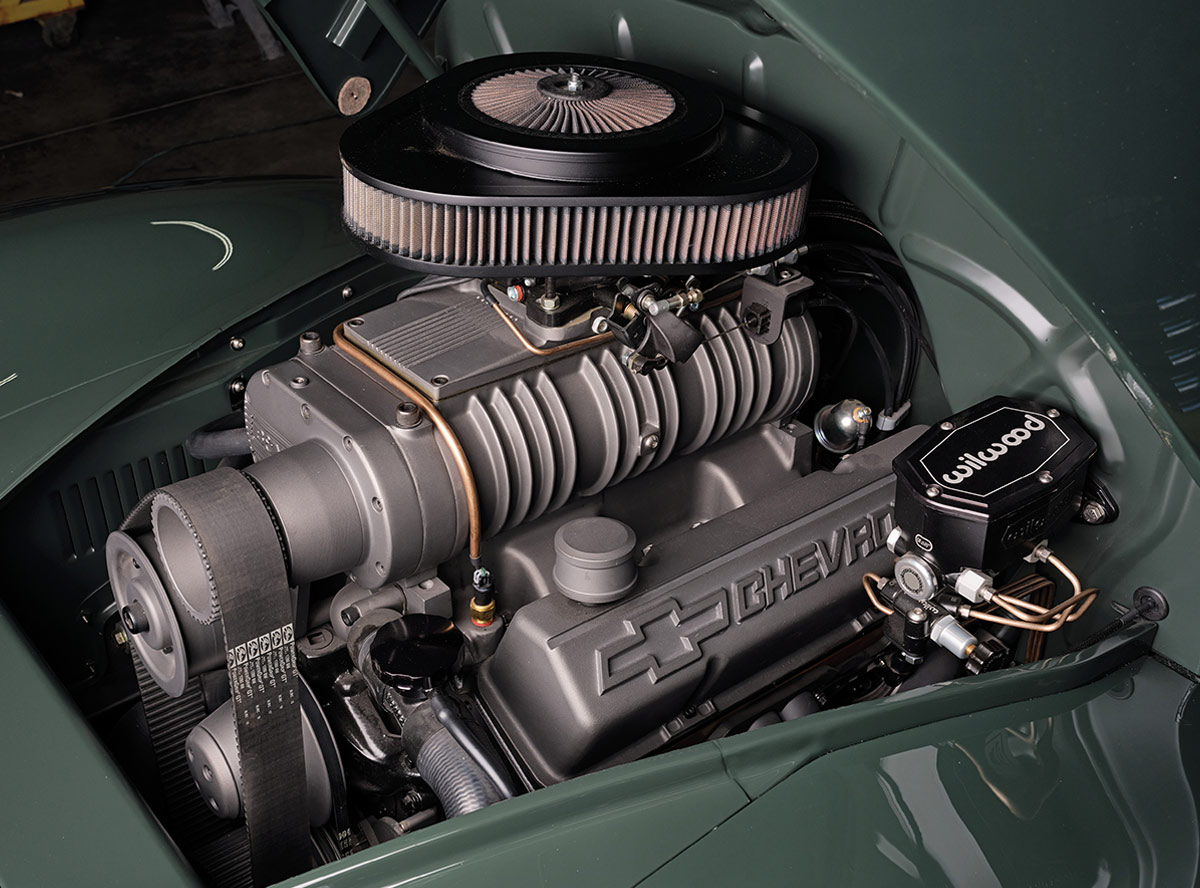
Blown small-block Chevy engine in detailed engine bay
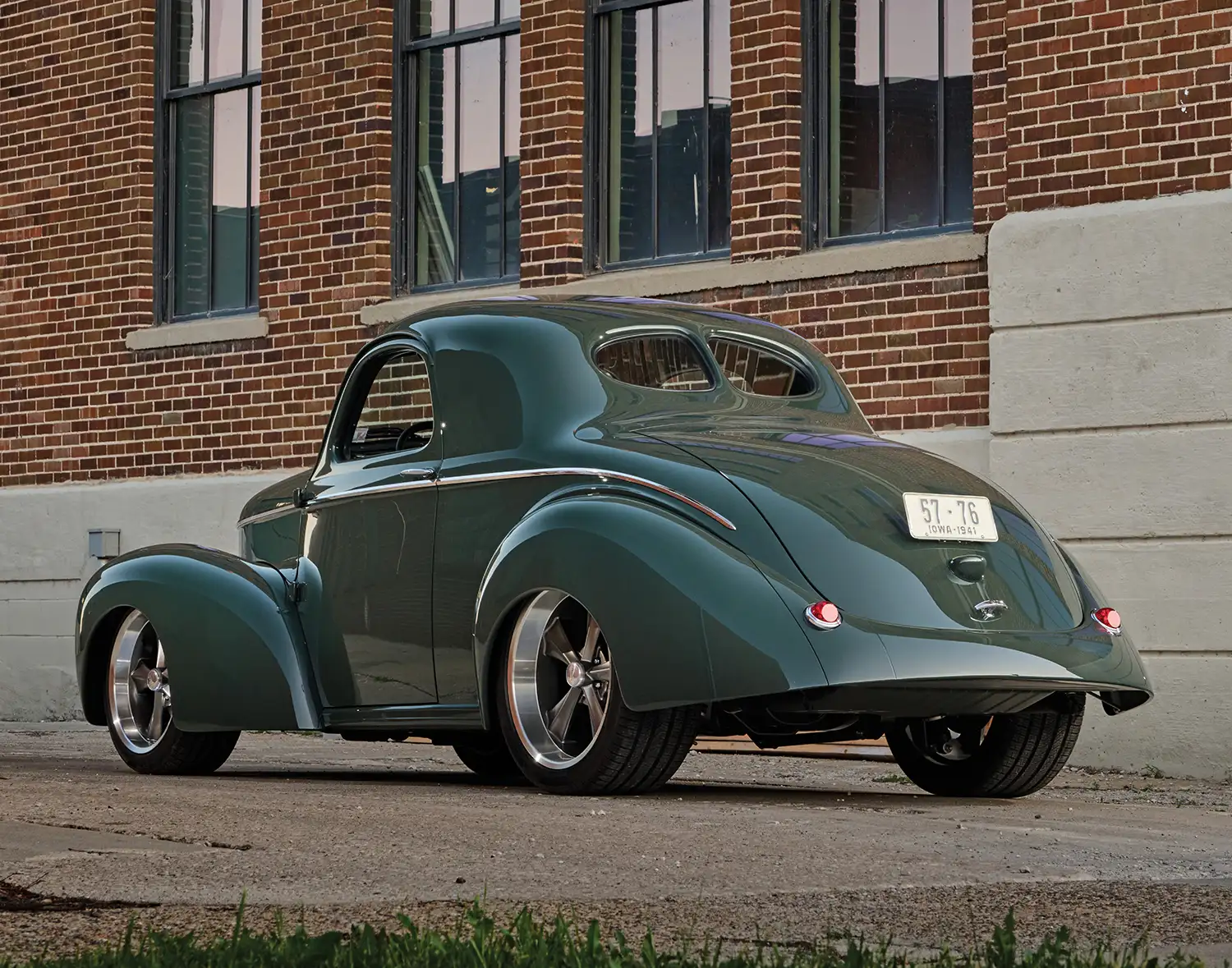
Rear view of green Willys showing sleek body lines
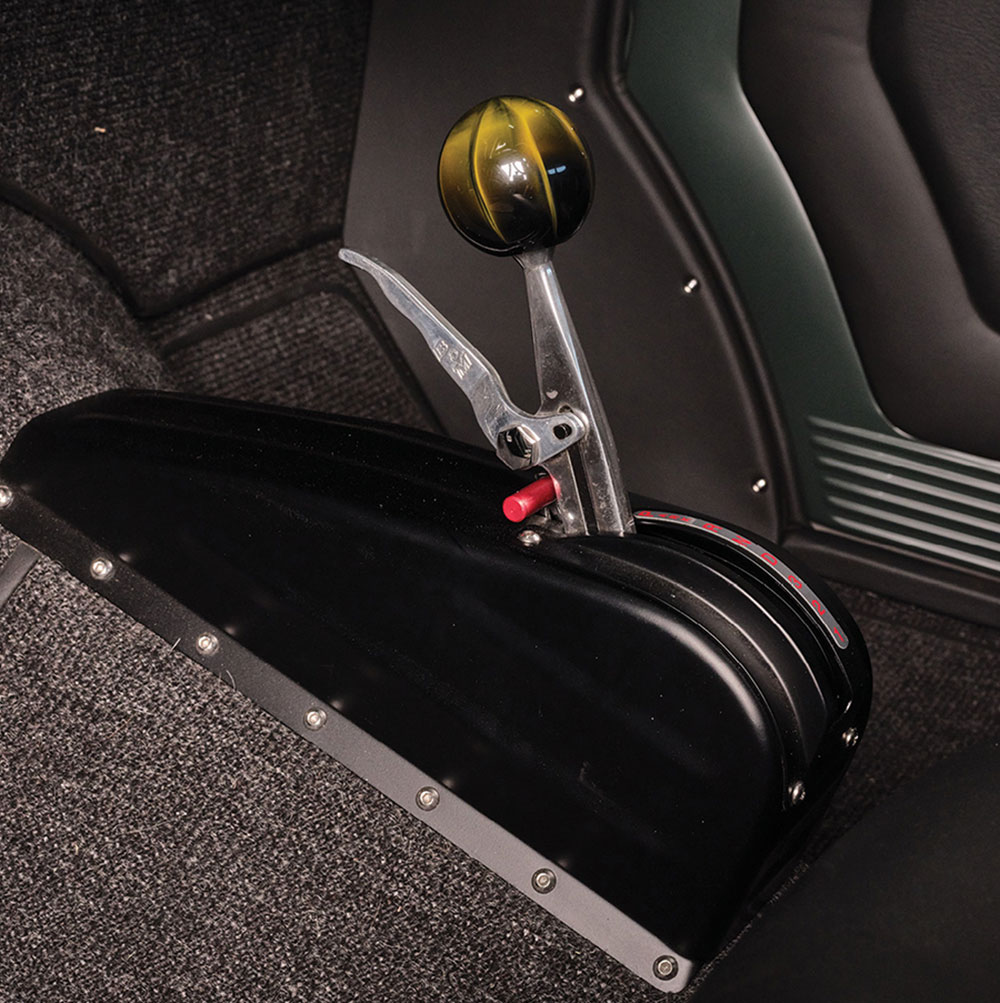
Speaking of blown small-blocks, the one in this 1941 Willys coupe is a 1969 Chevy block with a 0.040-over bore, allowing the small-block to displace 358 ci. Bowman Woods Service installed Ross 7:1 compression ratio pistons on a set of Eagle H-beam rods, along with the crank, and the reciprocating combo was balanced. Iron heads were retained (which increases the compression ratio compared to aluminum heads), and a B&M Super Street Charger camshaft is used with Cerakoted GM aluminum valve covers. The induction system comprises a B&M Power Charger 250 coupled with Holley Sniper EFI and a K&N air filter. The ignition is based on an electronic MSD distributor with ACCEL Extreme 9000 ceramic (plug ends) primary wires. Exhaust gases exit through a pair of custom Ultimate Headers that feed an ER&C-fabricated exhaust system, which runs through Cerakoted stainless 2-1/2-inch tubing and leads to a pair of Cerakoted Borla mufflers. Engine accessories include a Powermaster starter and alternator, used in conjunction with a trunk-mounted XS 3400 battery. Cooling is provided by a Stewart cast-iron water pump and an SPAL electric fan supporting the custom-made U.S. Radiators radiator. From here, the power is routed back to a Bowler Performance Transmissions–prepped 700-R4, which is shifted via a floor-mounted B&M shifter.
Front three-quarter view of green 1941 Willys coupe
The body is an all-steel 1941 Willys coupe, but it has a Willys sedan windshield and cowl installed. From there, freshly fabricated wheeltubs were made, along with a new inner metal structure and a highly modified firewall. The nifty sheet metal work was handled by ER&C’s McClain Phelan, while AJ Lucas jumped in on bodywork and sprayed the custom mix of Glasurit basecoat in Gray Vineyard Green. The desired tonal quality was to make the color look like something that would have been used in the 1930s and 1940s. (Job well done.) From there, a clearcoat was applied. Also involved in the meticulous bodywork were Joel Rupe, Tristan Pasker, and Chris Lint of ER&C’s shop. When it came time to put the many pieces of this hot rod puzzle back together, Michael Pettus was on hand for the assembly as well as additional mechanical efforts.

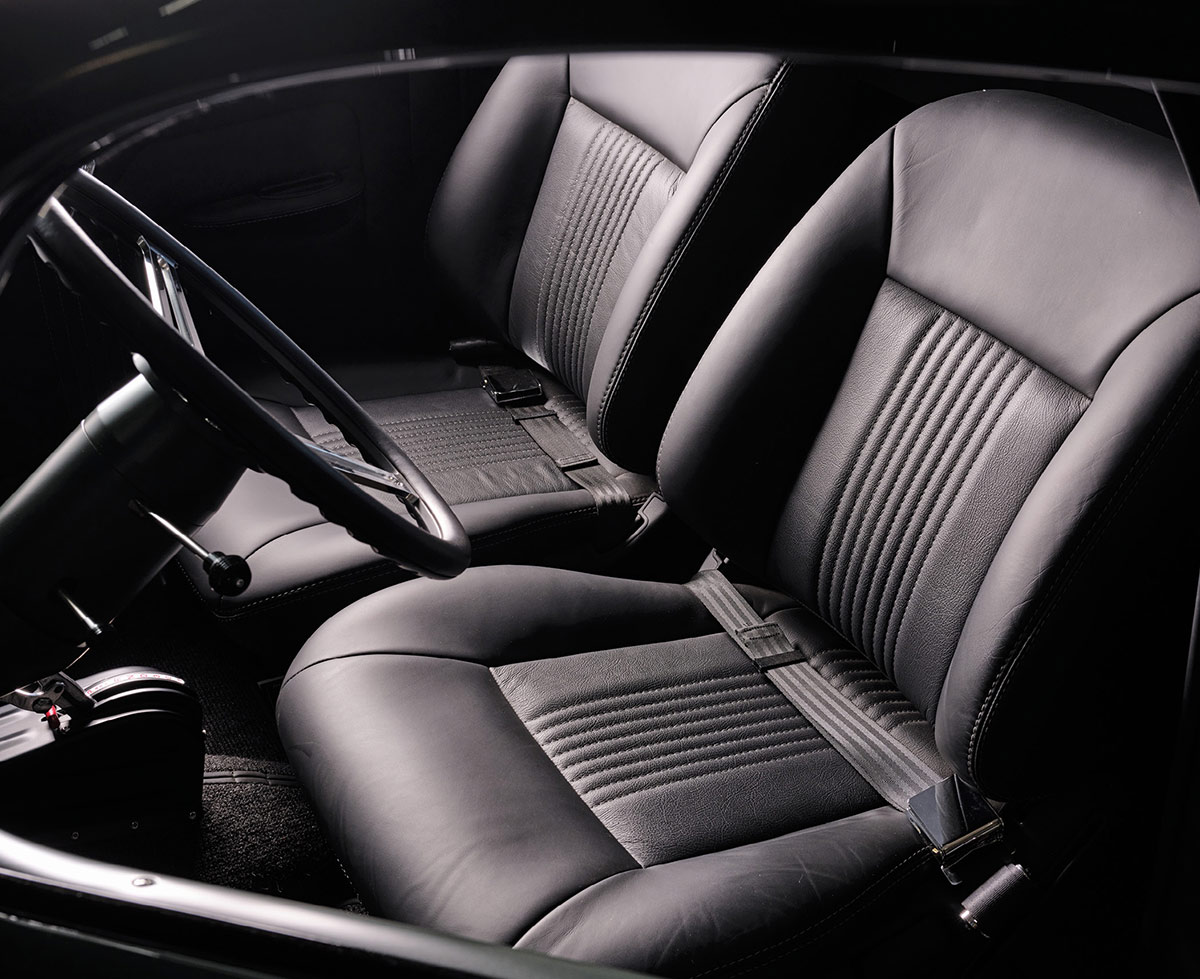
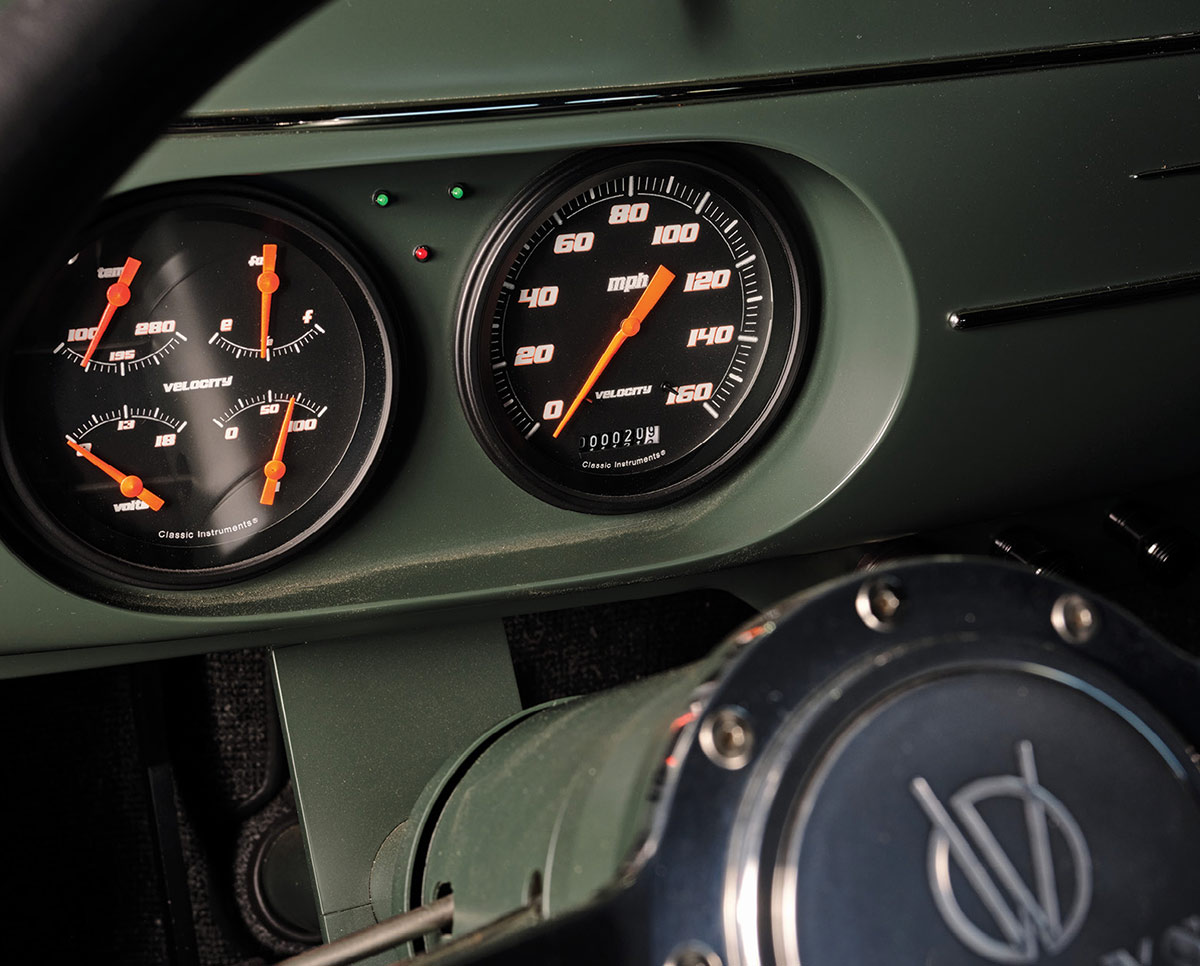
Inside the firewall, the original has been modified and filled with a pair of Velocity (large-dial) Classic Instruments. The left-side circular gauge holds four mini-instruments (water, fuel, volt, oil pressure), while the right-side gauge is a 160-mph speedo. The required wiring is handled by a Ron Francis Wiring system and was completed by ER&C’s own Ben Greif and Mike Ernster, who also handled an assortment of mechanical chores. Also attached to the dash is an Ididit steering column with a Billet Specialties slotted three-spoke wheel. A pair of late-model Pontiac Grand Am buckets are used, now recovered in dark charcoal gray leather and suede by Dave Schober of Schobers Custom Hot Rod Interiors. Schobers also did the kick and door panels as well as the headliner.

While we have seen this 1941 Willys coupe at many events, it is always a showstopper and sure to draw plenty of hot rodders to stop and stare. It may not be built in the traditional vein of a 1941 Willys coupe, but it fits nicely into how hot rods are perceived today. It does take some getting used to seeing a classic hot rod like this Willys without the blower sticking through the hood.
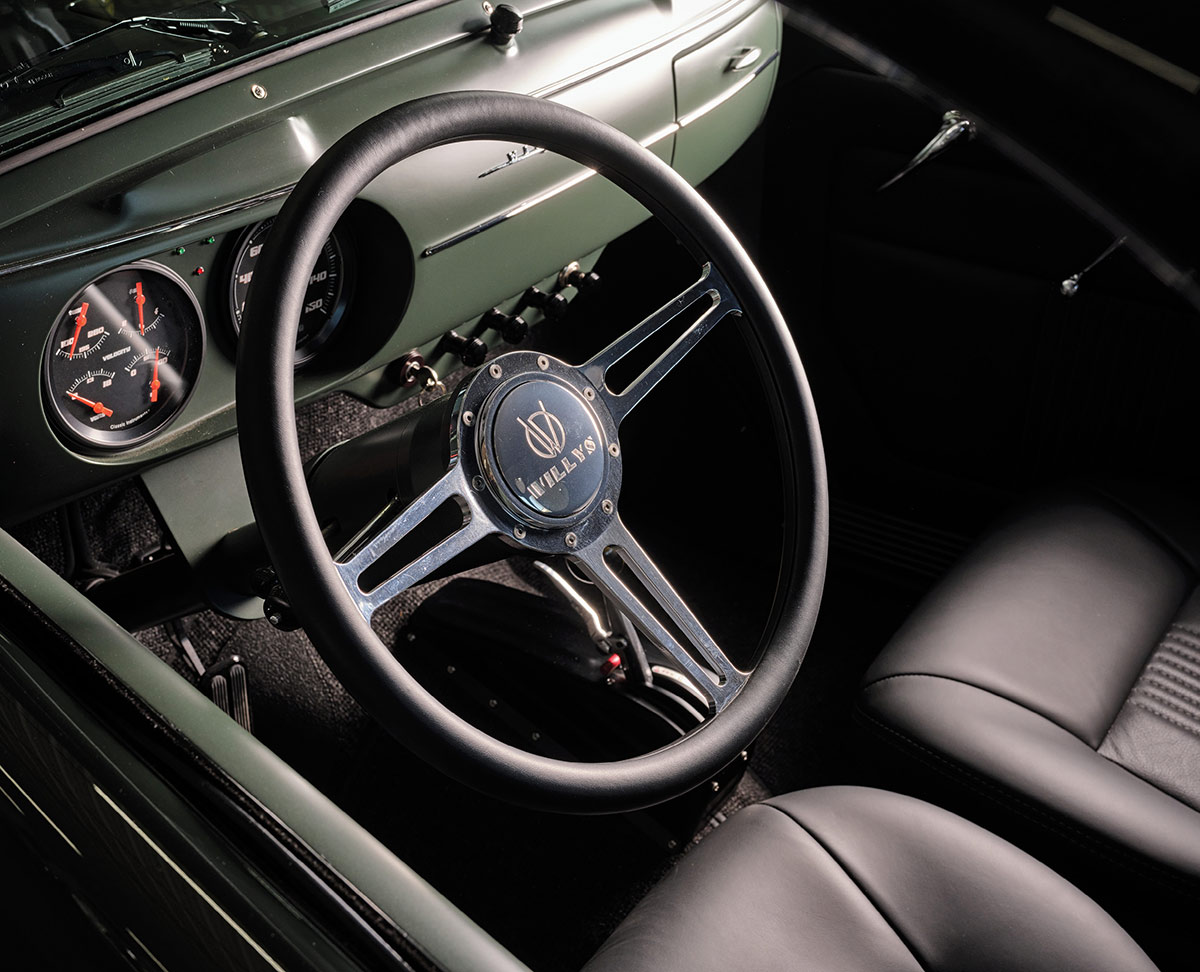
Interior view with steering wheel and custom dashboard
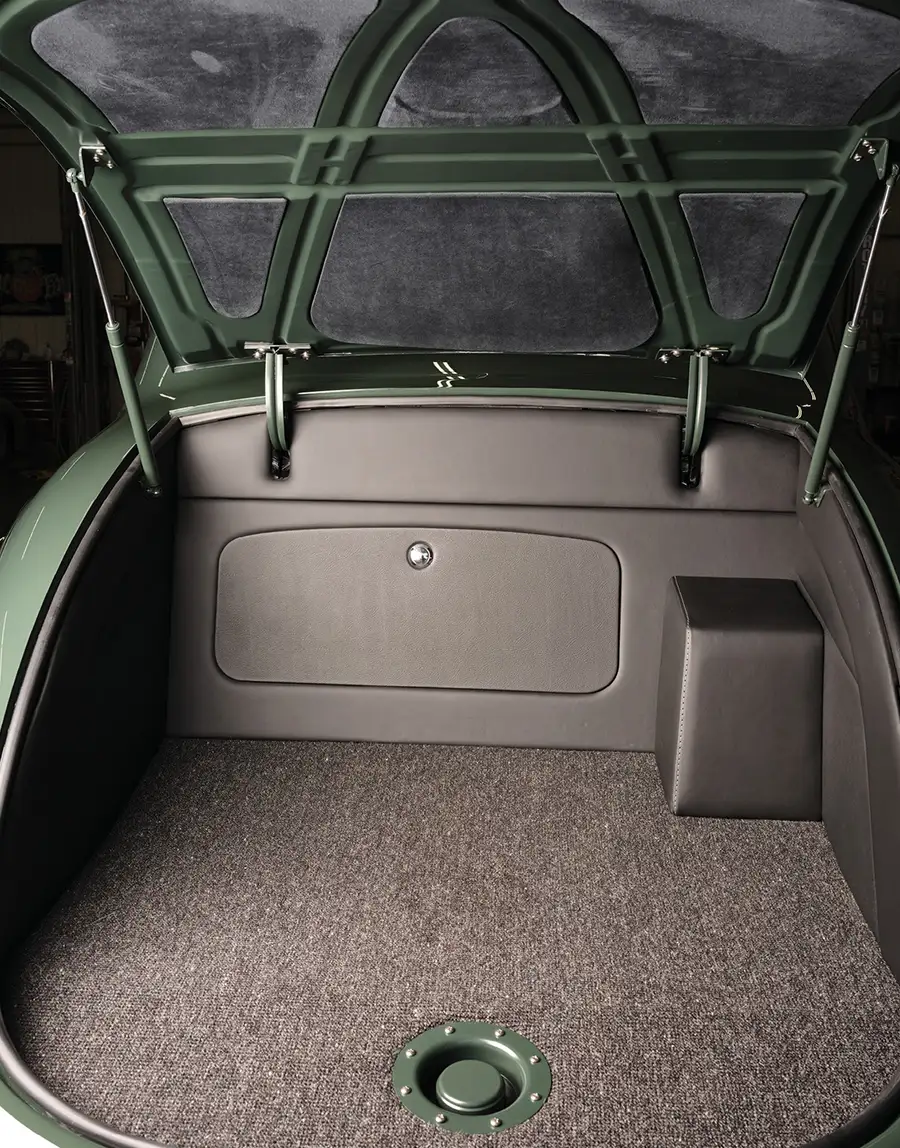
Fully upholstered trunk area with recessed fuel cap
Custom charcoal gray leather bucket seats
Velocity series gauges in a custom dashboard
Floor-mounted B&M shifter with custom knob
Modern Rodding
VOLUME 7 • ISSUE 73 • 2026