


Modern Rodding Tech
Sound Engineering
1932 Ford Roadster yellow hot rod inside performance shop during stereo system installation
1. Roadster owners deserve great sound systems, too. Alan Hickman, owner of the Audio Shoppe, prepares to install state-of-the-art Arc Audio stereo components in a recently completed 1932 Ford highboy.
Sound Engineering
Giving a Hot Rod a Tune-Up
By Ron Ceridono Photography by Brian Brennan
S

ince its inception, hot rodding has been about performance. We modify our cars for various reasons, installing components to make them go faster, stop quicker, or corner more confidently—all to make driving more enjoyable. Of course, another way to achieve that goal is by listening to your favorite tunes on the road. That’s why hot rodders from across the country turn to Alan Hickman at the Audio Shoppe for a custom sound system.

Like any professional engine or chassis builder, Hickman selects the best components for the application when installing stereo components. In the newly built 1932 Ford roadster shown here, the speakers and amplifier are from ARC Audio.

Up front, Hickman installed a pair of ARC Audio coaxial speakers in the highboy’s kick panels. The term coaxial is common in audio terminology for what is essentially two speakers in one unit. This design features a woofer cone with a separate tweeter, providing full-range sound quality and better frequency coverage than single-cone speakers.

For the kind of sound that satisfies any audiophile, Hickman installed a pair of ARC Audio 8-inch subwoofers in an enclosure behind the driver seat. Subwoofers respond to frequencies below the range of traditional speakers, which produces that deep, bass sound. Placing subwoofers in an enclosure increases the air pressure the subwoofer creates, which we perceive as sound. Without an enclosure, the sound waves from the back of the subwoofer cancel out those from the front, killing the bass.

A term often heard in relation to speakers is impedance, which is the speaker’s resistance to current measured in ohms. In simple terms, speakers with lower impedance can draw more current, resulting in louder sound. For example, an 8-ohm speaker will need more power to produce the same sound level as a 4-ohm speaker. The key is to match components, meaning the amplifier and the speakers should be compatible. A unique feature of the ARC Audio X2 600.4 amplifier is its adjustability. Each pair of channels includes a load control switch that can be set to accommodate speakers with a total combined impedance between 2 and 4 ohms (not lower than 2 ohms), with a second setting for combined impedance over 4 ohms.

At the center of the system shown here is an ARC Audio amplifier. It acts like a supercharger for stereo systems, boosting the signal from the source to power speakers and subwoofers—power that most car stereos can’t deliver. Additionally, amplifiers improve sound quality and reduce noise and distortion thanks to advanced electronics.

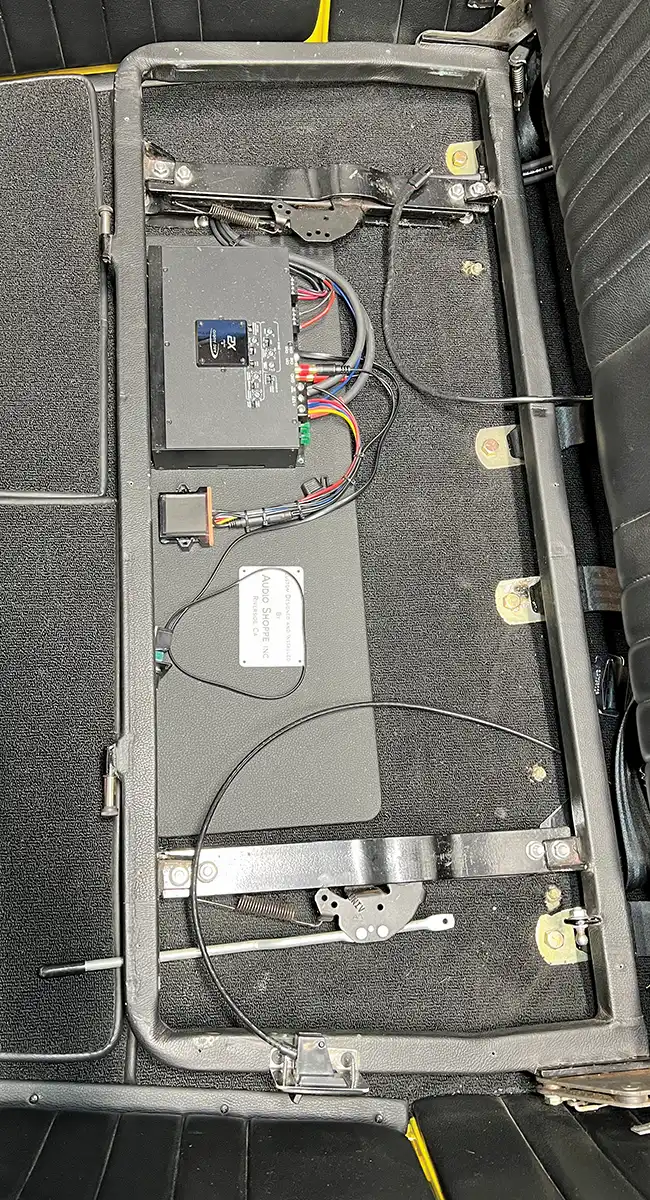
Something that seems to be missing from this system is an obvious source of music. There’s no radio, tape deck, or CD player simply because none of them are needed. Hidden away under the seat is a small Bluetooth module. It receives a signal from any compatible device, like a cell phone, that has recorded audio. The module connects to the amplifier, which in turn feeds the speakers, creating a clean, unobtrusive sound system.

For gearheads, there’s nothing more enjoyable than cruising in a hot rod. The only thing that could make it better is being able to hear your favorite tunes while doing it, and as we’ve shown here, it’s simple to “tune” up your hot rod with some sound engineering.
1932 Ford Roadster under seat amplifier and wiring layout for custom stereo system installation
2. Except for the speakers, the necessary electronic components for the roadster’s sound system were hidden under the seat.
1932 Ford Roadster ARC Audio amplifier wiring connections with power ground and RCA audio cables
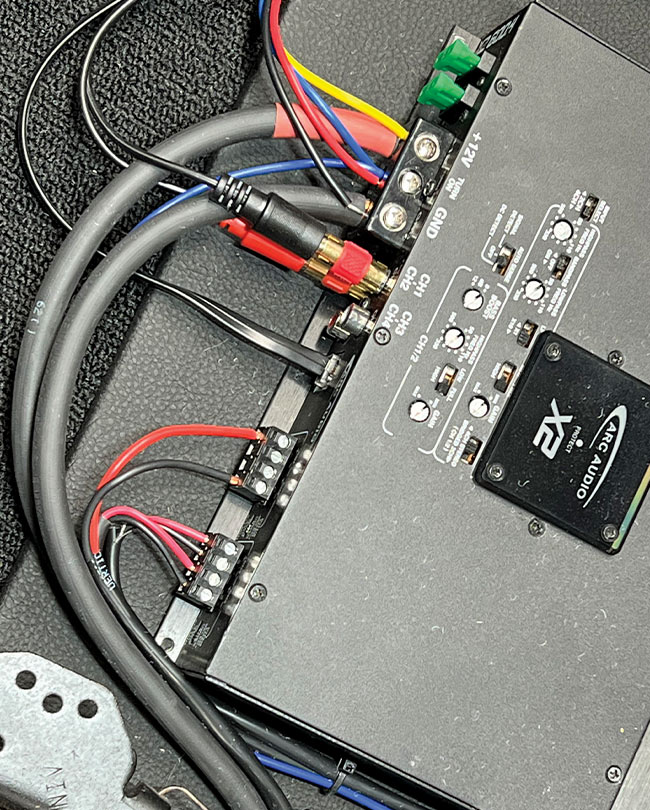
3. The ARC Audio X2 600.4 is a fan-cooled, four-channel amplifier. Notice the two large black wires; they are pure copper power and ground conductors connected directly to the battery. The amplifier is turned on and off by the ignition switch, which controls an internal relay.
1932 Ford Roadster stereo system control module and wiring harness mounted under seat
4. On the right is the wireless Bluetooth module and on the left is the subwoofer level control.
1932 Ford Roadster ARC Audio X2 5.25 inch coaxial speakers with mounting ring and grille
5. Hickman ARC Audio X2, 5.25-inch coaxial speakers for the passenger compartment.
1932 Ford Roadster interior panel with sound insulation and speaker wiring preparation
6. To ensure the clearest sound quality, Hickman placed foam behind the kick panel–mounted speakers to absorb the “back wave” (the sound that’s generated on the back side of the speaker) so it can’t be heard.
1932 Ford Roadster door panel speaker opening with wiring prepared for audio installation
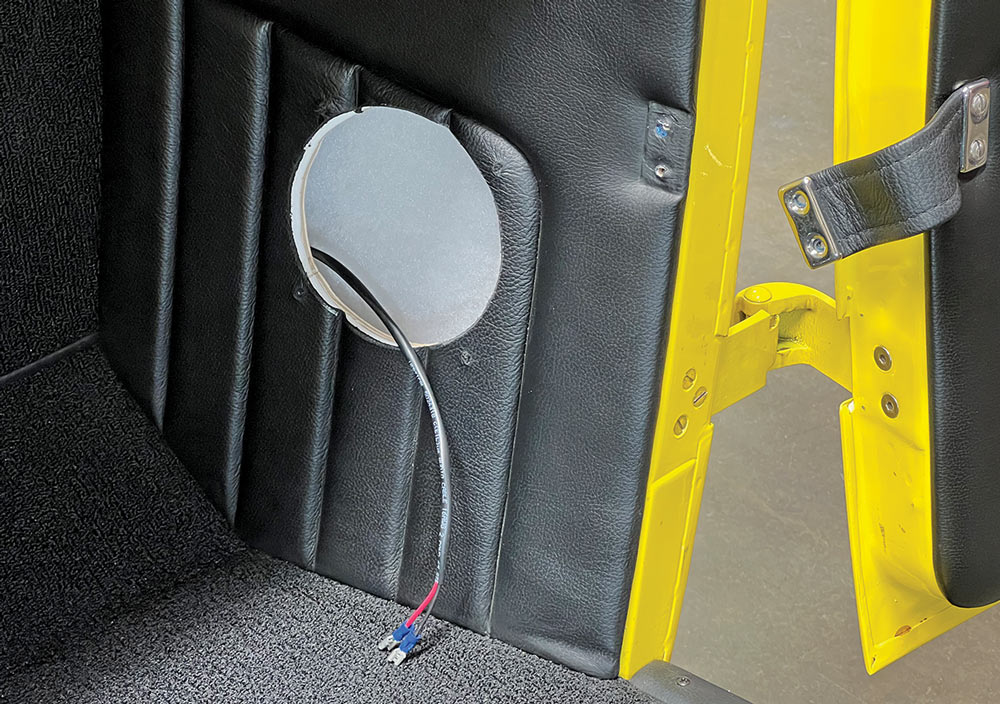
7. With the foam installed, holes for the speakers were carefully cut in the upholstery panel. Since this requires precision, a hole template is included with the speaker.
1932 Ford Roadster ARC Audio X2 502 speaker mounted in custom door panel enclosure
8. Another important consideration is securing the speaker to the panel to prevent vibration. Hickman used screws and nuts to fasten the speakers to the Luan (1/8- to 1/4-inch lightweight and flexible plywood) backing of the kick panels.
1932 Ford Roadster ARC Audio speaker wiring terminals with red and black audio leads
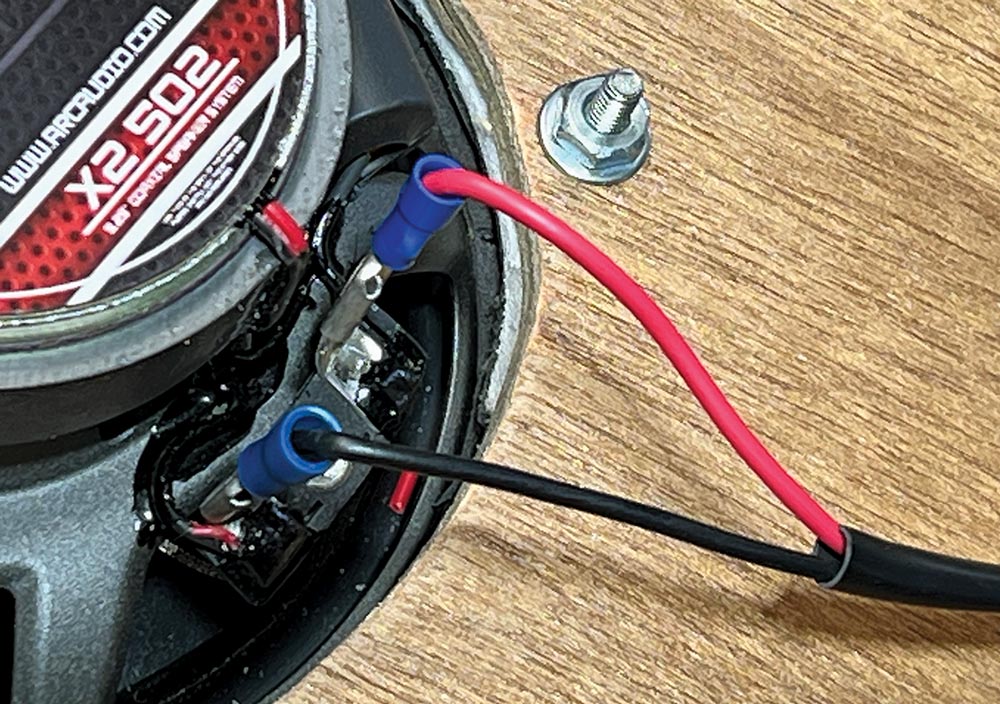
9. To verify the speakers were connected correctly, red and black wires were used so the speaker input and amplifier output polarities could be identified and matched.
1932 Ford Roadster finished door panel with installed round speaker grille and custom interior trim
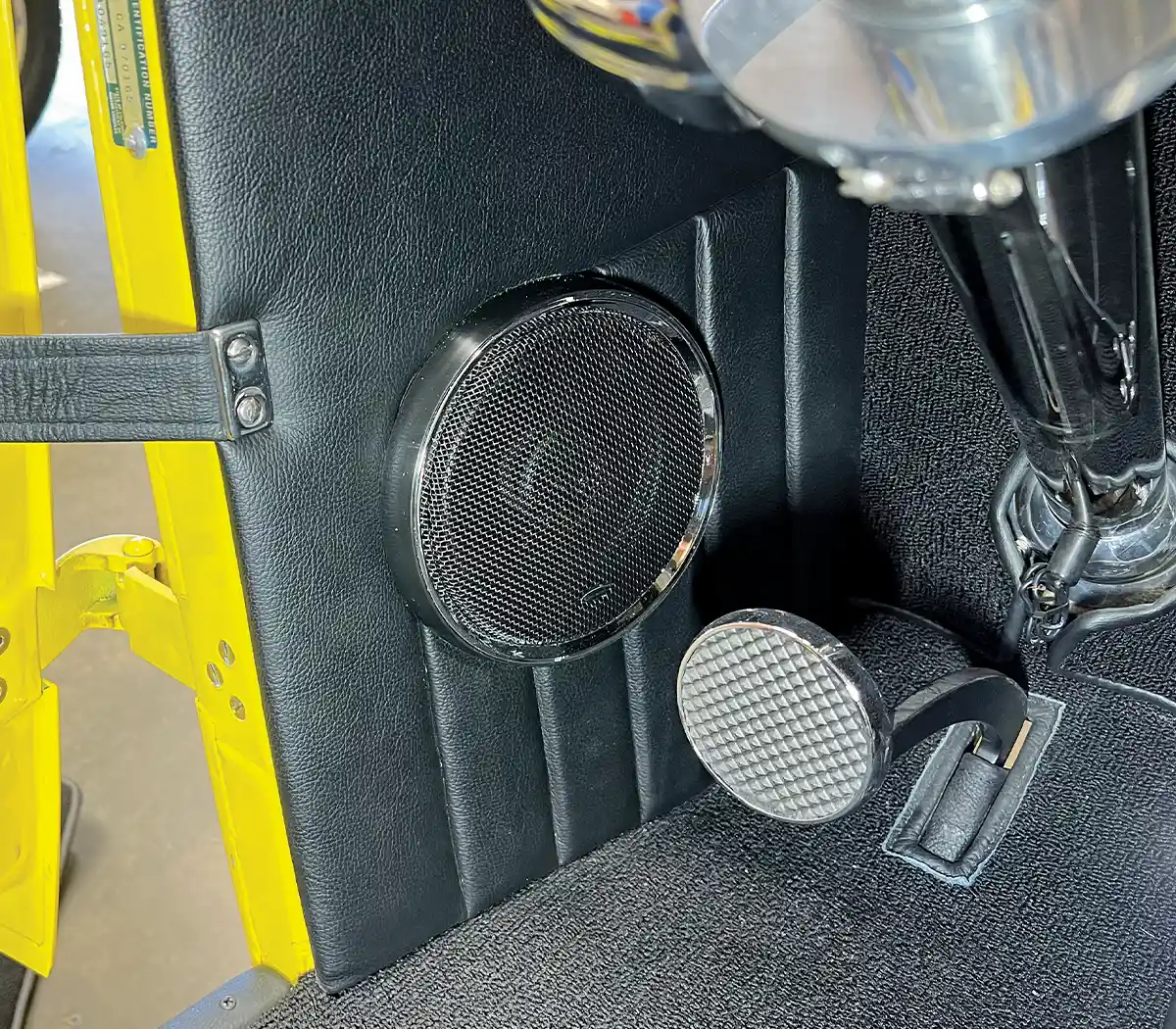
10. The installed front speakers look clean and unobtrusive. With the coaxial speakers combined with subwoofers, the sound quality is excellent.
1932 Ford Roadster custom dual subwoofer enclosure with wiring prepared for trunk stereo installation
11. Hickman built the enclosure to hold a pair of ARC Audio subwoofers, shown here from the bottom.
1932 Ford Roadster trunk interior with battery box and carpet ready for subwoofer enclosure installation
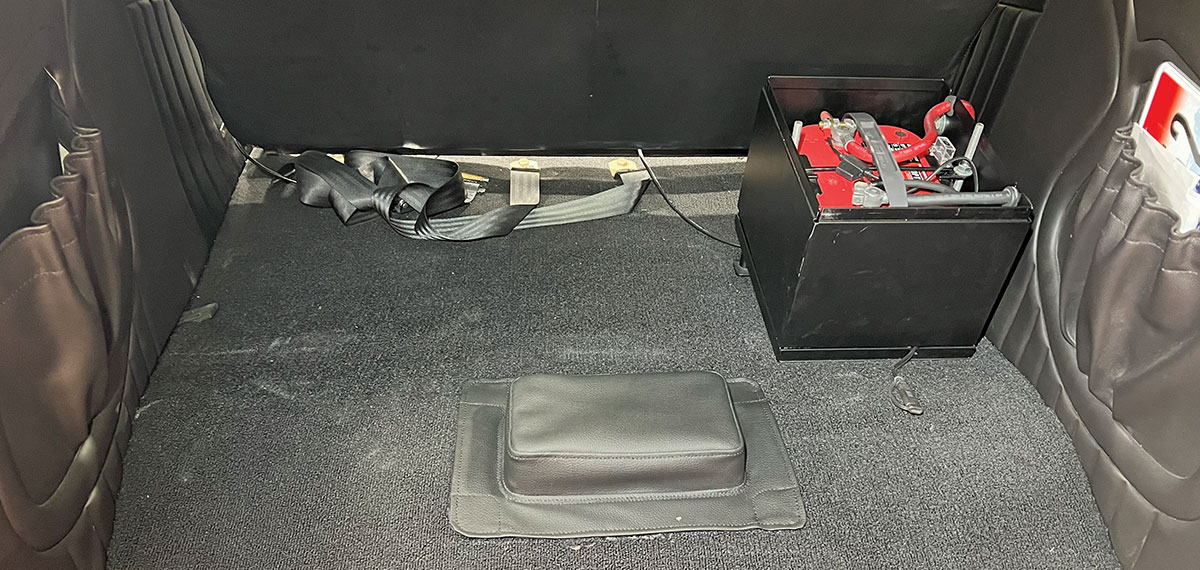
12. Since space was limited, Hickman had to build a subwoofer enclosure that fits directly behind the seat and snugly against the battery box.
1932 Ford Roadster ARC Audio subwoofer driver used for custom hot rod stereo system
13. Housed in the enclosure are two Arc Audio ARC-8 subwoofers. These high-end, 8-inch speakers have a peak power capacity of 300 watts.
1932 Ford Roadster ARC Audio subwoofer terminals showing positive and negative speaker wire connections
14. Making a good connection to the ARC Audio subwoofer is easy with the spring-loaded terminals that securely hold the wire.
1932 Ford Roadster dual ARC Audio subwoofers wired in parallel for custom stereo installation
15. ARC Audio’s subwoofers have dual voice coils. Note the jumper wire connecting the plus (red) and minus (black) terminals, which means the coils are connected in series while the speakers are wired in parallel.
1932 Ford Roadster ARC Audio subwoofer with large magnet assembly for high performance car audio
16. Properly wiring the subwoofers is essential to avoid damage to very sensitive and costly components. For those lacking Hickman’s expertise, ARC Audio provides detailed instructions on connection options.
1932 Ford Roadster subwoofer mounting gasket installed on speaker frame for sealed enclosure fit
17. Sealing the subwoofers to the enclosure is achieved by adding a rubber gasket to the speaker’s mounting flange.
1932 Ford Roadster dual ARC Audio subwoofers installed in custom upholstered enclosure
18. Here, the gasket has been installed on one speaker. Note that the number of mounting holes on the flange is equal to the number used to prevent the speaker’s frame from vibrating.
1932 Ford Roadster finished dual subwoofer box ready for installation in hot rod trunk
19. This is the subwoofer enclosure with the speakers installed. Arc Audio provides guidelines for the size of enclosures to ensure the best sound quality.
1932 Ford Roadster subwoofer enclosure internal wiring lead routed through sealed cabinet opening
20. Hickman used Molex connectors so the subwoofer enclosure can be removed if necessary. The same style connectors were also used on the front speakers.
1932 Ford Roadster trunk installing custom dual subwoofer enclosure beside battery box in hot rod interior
21. From the front, the enclosure’s opening, which allows air to escape, is located at the bottom.
1932 Ford Roadster trunk with finished custom upholstered subwoofer enclosure and battery relocation box
22. To match the roadster’s interior, Hickman had the enclosure covered in black vinyl.
1932 Ford Roadster stereo quick disconnect wiring connector for removable subwoofer enclosure
23. The final step in the installation is to connect the Molex two-pin connector from the amplifier.
1932 Ford Roadster ARC Audio X2 amplifier wiring connections with power ground and RCA audio cables installed
24. Like many high-performance engine components, the ARC Audio amplifier has lots of “tuning” options. Careful, incremental adjustments will yield the best results.

Audio Shoppe

Modern Rodding
VOLUME 7 • ISSUE 68 • 2026