
Modern Rodding Tech
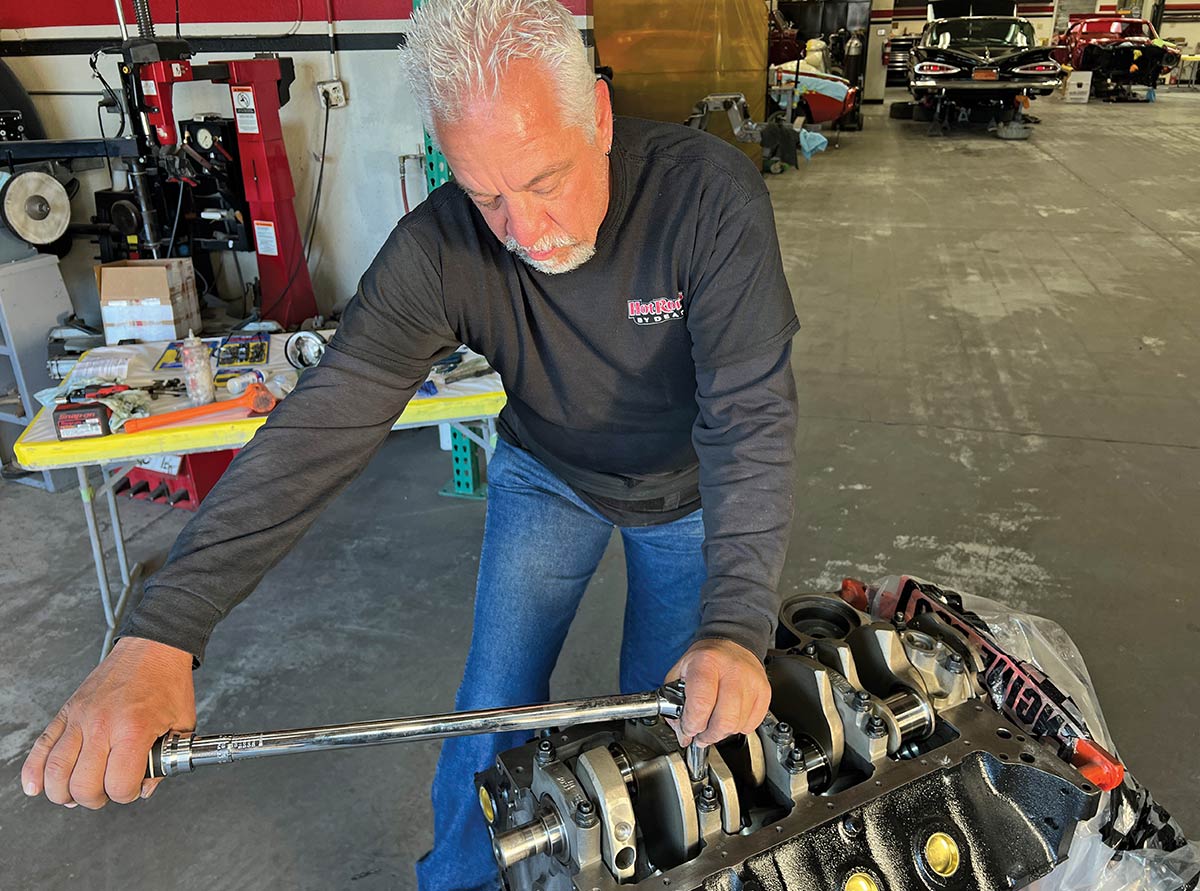
Technician tightening nuts on ARP main engine studs
1. Willey Wray from Hot Rods By Dean tightens the nuts on the ARP main studs of a small-block Chevy (SBC) being assembled for the shop’s race car.
Fascinating Fastener Facts
The Nuts and Bolts of Holding Things Together
By RON CERIDONO Photography by THE AUTHOR, BRIAN BRENNAN & COURTESY OF ARP
F

or those who have been playing with hot rods as long as the editorial staff of Modern Rodding, there are countless tales of woes resulting from youthful ignorance. Take the time a buddy of an unnamed impressionable lad used all-thread to replace two missing main bearing bolts in a Flathead Ford. The results were not pretty. Gary Holzapfel also bore witness to fastener failure; seeing catastrophic failures in various race engines, albeit for far less ridiculous causes than what a clueless kid created. Holzapfel saw a need for quality fasteners and used his aerospace background to create Automotive Racing Products (ARP). Today, ARP’s line of products includes virtually all the fasteners found in an engine or driveline, ranging from high-quality OEM replacement parts to specialty fasteners used in every form of racing on land or water.

One of the reasons for ARP’s success is the complete control of the manufacturing process and the use of the best materials. ARP notes, “The alloys employed in manufacturing fasteners come in various grades; ARP uses only the purest grades, which are superior to commercial and aircraft-quality material. All heat-treating is done in-house (as are all manufacturing operations) to ensure reaching the proper strength level, with special racks used to guarantee precise, even penetration. Threads are rolled (not cut) after the heat-treating process for superior (up to 20 times better) fatigue life.”

When it comes to replacing fasteners, the experts at ARP explain that it’s done for various reasons. Chief among them are age, stress, hydrogen embrittlement, and corrosion. They also point out that critical fasteners like rod bolts stretch a certain amount when the desired torque is reached. Given the number of cycles rod bolts endure, replacing them during a rebuild makes good sense; the same applies to head bolts. ARP has tested nearly every fastener used in popular engines manufactured from the 1950s to the present—even flathead V-8s going back to the ’30s—and has developed high-performance replacements. There are thousands of special kits in ARP’s catalog, all designed to be reused.

Many contemporary engines use torque-to-yield (TTY) fasteners. These fasteners are torqued to a prescribed value then tightened further by turning them a specified number of degrees to stretch them. ARP notes that while TTY fasteners are suitable for OEM applications, additional stress from engine modifications can cause them to fail. For that reason, and because reusing these fasteners is not generally recommended, ARP has developed replacement bolt kits for engines with TTY fasteners, each with application-specific torque specs.

A common question asked of ARP’s factory tech representatives is, “Which are better, bolts or studs?” The answer is, “It all depends on the application.” For stock to mildly modified street engines, ARP head bolts are more than adequate. Once the argument for bolts over studs was that for street-driven vehicles with many accessories in a tight engine bay bolts made it easier to remove the cylinder heads with the engine in the car. However, ARP studs are hex broached on the ends, making them just as easy to remove as bolts, so there’s no real downside to using them. Additionally, studs offer several advantages—they simplify head and main cap installation and, in performance applications, provide more consistent torque loading. As the ARP tech guys explain, “When you use bolts, the fastener is actually being ‘twisted’ while it’s being torqued to the proper reading. Accordingly, the bolt is reacting to two different forces simultaneously.” When a stud is properly installed (hand-tight), as the nut is torqued, the stud will stretch only along the vertical axis, thereby applying an even clamping force.

ARP emphasizes the importance of properly tightening fasteners of all types. They note that general torque recommendations are only guidelines; following the specific torque instructions provided is essential. Another key factor when torquing fasteners is the use of appropriate lubricants. Using oil, moly, and common assembly lubricants can lead to what’s called “preload scatter,” which means different torque amounts on adjacent fasteners.

ARP’s Ultra-Torque provides consistent and repeatable torque readings during assembly and helps prevent corrosion. Since head gaskets may compress during installation, always consult the gasket manufacturer to determine if retorquing is necessary.

When it comes to torque specifications for rod bolts, they are critical. ARP tells us a typical 3/8-inch small-block Chevy rod bolt must be stretched between 0.0055 and 0.0060 inch to achieve the approximately 10,000 pounds of preload required. Of course, the most accurate way to measure that is with a stretch gauge, which is usually only found in high-end race shops. As a result, in most cases, a torque wrench becomes the tool of choice when tightening rod bolts, which requires some consideration. First and foremost, a proper lubricant must be used; ARP specifies Ultra-Torque. Second, it’s essential to follow the rod bolt stretch/torque specifications provided with the bolts (found in the ARP catalog). Third, ensuring the torque wrench is accurate is important. Maintaining accuracy involves returning the torque wrench to 0 after use and never using it as a breaker bar to remove fasteners.

Along with all their high-performance fasteners, ARP also offers show-quality engine and accessory fastener kits for all popular engines. Virtually everything you need is labeled and organized in one convenient package. Kits are available in black oxide finish chromoly steel or polished stainless; both are available with hex or 12-point heads.

In addition to engine kits, ARP offers bolts in packages of 5 in standard sizes from #10 to 1/2 inch and metric sizes from M6 to M12; matching nuts and washers are also available. When it comes to holding your hot rod’s engine, driveline, and suspension together, ARP has all the nuts and bolts it will take.

Various high-performance engine fasteners including rod bolts
2. ARP offers every conceivable fastener for high-performance applications. Destined for the SBC Wray is assembling are a balancer bolt and washer, rod bolts, and a high-volume oil pump stud.
Cleaning engine block threaded holes with a tap
3. Prior to assembly, threaded holes must be cleaned, as any residue can affect torque accuracy. However, using a standard tap is not the right way to do it.
Assortment of ARP thread cleaning chaser tap tools
4. ARP’s thread cleaning chaser taps are designed to clean existing threads, not to cut new ones. They have the correct thread pitch and diameter to clean dirty blind or through holes. They are available in both U.S. and metric sizes.
Wiping down an engine fastener with a cloth
5. To ensure proper torque values, clean fasteners before applying ARP’s assembly lube or thread locker. Use a solvent or another non-oily cleaner; diesel fuel isn’t recommended.
Installing main studs hand-tight into an engine block
6. After cleaning and chasing the threads, the main studs are installed “hand tight” only (the hex on the end of the stud is there to make installation easy). Thread locker may be used for permanent mounting, if preferred.
Applying Ultra-Torque assembly lubricant to main cap threads
7. ARP Ultra-Torque lubricant is included with stud kits. After installing the main caps and verifying alignment, assembly lube is applied to the threads.
High-strength flanged nut and washer for engine main studs
8. The SBC main stud kit shown here includes high-strength washers and flanged nuts.
Lubricated engine washers and flanged nuts on a block
9. In addition to the threads, the washers and the nut’s flanges are lubricated with Ultra-Torque. Never use motor oil as a lubricant, as it can cause inconsistent torque wrench readings, leading to uneven clamping forces.
Packaging for application-specific ARP rod bolt kits
10. ARP rod bolts are application-specific. This can be an issue with some aftermarket SBC 383 engine kits, depending on the rods used. The shorter 400 rods use bolts PN 134-6002; the longer bolts for 350 rods (which are often preferred) use bolts PN 134-6003.
Side-by-side comparison of 350 and 400 rod bolts
11. Here’s a comparison of SBC rod bolts: a 350-rod bolt (top) and the shorter 400 bolt below.
Engine connecting rod with high-performance ARP rod bolts
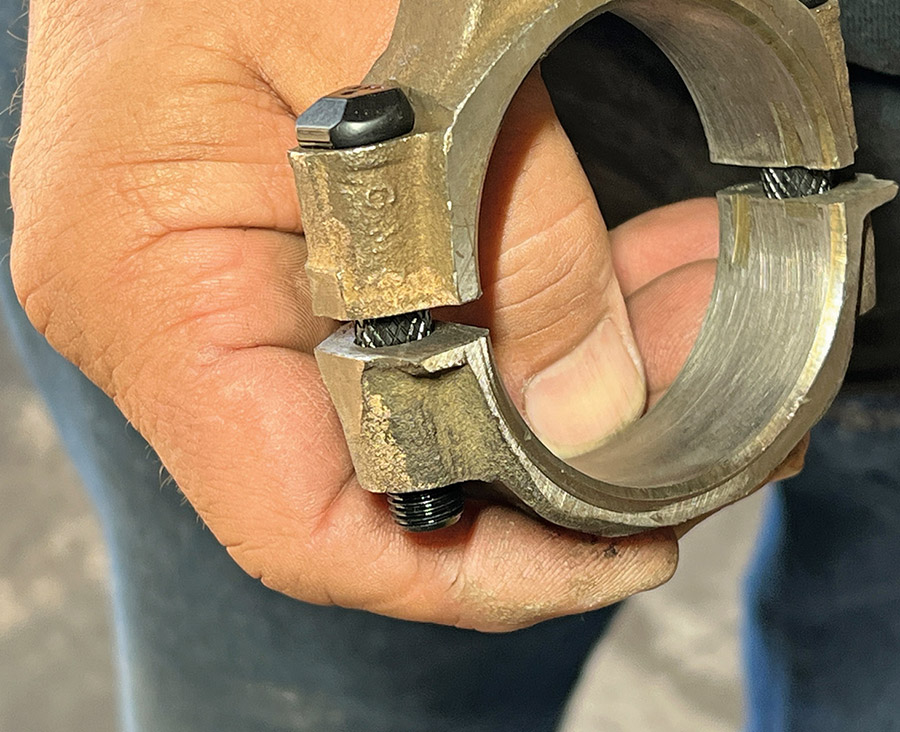
12. Arguably the most important fasteners in an engine are the rod bolts. Whether assembling a stock or high-performance engine, ARP rod bolts are a cost-effective way to prevent catastrophic failure.
Close-up detail of installed engine connecting rod bolts
13. For their drag race 383 small-block, Wray installed ARP’s high-performance rod bolts; they’re five times stronger than OEM bolts. ARP also offers OEM-style Wave-Loc and Pro Series rod bolts for extreme applications, as well as bolts for aftermarket rods.
Measuring rod bolt preload with a precision stretch gauge
14. Admittedly not something typically used in standard engine builds, ARP offers precision bolt stretch gauges that indicate the correct preload of rod bolts during installation.
Polished 12-point bolt for engine flywheel and flexplate
15. ARP’s flywheel and flexplate bolts come in two series—High Performance and Pro. Both are forged from aerospace alloy and heat-treated, featuring rolled threads and 12-point heads.
Comparing larger ARP flywheel bolt shank to OEM version
16. For increased strength and more precise registration, ARP’s flywheel bolts feature larger-diameter shanks than OEM bolts. Lock washers are not used, and if thread locking compound is applied, the fasteners should be torqued before it hardens.
Boxed kit of ARP High Performance Series head bolts
17. For those who prefer head bolts over studs, ARP offers their High Performance Series for a wide range of engines (shown is for a 409 Chevy). They also have the Pro Series and Stainless Series for selected extreme performance applications.
Detail of a chamfered parallel ground engine washer
18. The parallel ground washers included with head bolt kits are chamfered on one side. They should be installed with the chamfered side facing the bolt head.
Fastener assembly lubricant and thread sealer for engine builds
19. ARP’s Ultra-Torque is the recommended lubricant for obtaining accurate torque wrench readings during assembly, while ARP thread sealer is used for fasteners that penetrate water jackets to prevent leaks.
Installed head bolts with 12-point flanged head design
20. Our 348 is equipped with ARP High Performance Series head bolts. They are available with reduced hex or 12-point flanged heads, which eliminate the need for valvetrain removal if retorquing the heads is necessary.
Using a digital torque wrench for precise bolt tightening
21. Regardless of the fasteners used, torque wrench accuracy is essential. If there’s any doubt, calibration services are easily accessible. A click-style torque wrench can be calibrated for as little as $50.
Set of engine head studs with 12-point nuts
22. ARP offers head studs for all popular engines; most come with 12-point or hex nuts and washers. For Flathead Ford fans, they’re available with forged, polished stainless steel acorn nuts.
Replacement stud kit for Chrysler Hemi TTY head bolts
23. This is an ARP stud kit designed to replace the torque-to-yield (TTY) head bolts used on 5.7 Chrysler Hemi engines. Kits are available for most engines with TTY fasteners.
Engine block with installed high-strength cylinder head studs
24. Head studs should be installed hand tight, with the nuts torqued to the specified values. When installing nuts on head studs, always apply Ultra-Torque to the stud’s threads and the underside of the nut’s flange.
Close-up of effective cylinder head sealing using studs
25. The key to effective sealing is following the specifications outlined in the instruction sheets. ARP recommends reaching the desired preload in three equal steps. For example, go to 25 and 50 pounds before reaching 75 pounds.
Various bolt head configurations including hex and socket heads
26. Bolts come in various configurations—hex head, socket head, and reduced head with six and 12 points. The latter two are often included in ARP engine accessory kits; they allow more space for a wrench in restricted spaces like those found on intake manifolds.
Stainless steel fastener coated in protective antiseize compound
27. When stainless steel fasteners are used, they must be coated with antiseize compound to prevent galling, which can damage the threads.
Compact ARP 12-point nut in a restricted engine space
28. Besides looking cool, the advantages of ARP 12-point nuts are that they fit in smaller spaces, can withstand high torque values due to the 12-point heads, and are tough with a tensile strength rating of 180,000 psi.
Stainless steel starter bolts featuring knurled shanks
29. Along with all the other engine accessory fasteners, ARP offers stainless steel starter bolts. They have knurled shanks for starter stability, small-diameter heads for easier access in tight spaces, and come with washers where needed.
Complete engine accessory fastener kit organized in packaging
30. The finishing touch for any engine is an ARP accessory fastener kit. Available for many popular applications, these kits include all the necessary fasteners to attach components and accessories to the engine.

Modern Rodding
VOLUME 7 • ISSUE 68 • 2026