

 Photography by Jason Matthew
he 1968 Plymouth Valiant was part of Chrysler’s A-body platform, which was introduced in the early 1960s. It is fast becoming a great starting point for a modern hot rod, especially the Mopar crowd. Given the potent powerplants that are available today for various Chrysler hot rods, it’s no wonder the Valiant, and more so the 1968 model, is a great platform to begin with. The Valiant’s transformation over the years—from a reliable family car to a platform for performance builds, such as with the Hellcat engine—illustrates this classic model’s versatility and enduring appeal. That brings us to Steven Shepard’s, Mount Sinai, New York, 1968 Valiant. Complete with a supercharged Hellcat that pumps out 700-plus horsepower to the rear wheels, it’s an accurate measure of today’s hot rod potency.

There is no getting around the fact that the Dodge Challenger Hellcat crate engine (PN 68303089AC), all 6.2 supercharged liters, packs all of the prerequisite punch a modern-day hot rod requires. The 2016 Dodge Challenger Hellcat is a supercharged 6.2L Hemi V-8 engine used in the Valiant. The factory compression ratio is 9.5:1, with horsepower ratings between 707-717 at 6,000 rpm. This is achieved using intake valves measuring 2.140 inches and exhaust valves measuring 1.655 inches. The supercharger boost, combined with the compression ratio 9.5:1 gives the Hellcat motor an effective compression ratio of over 14:1. This robust powerplant generates an impressive 707-plus horsepower and 650 lb-ft of torque in its stock form, but with custom exhaust made from TTi Performance Exhaust and Headers in the form of long-tube headers with 2-inch primary pipes, full 3-inch custom exhaust with an X-pipe, and a pair of Flowmaster mufflers help to bump the power up to the current RWHP readings. Other engine accessories include a pair of SPAL electric fans and a trunk-mounted Optima RedTop battery. All the electric and computer engines are factory Hellcat components.

The 1968 Valiant is based on a unibody construction, but the suspension is upgraded with a USCT Motorsports core support stiffener to tie the front framerails together. Steve also used QA1 tubular front crossmember and front sway bar, Magnum Force 2-inch dropped front spindles, and Calvert Racing 90/10 shocks. (These shocks are for straight-line acceleration, not daily highway cruising.) The front steering is based on a Borgeson quick-ratio box and a Flaming River steering column. He also used Hotchkis frame connectors, something ideal for unibody cars.


We have all come to know the body as a Mopar A-body, a 1968 Plymouth Valiant, but this one has a staggering amount of power. The quarter-panels are Dart while the side moldings have been removed. A modified firewall and tunnel, a custom steel hood outfitted with a nifty scoop, and 3-inch custom wheeltubs were also installed. The bodywork and the subsequent paint come from the efforts of Steve and his dad, who sprayed on the PPG Concept DCC in White while the hood is painted in black and then covered with PPG Global Matte Clearcoat (D8115).


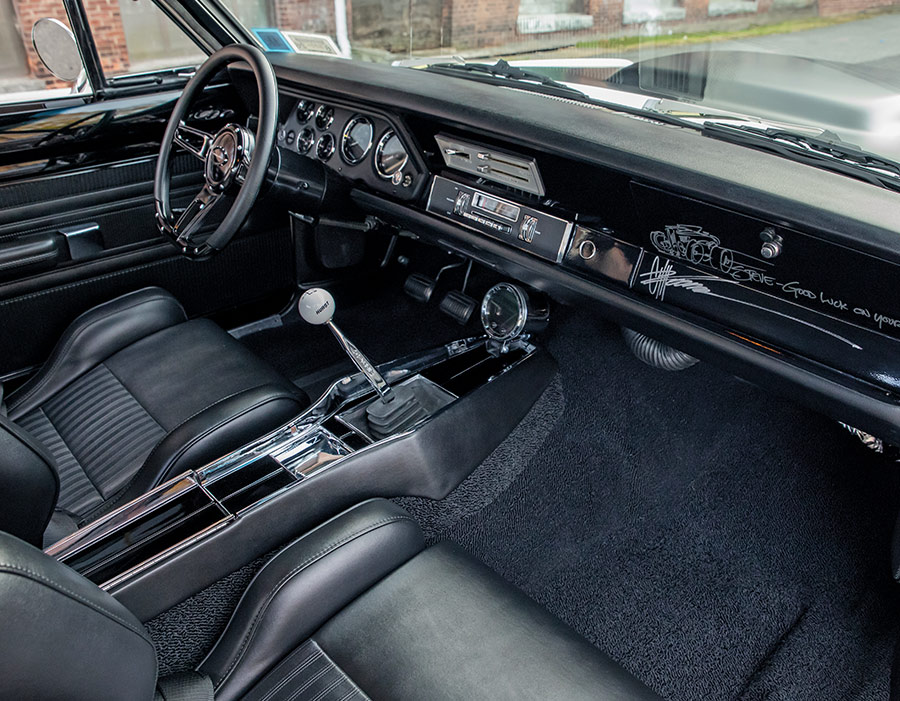
The twin buckets are from the aftermarket. Corbeau buckets are wrapped in vinyl as an original seat might have and feature a four-point restraint system. The rear seat is the factory bench, neatly tucked beneath the single-loop rollbar. All the stitchwork was handled by Miller Place Auto Upholstery (specializing in giving cars their original factory look), which did the seating, the factory headliner, carpeting, and all the panels.
All good things in time. This 1968 Plymouth Valiant has come a long way from its original purpose. Now packed with modern Hellcat power, it’s best to look closely when this hot rod pulls up. It’s much more than you anticipated.