

 Photography by NotStock Photography
isten to Nathan Curry of Missouri; he will tell you what you must know about his chopped and channeled 1928 Ford sedan. “I wanted something unique. My goal was to build as much as I could so no one else would have the same thing. It was a father-son-son-fiancé project with my dad, Tony Curry, my 15-year-old son Cam, and my fiancé Stevie Varney. We started with a one-off designed frame and from here we did everything for this car except build the motor and do the upholstery.”

The six-year project came together, and the “family affair” is a true example of working shoulder-to-shoulder, handling a great deal of the build, such as the metal fabrication, body- and paintwork, artwork, assembly, and more. All that was left to the outside world was the engine build and the interior.
Having found the Model A body in a field, Nathan purchased it and brought it home. The goal was a fun project for the family to do “burnouts” and drive around. However, all that changed when the opportunity arose to have the hot rod at the SEMA Show. Suddenly, the project got “real serious.” Nathan didn’t want something that might be a “different” version of what others would have, so he and the family built this unique example of hot rodding.
It should be noted that Tony Curry owns a hot rod shop called Show Me Rod & Custom, while his son, Nathan, is a custom painter (airbrush artist) who works under the same roof. This is more than a “marriage” of convenience; having each geographically close to one another made for a more mutually invested project, giving the father and son time to enjoy each other’s talents and ideas.

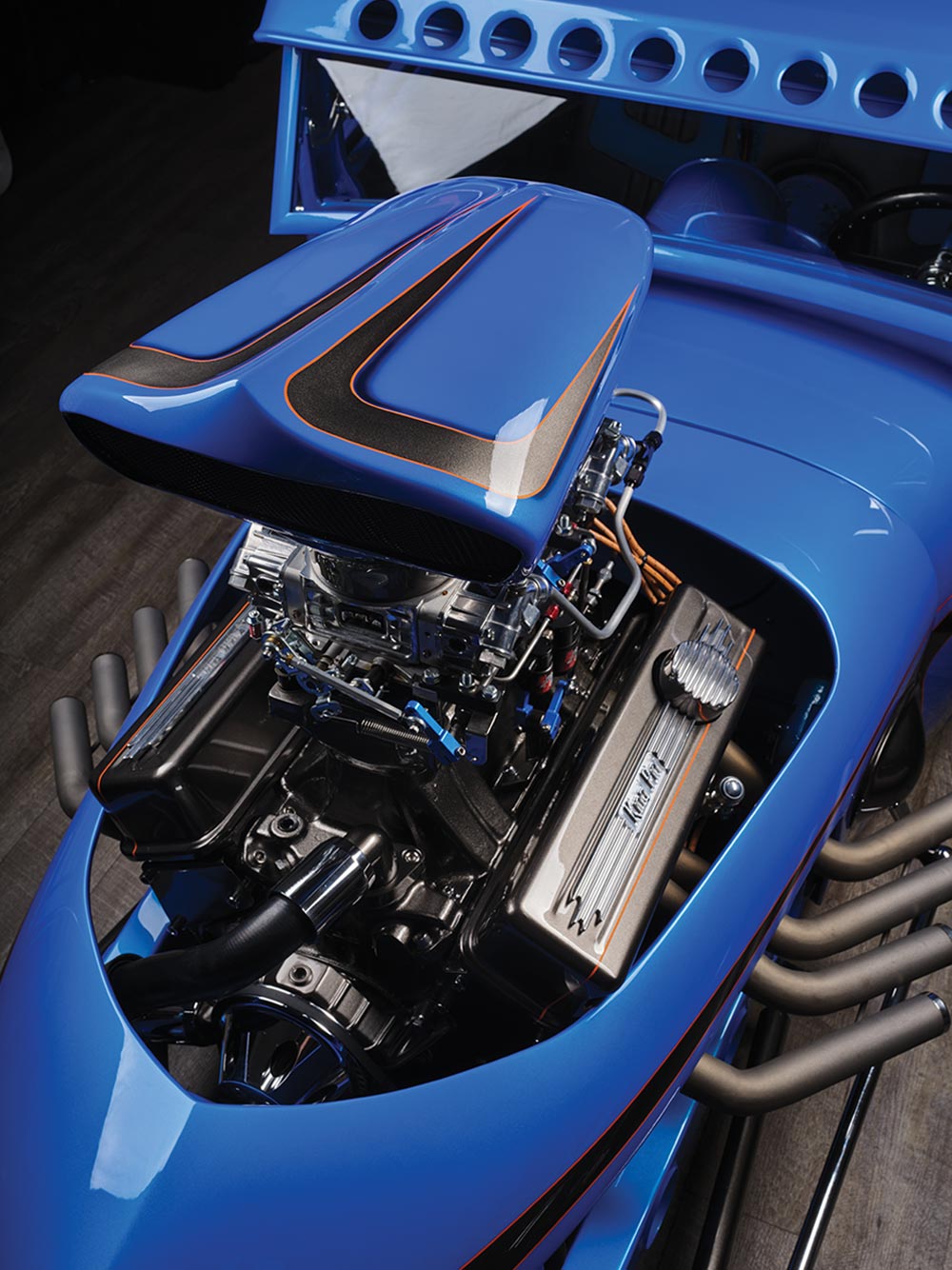
Resting on the small-block Chevy is a tunnel ram with a pair of Holley 750-cfm four-barrels fed through an electric fuel pump and covered by more Nathan handwork in the custom air cleaners. To ensure that the fuel load is amply “charged,” the V-8 is supported with an N.O.S. system from Nitrous Outlet in the form of a 150hp shot supplied by two 10-pound bottles. The ignition uses an HEI system with an MSD box (coil), an underdash-mounted mini battery, a 100-amp alternator, a mini race starter, and vintage cloth plug wires. The 16-inch electric fan handles cooling. The headers are based on 1-7/8-inch coated tubing, giving an exhaust system with individual tubes reminiscent of World War II–era fighter plane’s exhaust system.


The chassis is based on a Model A frame that has undergone a 5-inch “Z” front treatment and a whopping 19-inch rear kick. Patrick Elkins and Chris Clark are responsible for the frame magic. The chassis is outfitted with an air-ride suspension and rests on rubber bumpstops at rest. The wiring is run through the frame until it reaches its connection points. The front suspension is based on a plated and drilled Super Bell 4-inch I-beam drop axle that uses 1937 Ford spindles, chrome Pete & Jakes friction shocks, one-off air-ride suspension, and Corvair steering. Braking combines GM metric calipers with custom covers, backing plates, and the rear Ford 11-inch drums. From Kugel Komponents are the underdash mounting bracket, dual reservoir master cylinder, and brake pedal assembly. More corner selections are the Rocket Fire 16-inch wheels in front and the 18s in back—all painted in House of Kolor Galaxy Gray (HOK) and then sprayed with HOK Urethane Satin Klear—wrapped with Firestone rubber; 6.00 in front and 7.00 in back.
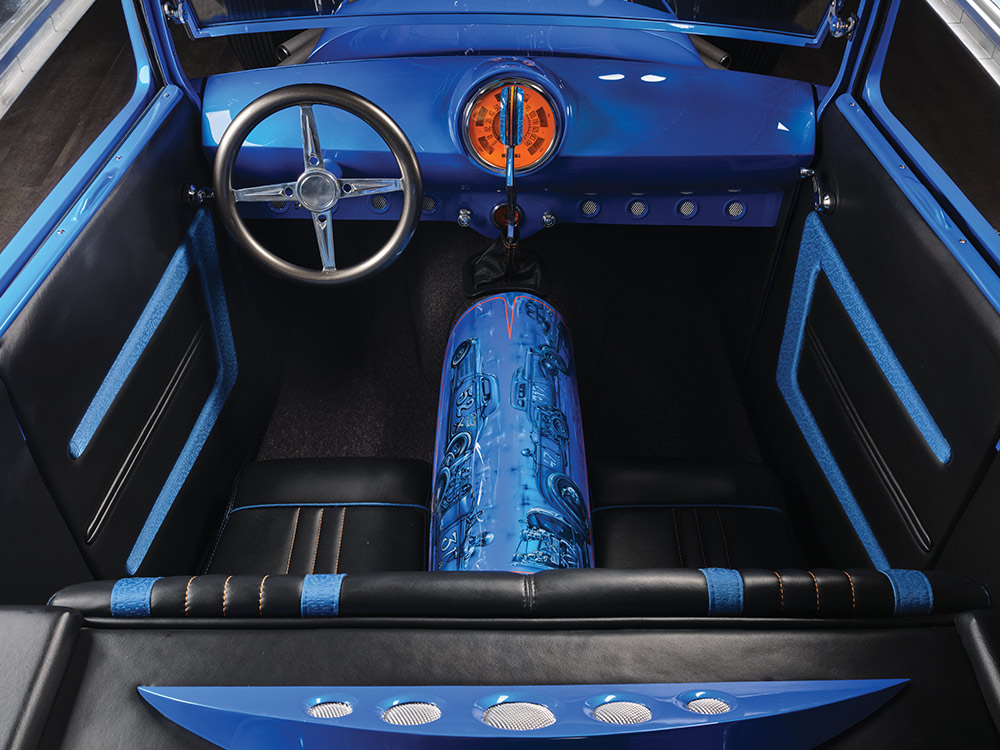
There can be no question that this Model A sedan has undergone a staggering amount of changes since leaving Henry’s rouge manufacturing plant back in 1928. There is a 5-inch top chop to go along with the 3-inch channel. Note the roof insert is fully retractable, giving the ultimate sunroof look. From here, the doors were reversed, now opening in a “suicide” style with a full bellypan, while the cowl was widened 2 inches per side and there is now a custom-molded and drilled visor. Lighting comprises motorcycle headlights resting within molded mounts, and in the back, the taillights are 1937 Ford molded into the body. Also cut into the rear sheetmetal is the flush-fit gas door that leads to a custom-made 15-gallon steel tank. Tony Curry handled the bodywork, while Nathan applied the HOK custom mix of blue and Galaxy Gray dark panels, then pinstriped in Tangelo Pearl. (Special thanks to Mike Taylor of HOK for his assistance with colors and materials.)



Nathan wanted something that stood out from the crowd of hot rods, and we believe he has achieved that goal—and then some.