
Modern Rodding Tech
InTheGarageMedia.com
Ford Mustang core support with bare engine bay and fresh primer, showcasing steering rack and chassis rails
Mustang Makeover typography
1. With a new core support and fender apron from Golden Star Classic Auto Parts, this 1965 Mustang is on track to be as good as new.

Part 3: A New Nose for an Old Pony

By Ron Ceridono Photography by Tate Radford
F

or at least one of Modern Rodding’s senior staff members (we won’t mention the editor by name) the memory of Ford introducing the Mustang fastback 61 years ago is vivid. Unfortunately, over the past six decades, many of those ponycars that were once the desire of many young enthusiasts have suffered from use and abuse. But thanks to Golden Star Classic Auto Parts, just about every piece of sheetmetal necessary to make any early Mustang as pristine as it once was is readily available.

As we’ve noted before, Mustangs were introduced in April 1964, initially as hardtops and convertibles, with the fastback appearing a few months later, in August that same year. While these early cars were often called 1964-1/2 models, Ford classified all 1964 and 1965 Mustangs as 1965 models, which is why when it comes to ordering parts, 1965 is usually the earliest year listed.

When Colin and Sue Radford discovered their Fastback, it was clear that the Mustang had been driven hard but it was definitely worth restoring. Colin and his grandson, Tate, began the restoration process by updating the front suspension with components from Classic Performance Products (CPP), which was covered in Modern Rodding in the Feb. ’25 issue. They then replaced the entire floor and front frame extensions from Golden Star, which was detailed in Modern Rodding’s Mar. ’25 issue.

As with many cars, the Mustang’s battery was mounted to the inner fender apron on the passenger side, and like many cars that had fallen into disrepair, battery acid had corroded a rather large hole in the sheetmetal. Since the inner apron on the left side was undamaged, Tate only replaced the right side with a new panel from Golden Star. As part of the front suspension update, the large pockets that held the Mustang’s coil springs, shocks, and upper control arms were removed. To cover the holes left by their removal, Colin fashioned filler panels from 16-gauge steel.

Another commonly damaged area in early Mustangs is the radiator support. Rust is often an issue; it’s not uncommon for a variety of extra holes drilled for no apparent reason, and the integral crossmember that connects the two framerails is often bent and distorted. For these reasons, Tate installed a new radiator support from Golden Star.

At this point, we would be remiss if we didn’t address the elephant in the room, or, more specifically, the Mustang in the shop. Colin has many years of experience in bodywork and confirms what everyone suspects: many offshore parts don’t fit properly and are made from inferior materials. However, Colin has also discovered that with Golden Star sheetmetal those issues are non-existent. Manufactured in Taiwan using state-of-the-art tooling and the same gauge and quality material as the original parts, Golden Star sheetmetal fits as it should. Although we may not be able to turn back the clock on cars like this Mustang, thanks to Golden Star we can undo the effects of time.

passenger-side apron of Ford Mustang with flaking undercoating and visible firewall panel contours
2. This is typical damage to the passenger side fender apron from battery acid. Note the hole where the factory spring tower was removed when the new Classic Performance Products (CPP) front suspension was installed.
technician drilling out spot welds on Ford Mustang radiator support using Blair equipment in a restoration shop
3. Tate Radford starts to remove the front section of the passenger side fender apron by drilling through the factory spot welds.
removing apron spot welds from Ford Mustang inner fender with air hammer and safety gear
4. The spot welds connecting the fender apron to the remaining flange of the factory spring tower were removed leaving the flange.
technician chiseling spot welds from Ford Mustang apron near coilover and upper control arm mount
5. With the spot welds cut, a hammer and chisel were used to separate the fender apron from the spring tower flange.
using hammer and chisel to remove radiator support from classic Ford Mustang engine bay
6. After drilling out the spot welds securing the core support to the left fender apron (which won’t be replaced), the hammer and chisel were needed once more.
side view of radiator support removal on Ford Mustang showing separation from inner fender
7. Still more drilling was needed where the core support and crossmember connected to the framerails.
close-up of spot weld drill on lower radiator bracket of Ford Mustang core support
8. Once more, the hammer and chisel were employed. The key here is to avoid damaging the framerail flange.
hammer and chisel technique removing radiator support tab from classic Mustang
9. To simplify the process, an abrasive wheel was used to cut the right fender apron so it could be removed with the core support. The remaining spot-welded flange will be removed later.
air grinder used to split frame-to-apron seam on Ford Mustang front end
10. The core support attaches to two diagonal supports; the welds securing one to the other were cut with an abrasive wheel.
technician removing passenger-side apron from 1965-66 Ford Mustang during core support disassembly
11. Once all the sheetmetal surgery was completed, the core support and the right-side fender apron’s front section were removed.
Mustang front clip prepped with mockup chassis legs and black firewall paint ahead of apron installation
12. In preparation for the new Golden Star components all the areas to be welded were cleaned down to bare metal.
close-up of driver-side rail and apron mounting area with drilled spot welds and disc brake system
13. Here, the fender apron flange on the framerail (arrow A) and the spring pocket (arrow B) flange have been prepared for welding. The spring pocket flange was kept to assist in aligning the new sheetmetal.
fresh replacement Mustang inner apron panel in e-coat primer, ready for fitting
14. The new Golden Star front right fender apron fits 1964-66 Mustangs (PN FA20-64FRdf).
using pneumatic hole punch to prep new Mustang apron panel for plug welds
15. A pneumatic punch was utilized to create holes in the fender apron a series of spot welds.
straightening lower rail bracket on Mustang chassis with large adjustable wrench for alignment
16. The core support and mating surfaces were straightened before fitting the fender apron.
replacement Mustang radiator core support panel shown in e-coated steel before fitment
17. This is a Golden Star radiator support and lower crossmember for 1964-66 Ford Mustangs (PN CS20-641).
air punch used to perforate radiator support flange for welding on 1965-66 Mustang
18. Similarly to the fender apron, holes were punched in the radiator support for spot welds.
new apron panel plug welded in place on Mustang chassis with visible tack welds and alignment
19. Here, the fender apron has been spot welded to the flange at the top of the framerail and the remaining flange for the spring pocket.
technician welding radiator core support on classic Mustang with clamps and Lincoln Electric setup
20. With the fender apron properly located, the radiator support was clamped in place and welded.
newly installed driver-side apron on 1965-66 Mustang with spot welds and fresh primer coat
21. From outside the engine compartment the alignment of the fender apron and spring pocket flange is visible.
core support panel tacked into place between Mustang frame rails for alignment test-fit
22. The radiator support is tack-welded to the diagonal braces and will be fully welded to them and the framerails.
full front clip view showing new apron and radiator support fitted on early Mustang shell
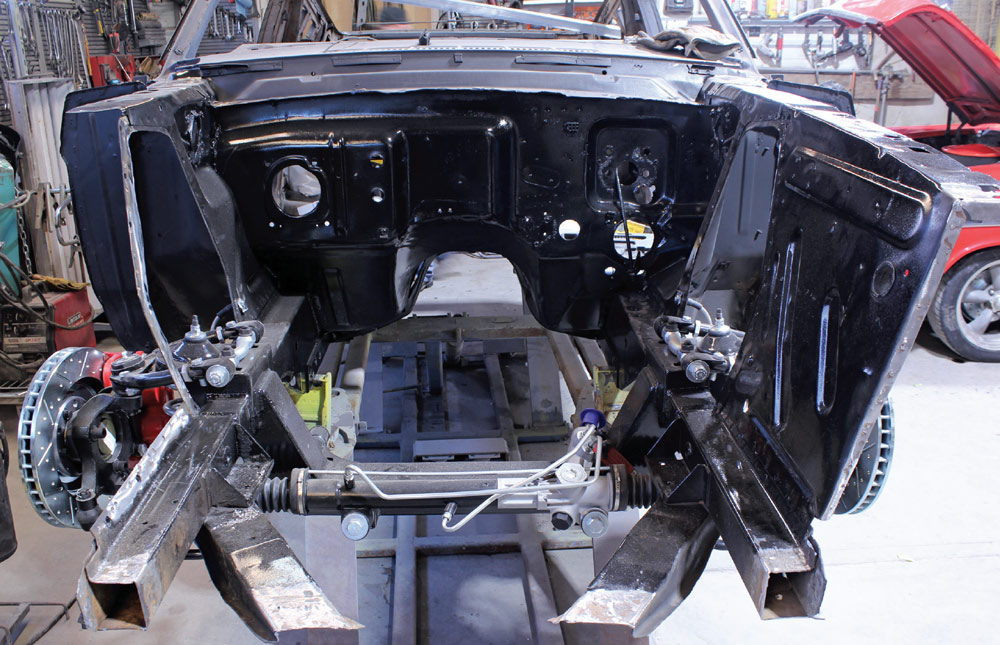
23. Replacing the damaged fender apron and radiator support restored the chassis’ structural integrity and made it look much better.
original Mustang engine bay with factory suspension mounts and brake lines before restoration
24. These are the original Mustang spring pockets; removing them will simplify the installation of a big-block Ford.
technician marks template alignment on Mustang inner fender for custom patch fabrication
25. To fill holes by removing the spring pockets, Colin initially created paper patterns for filler panels.
cardboard template laid out on steel sheet for tracing new Mustang patch panel shape
26. Since both filler panels are identical, both used the same pattern.
cutting custom patch panel from sheet metal with air shear, guided by traced template

27. The filler panels were cut from 18-gauge sheetmetal.

edge forming detail added to custom Mustang patch panel using bead roller or metal brake
28. Colin ran the filler panels through a bead roller to add a custom touch and stiffen the panels.
patch panel welded into apron of 1965-66 Mustang, with labeled orientation and clean welds
29. After creating holes in the edges of the filler panels, they were rosette welded in place.
SOURCES
Modern Rodding
VOLUME 6 • ISSUE 57 • 2025