
Modern Rodding TECH

InTheGarageMedia.com
under the hood of a '36 Ford
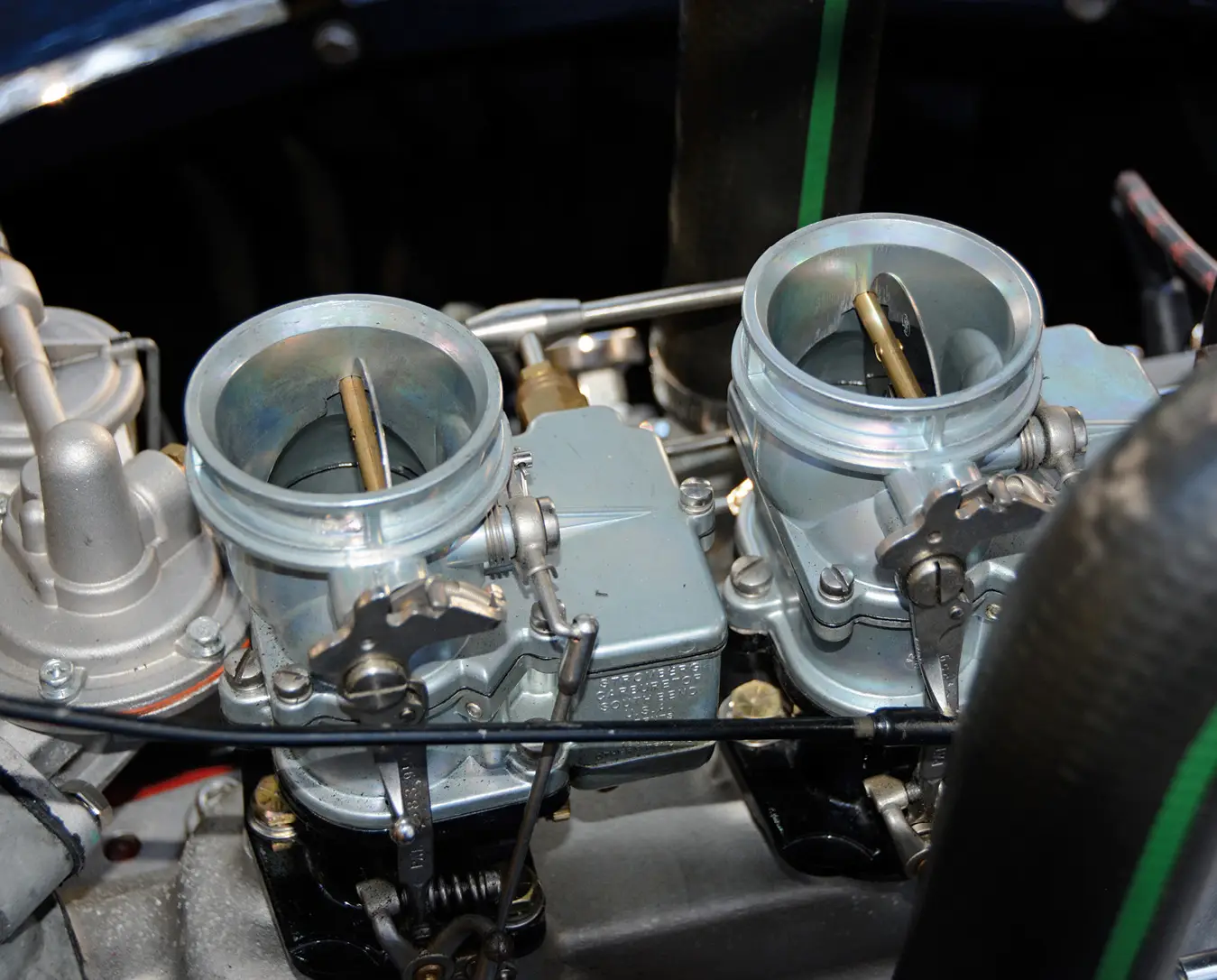
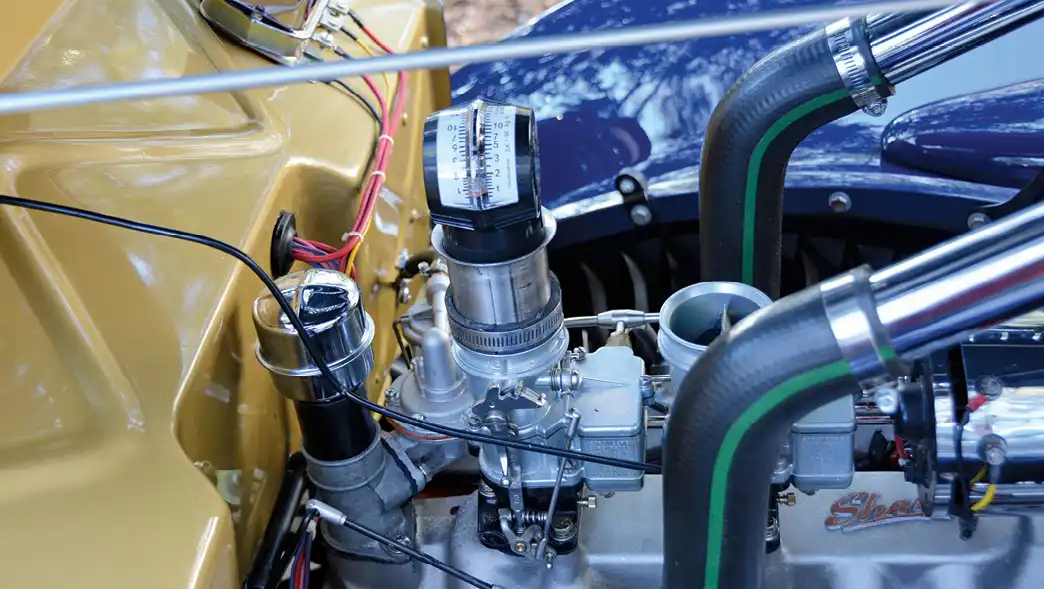
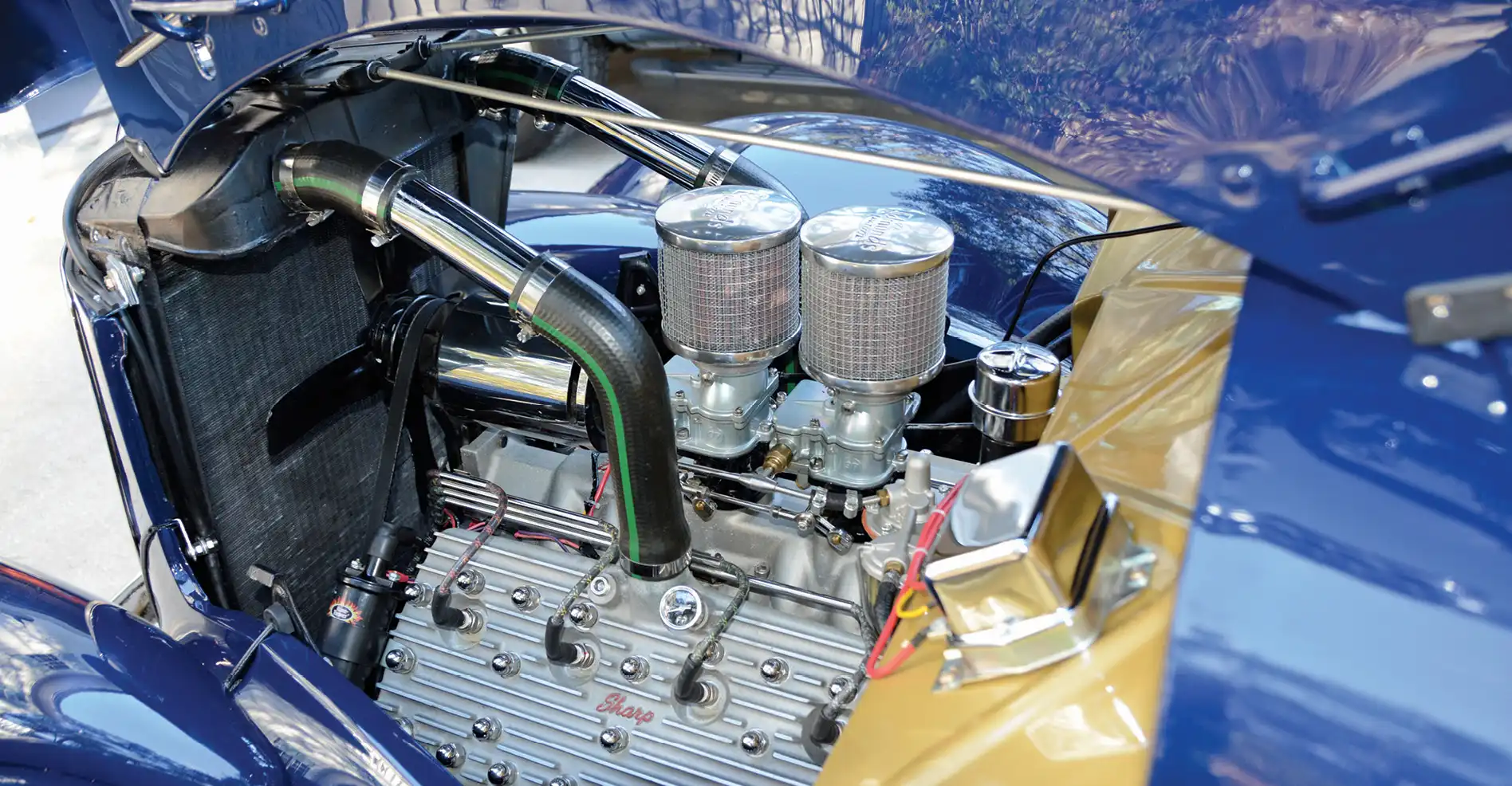
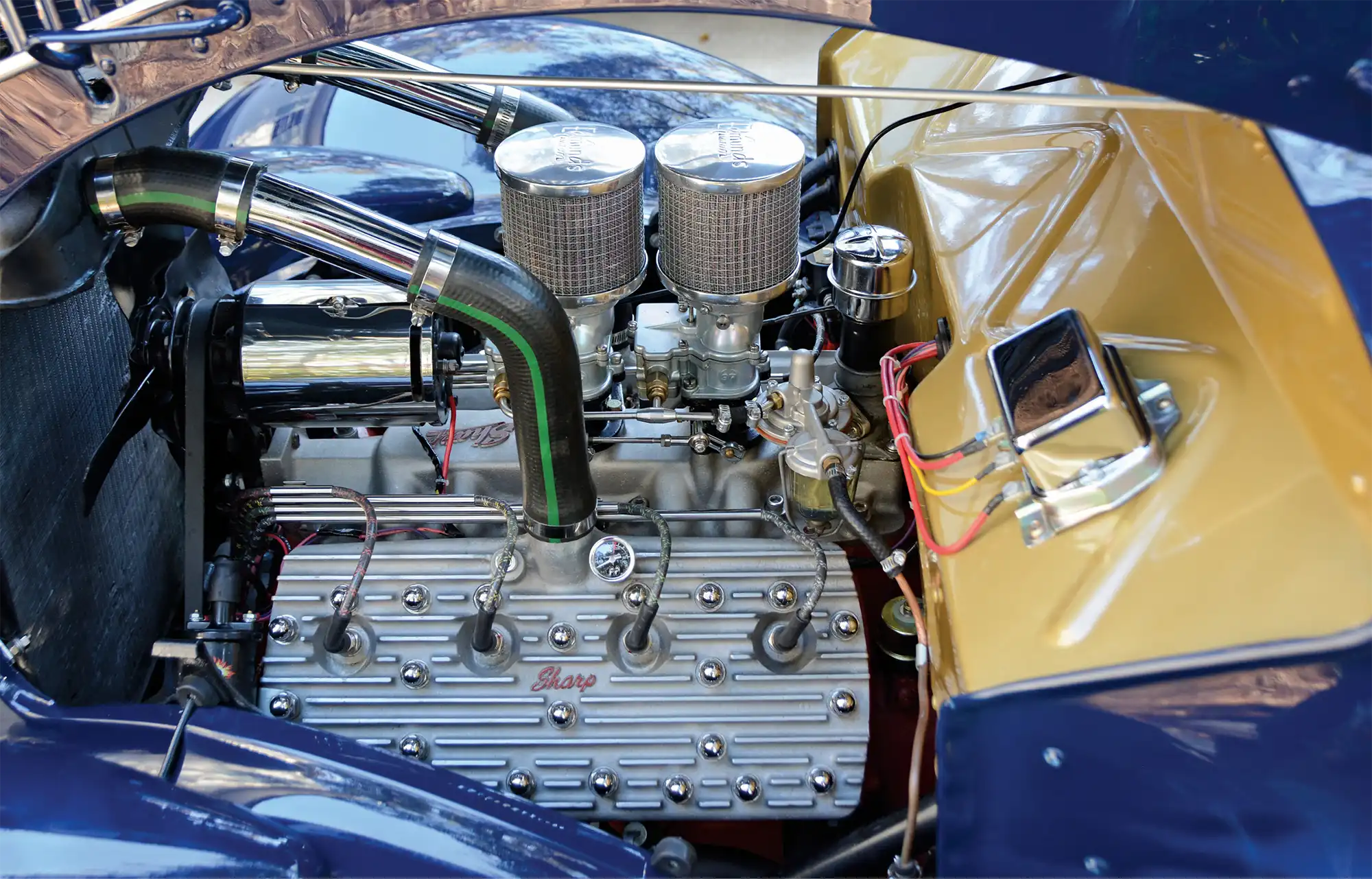
1. There is a lot to love about the utter simplicity and beauty of a Flathead-powered hot rod. A pair of Stromberg 97s feed our 76-year-old motor mounted to a Sharp intake breathing through Edmund’s breathers. A matching set of unpolished Sharp heads completes the picture. Sharp speed equipment was sourced through H&H Flatheads, breathers were from O’Brien, and Summit had the carbs.
Go With The Flow
Turning Twin Stromberg Carburetors Means Going Full Synchro
By Gerry BurgerPhotography by The Author
P

art of the allure of traditional hot rodding lies in its utter simplicity. As my latest project takes to the road, it is time to deal with those pesky little details that make such a big difference. My ’36 Ford phaeton is pure vintage hot rodding. Super Bell I-beam up front, split bones, with a 9-inch rear on parallel leaves out back. Under the hood is a vintage ’47 59AB Flathead built with Sharp heads and intake sourced from the Flattie gurus at H&H Flathead. We even stayed with a 12V generator from a ’56 Ford mounted directly in front of a pair of Stromberg carburetors. The motor was built here in my home shop using ARP fasteners. The Stromberg electronic ignition fired the Flat motor to life on the first try … ah life is good.

Coupled to a T5 tranny we did a bit of local motoring; the occasional tailpipe popping made it clear the engine would need a bit of tuning. We returned home and allowed the motor to cool. One of the many joys of a Flathead is the spark plug access. Working on a cool motor, we pulled the plugs to discover the engine was running “rich” or “fat,” or whatever your favorite term for too much fuel and not enough air might be. Since we were running two brand-new Stromberg carbs, we decided to read the informative instruction booklet; it’s amazing what you find in a manufacturer’s instruction sheet. Before proceeding with the fine-tuning, the engine must be free of vacuum leaks and ignition problems, and the idle should be set at the desired rpm.

While twin carbs might be one too many for a basically stock engine, multiple carbs are simply mandatory equipment for any real hot rod, and with proper tuning they work perfectly. As per the instruction sheet, before making any adjustment, we disconnected the gas pedal linkage and the linkage rod connecting the two carburetors to ensure both throttle plates were closed.

Our first adjustment was moving the accelerator pump rod from the “W”-post to the “S”-post on the carburetor linkage arm. (Think “winter” and “summer.”) Moving this rod to “S” on both carbs provided a less-aggressive accelerator pump. This is our first step to curing the “rich” fuel situation.

We began our next adjustments with the air/fuel mixture screws on the rear carburetor. Like most carburetors, these screws are turned clockwise to restrict fuel flow and lean the motor out and turned counterclockwise to add additional fuel and richen the motor. Adjusting involves turning the knurled air/fuel circuit screws in (clockwise) until the engine stumbles, then slowly (seriously, do this slowly, one-quarter turn and pause) turn the screw back out (counterclockwise) until the engine runs smooth. You may notice increased rpm when the air/fuel hits that “sweet spot.” Now move over to the second adjustment screw on the rear carburetor and repeat this procedure. You should already notice an improved idle.

We moved to the forward carburetor and repeated the same procedure: turn ’em into a stumble, turn ’em out until it’s happy (smooth). Moving the throttle by hand showed us the engine ran smoothly through the range to 2,500 rpm. If these adjustments have altered the idle, adjust it now by turning both carburetor idle screws in equal amounts to attain the desired idle. We were so pleased with how the Stromberg carbs responded to our adjustments that we almost closed the hood, thinking we were done.

Then, a friend who works on some of those “furrin’ cars” mentioned synchronizing the carburetors, also known as flow balancing. This is critical on engines with carburetors feeding opposing banks of cylinders mounted on separate intake manifolds. Since our inline carburetors fill a common plenum, the flow may not seem as important, but since we were in the full tune-up mode, we decided to go with the flow and see if it really changed anything.

The first step was buying a flowmeter. You will be pleasantly surprised to discover that your basic Rage or “snail-style” flowmeter is very affordable, at around $35. Armed with our new tool, we warmed the engine to normal operating temperature. Next, we removed our cool Edmunds Custom air breathers from both carburetors. The throttle linkage from the gas pedal to the carburetors and the linkage connecting the two carburetors were disconnected. This ensures both carburetor throttle plates are in full closed position and the linkage is not affecting the carburetors in any way. Our Strombergs are connected with straight linkage so there are no concerns about tuning progressive linkage.

Before restarting the engine, we tested the fit of the flowmeter to our Stromberg carbs. The tapered cone was way too small for the carburetor opening. We made a simple adapter out of flared exhaust tubing and a piece of radiator hose. This adapter sat perfectly on the carburetor lip, and the tapered flowmeter sealed nicely inside the flared tubing. Problem solved, although it should be mentioned that adapters are commercially available for the flowmeter.

We fired the engine, held the flowmeter on top of the rear carburetor, and took a reading. Now, we will confess we aren’t exactly sure what the meter numbers mean, but we do know we want the exact same number from both carburetors. We made a note of the reading and then tested the front carburetor and noticed that the carburetor was flowing a good bit less air than the rear carburetor. With the flowmeter back on the rear carb, we backed the idle speed screw out (counterclockwise); this lowered the airflow in the rear carburetor to a number closer to the front carb. It also lowered the idle. Next, we moved the flowmeter to the front carburetor and turned that idle speed screw in (clockwise) to raise the idle a bit, thereby increasing the airflow to match the front carburetor. We went back and forth several times until we had the flow exactly the same on both carburetors.

We checked our idle speed and found it was a bit high. Once again, we synchronized the carburetors with the flowmeter as we lowered the idle speed. This was achieved by adjusting both carburetor idle screws until we had the desired idle along with perfectly matched flow. Ultimately, our Flathead idled smoothly at 600 rpm with perfectly synchronized carburetors. Next, we carefully adjusted the linkage rod to connect the two carburetors. We checked the flow to be sure the rod had not affected our airflow. Then, the throttle was connected back to the gas pedal, air filters were installed, and it was time for a testdrive. We were amazed at how smoothly the engine ran through the rpm range. There was no “flat spot,” no tailpipe popping, just raw, unbridled Flathead power.

So, our verdict is in: This was definitely worth doing. While the engine ran well after adjusting the air/fuel settings, synchronizing the airflow between the two carburetors brought it to the next level. And the best part is the process of getting there is actually fun. Airflow should be checked anytime you change idle or make carburetor adjustments.

We recommend leaving the airflow meter/adapter in clear view around the shop. When folks ask, “What’s that for?” casually mention … “Oh, that … I use it when I’m synchronizing multiple carburetor setups” and watch the eyebrows go up.

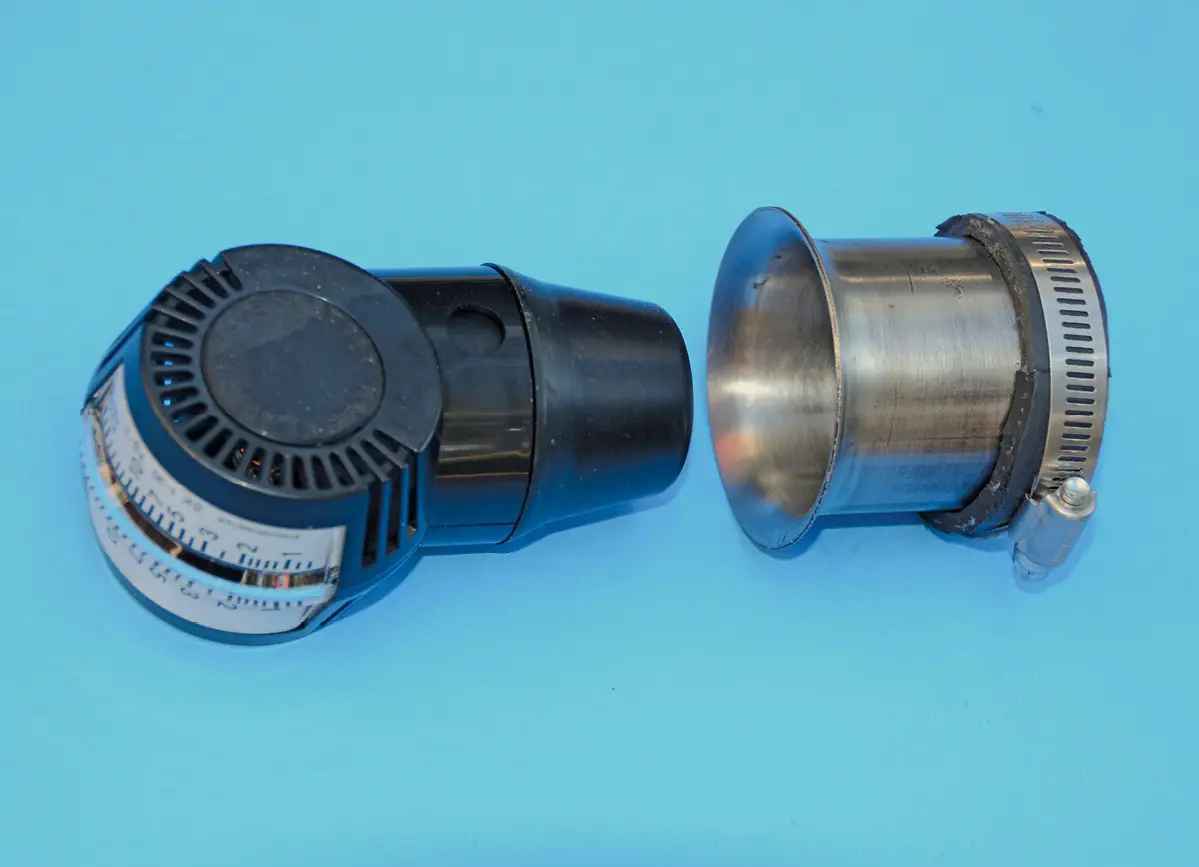
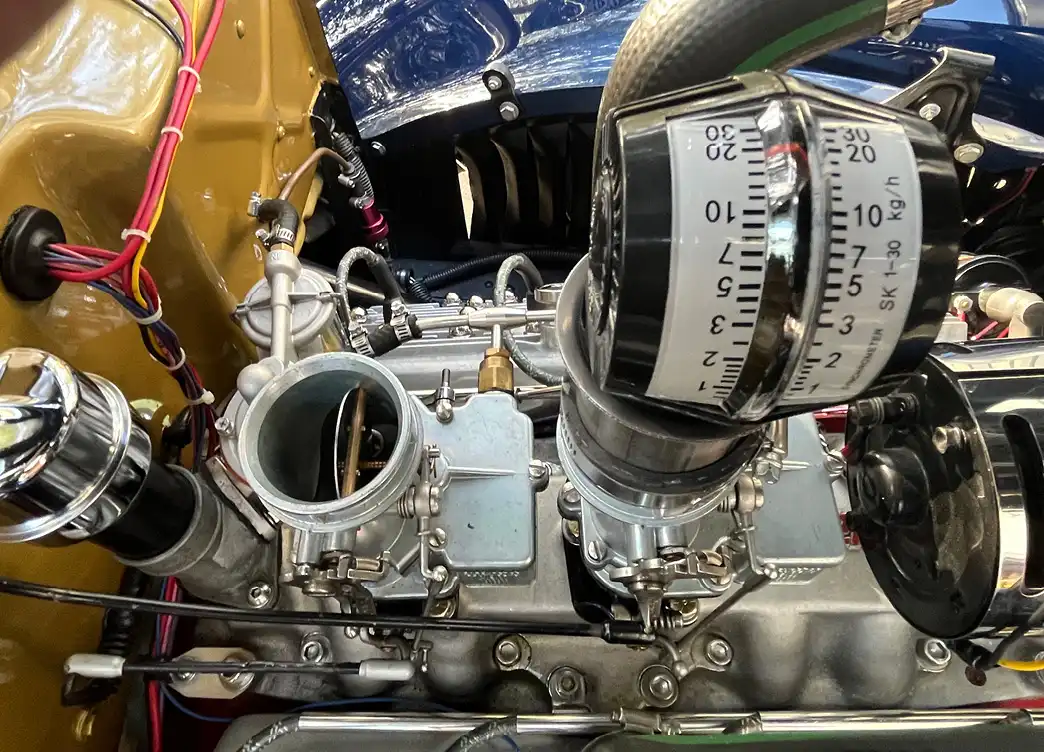
This gem is the tool we used to measure airflow through the carburetors. It is a synchrometer that is incredibly easy to use and very affordable. It simply measures the amount of air flowing into each two-barrel carburetor.
2. This gem is the tool we used to measure airflow through the carburetors. It is a synchrometer that is incredibly easy to use and very affordable. It simply measures the amount of air flowing into each two-barrel carburetor.
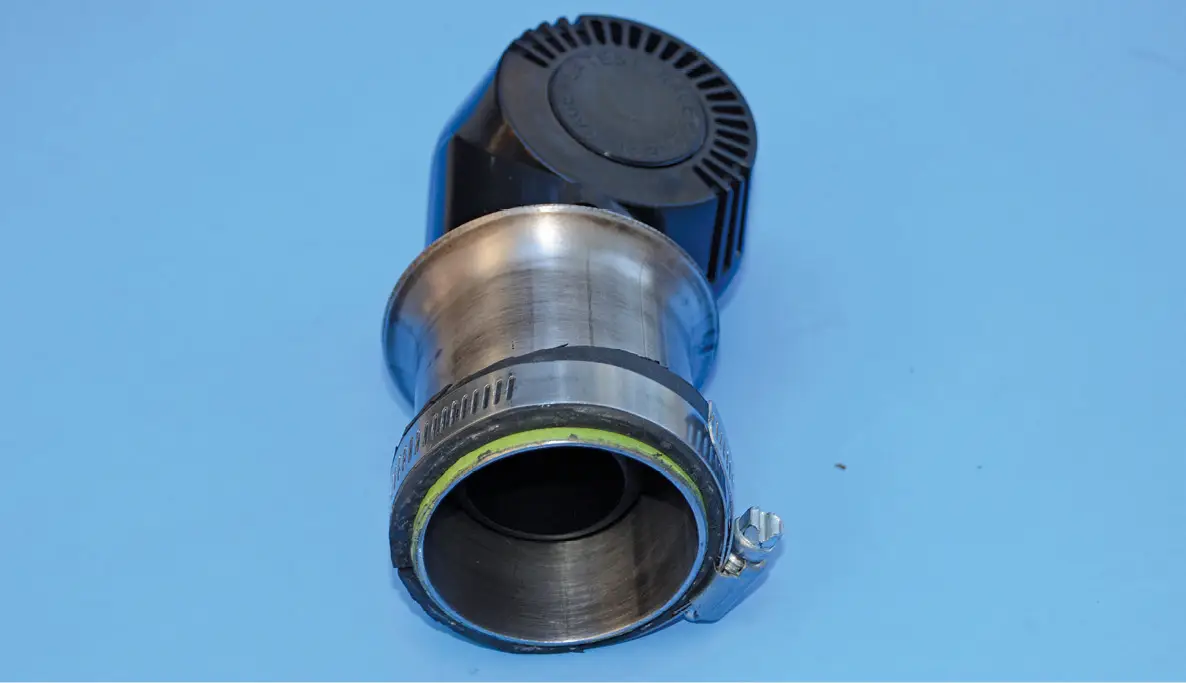
The flowmeter was too small for the throat of our Stromberg 97s, so we used 2-1/2-inch exhaust tubing to fit the carburetor, while the flowmeter fit on the flared top. A small piece of scrap radiator hose was clamped to the bottom of the tubing to provide a seal.
3. The flowmeter was too small for the throat of our Stromberg 97s, so we used 2-1/2-inch exhaust tubing to fit the carburetor, while the flowmeter fit on the flared top. A small piece of scrap radiator hose was clamped to the bottom of the tubing to provide a seal.
Our adapter is a very straightforward arrangement. The clamp holds a piece of radiator hose to the adapter/exhaust tubing. It does NOT clamp to the carburetor; it is simply held in place by hand.
4. Our adapter is a very straightforward arrangement. The clamp holds a piece of radiator hose to the adapter/exhaust tubing. It does NOT clamp to the carburetor; it is simply held in place by hand.
That rubber piece is clamped approximately 1/8-inch from the bottom of the tubing. This forms a small lip that centers the piece nicely on the carburetor.
5. That rubber piece is clamped approximately 1/8-inch from the bottom of the tubing. This forms a small lip that centers the piece nicely on the carburetor.
Armed with our newly adapted Latest Rage Synchrometer, we were ready to balance the airflow between the two carburetors.
6. Armed with our newly adapted Latest Rage Synchrometer, we were ready to balance the airflow between the two carburetors.
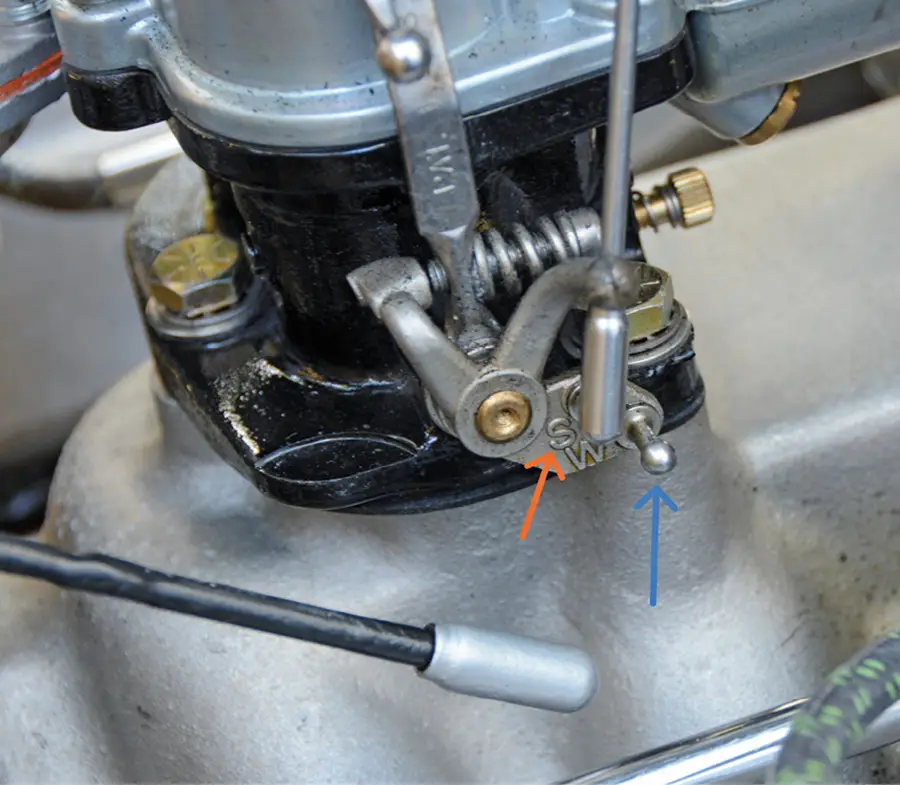
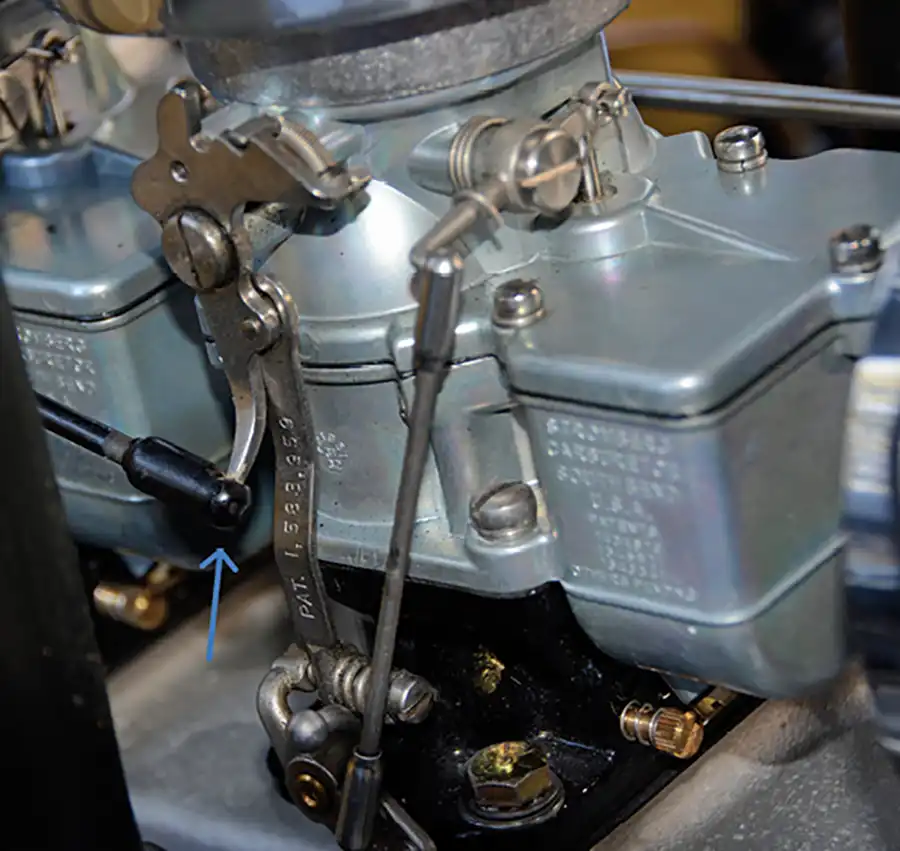
Before we tackled airflow, we moved the accelerator pump arm from the “W” post (blue arrow) to the “S” post (orange arrow). This makes for a less-aggressive accelerator pump that delivers less fuel. Removing vintage rod ends is as simple as sliding the sleeve back and pulling the rod off the pivot ball. You should never need a tool to pry the rod end off.
7. Before we tackled airflow, we moved the accelerator pump arm from the “W” post (blue arrow) to the “S” post (orange arrow). This makes for a less-aggressive accelerator pump that delivers less fuel. Removing vintage rod ends is as simple as sliding the sleeve back and pulling the rod off the pivot ball. You should never need a tool to pry the rod end off.
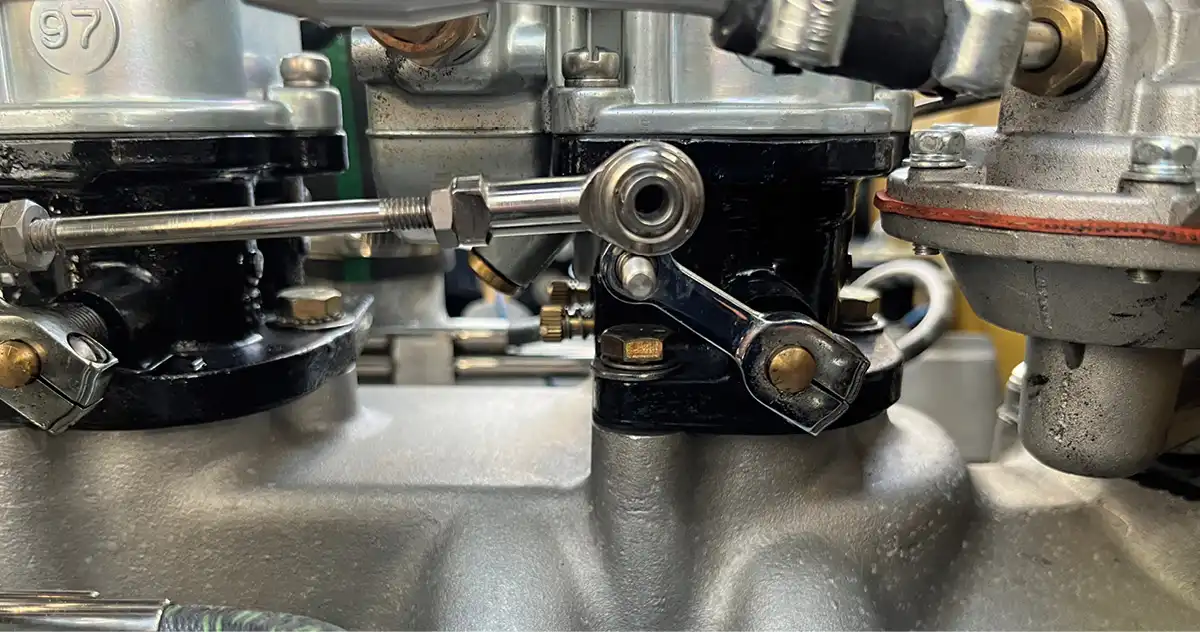
Moving to the opposite side of the carburetors, we disconnected the linkage between them. A simple Nylock nut was removed, and the rod end slid off the rear carburetor.
8. Moving to the opposite side of the carburetors, we disconnected the linkage between them. A simple Nylock nut was removed, and the rod end slid off the rear carburetor.
With all linkages removed from the carburetors, both Strombergs should now be fully closed with choke blades wide open.
9. With all linkages removed from the carburetors, both Strombergs should now be fully closed with choke blades wide open.
Next, we adjusted the fuel for each barrel of the two-barrel carbs. We are showing it with a screwdriver, but often you can turn the knurled screw by hand. Turn each screw in until the engine stumbles, then slowly back the screw out until it runs smoothly. Turn this screw out slowly, allowing things to settle between one-quarter turns. Do the same on the front carb.
10. Next, we adjusted the fuel for each barrel of the two-barrel carbs. We are showing it with a screwdriver, but often you can turn the knurled screw by hand. Turn each screw in until the engine stumbles, then slowly back the screw out until it runs smoothly. Turn this screw out slowly, allowing things to settle between one-quarter turns. Do the same on the front carb.
With the fuel mixture adjusted, we turned our attention to using our newly adapted flowmeter on the rear carburetor. This gauge measures Kg/min, but that doesn’t matter; what we want is the same number on each carburetor. Note how nicely the unit sits atop the Stromberg.
11. With the fuel mixture adjusted, we turned our attention to using our newly adapted flowmeter on the rear carburetor. This gauge measures Kg/min, but that doesn’t matter; what we want is the same number on each carburetor. Note how nicely the unit sits atop the Stromberg.
All adjustments are made with the engine at normal operating temperature. Our initial reading on the rear carburetor was 17.5 Kg/min at idle.
12. All adjustments are made with the engine at normal operating temperature. Our initial reading on the rear carburetor was 17.5 Kg/min at idle.
The front carburetor registered 21 Kg/min, so some adjustments were in order.
13. The front carburetor registered 21 Kg/min, so some adjustments were in order.
We turned the rear carburetor idle adjustment screw in slightly (clockwise), thereby increasing airflow. This also slightly increased the idle.
14. We turned the rear carburetor idle adjustment screw in slightly (clockwise), thereby increasing airflow. This also slightly increased the idle.
A quick check with the flowmeter showed we had increased the flow on the rear carburetor to 20 Kg/min.
15. A quick check with the flowmeter showed we had increased the flow on the rear carburetor to 20 Kg/min.
The front carburetor was still drawing 21 Kg/min, so we turned the idle adjusting screw out (counterclockwise) until it read exactly 20. This also reduced the idle back down close to the original setting. We spent a little time tweaking both carburetor idle screws to achieve our desired 600 rpm idle, checking all the while for perfectly matched airflow.
16. The front carburetor was still drawing 21 Kg/min, so we turned the idle adjusting screw out (counterclockwise) until it read exactly 20. This also reduced the idle back down close to the original setting. We spent a little time tweaking both carburetor idle screws to achieve our desired 600 rpm idle, checking all the while for perfectly matched airflow.
Now, we must adjust the linkage so it fits perfectly without moving either carburetor from its full resting place. We had to loosen and slightly shorten our linkage arm.
17. Now, we must adjust the linkage so it fits perfectly without moving either carburetor from its full resting place. We had to loosen and slightly shorten our linkage arm.
Certain we had not disturbed the carburetors; we tightened the lock nut on the rod end and installed the Nylock nut onto the linkage arm.
18. Certain we had not disturbed the carburetors; we tightened the lock nut on the rod end and installed the Nylock nut onto the linkage arm.
We snapped the throttle linkage arm back onto our rear carburetor. Since our dual-Strombergs are connected directly, this arm moves each carburetor the exact same amount, including both accelerator pumps.
19. We snapped the throttle linkage arm back onto our rear carburetor. Since our dual-Strombergs are connected directly, this arm moves each carburetor the exact same amount, including both accelerator pumps.
The final linkage was the choke arm (blue arrow); be certain this connection did not move the choke blade. We only “choked” the front carburetor.
20. The final linkage was the choke arm (blue arrow); be certain this connection did not move the choke blade. We only “choked” the front carburetor.
The testdrive proved that synchronizing the flow really improved performance. This type of simple tuning is a fun and rewarding afternoon in the driveway, never indoors. Now we have a package that runs as well as it looks.
21. The testdrive proved that synchronizing the flow really improved performance. This type of simple tuning is a fun and rewarding afternoon in the driveway, never indoors. Now we have a package that runs as well as it looks.
SOURCES