

 Photography by Wes Allison
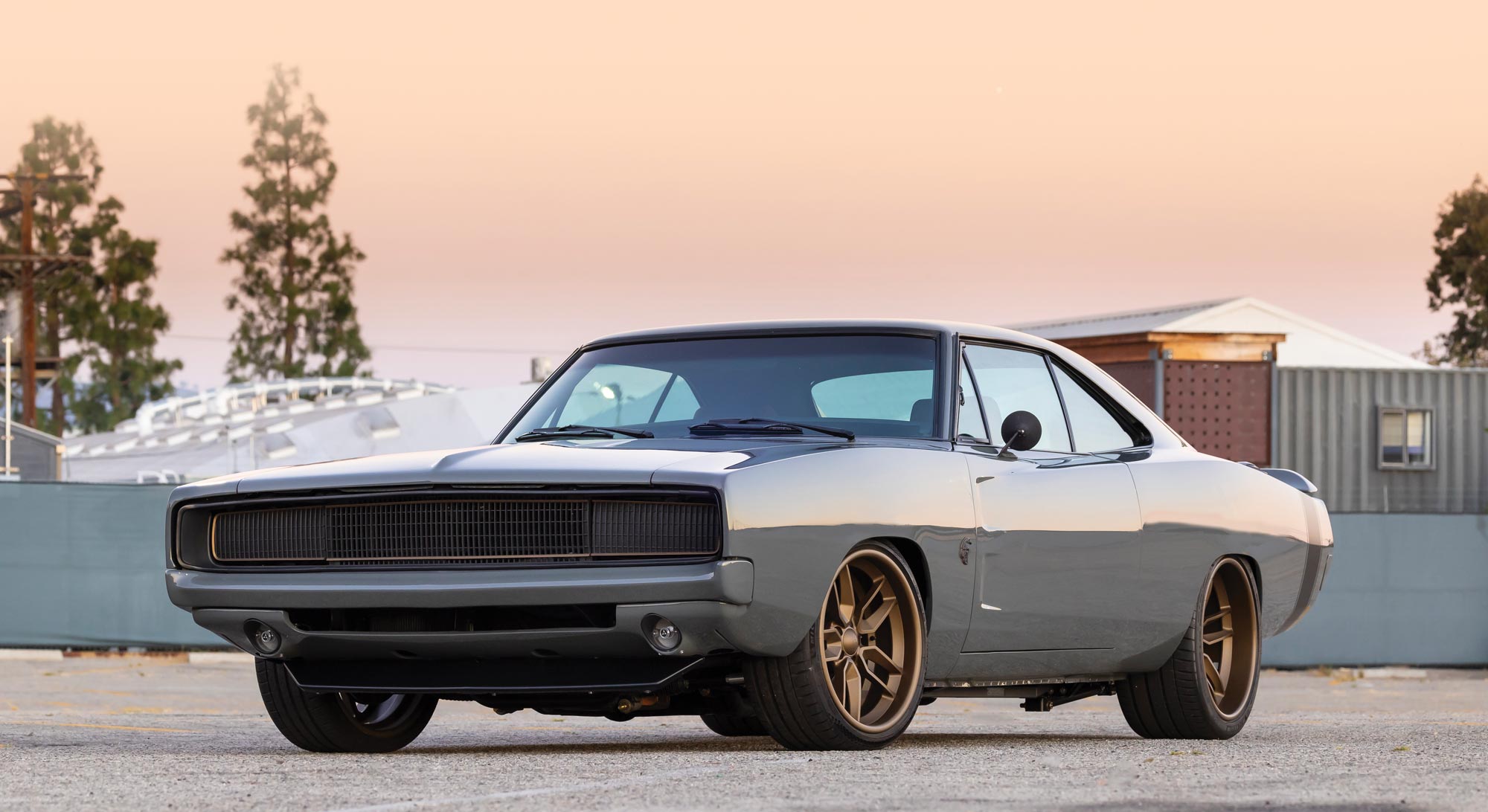
here can be no denying that the muscle car era of the ’60s fashioned some amazing adrenaline-fabricated Detroit Iron. Near the top was the Dodge Charger, specifically the ’68. Had the ’68 been blessed with the powerplant that now resides in the Hollywood Hot Rods (HHR)-built ’68 Dodge Charger, we suspect it would have clearly been number one within the muscle car crowd.
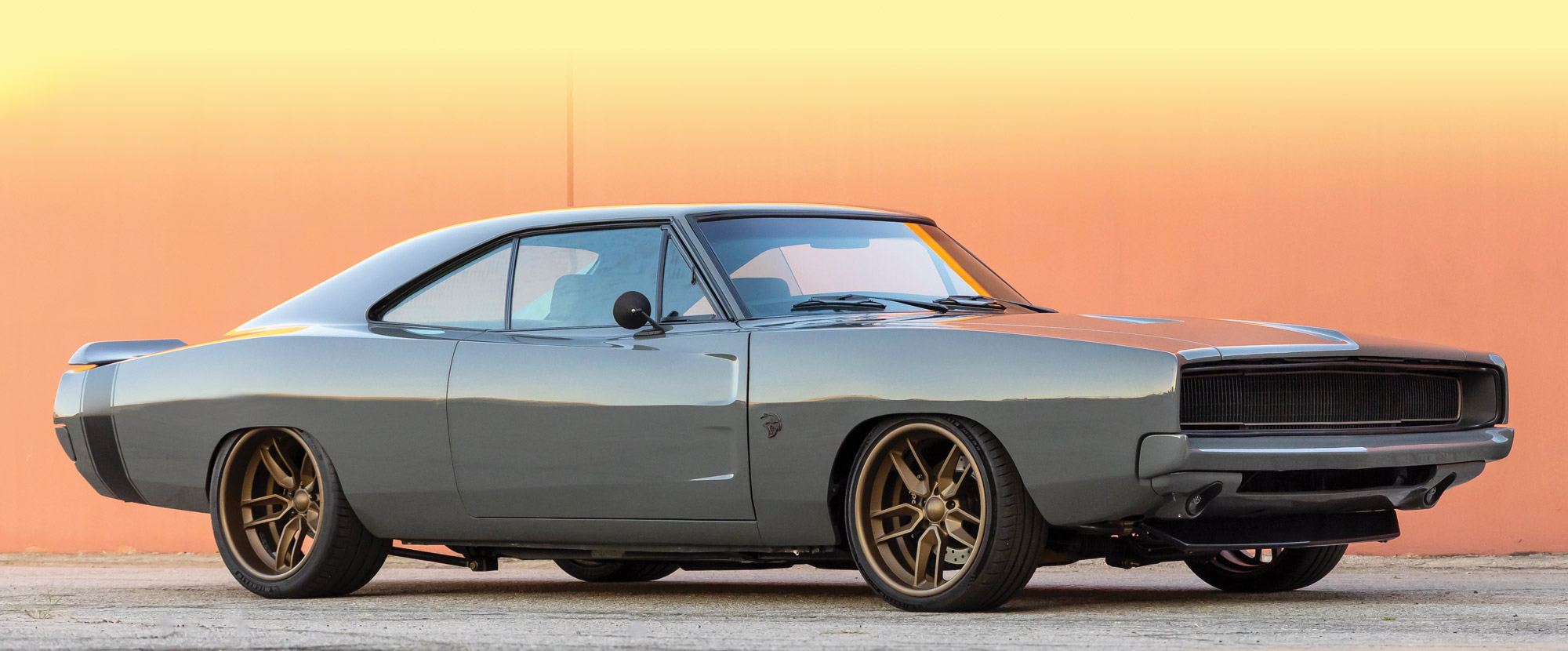
Back in 1967, the Dodge Charger had lost its appeal among the car crowd, with sales of around 16,000 units. Chrysler knew something had to be done. Fast-forward a bit, and 1968 saw sales skyrocket to approximately 96,000 units. Why? It was the first year of the “Coca-Cola body” style. (Richard Sias is credited with the unique styling of the Coke bottle appearance of the ’68 Dodge Charger. Stand back and look, and you will see what we mean.) That’s what the Charger needed, but there was more. The powerplant options were significant in 1968, ranging from a 318-inch 230hp V-8 to a very respectable 383 ci producing 325 hp. (Remember, we are talking about ’60s horsepower numbers.) However, the V-8 option that will be recorded in the history books and forever debated at car events everywhere is “the one,” the 426ci Street Hemi V-8. The word Hemi is enough to get any hot rodder’s pulse racing. But how about 425 hp (and we believe then some) and 490 lb-ft of torque? Remember, on the street, torque will get you from stoplight to stoplight in a righteous fashion. History has proven this: the Hemi, regardless of what generation, is always spoken with awe.
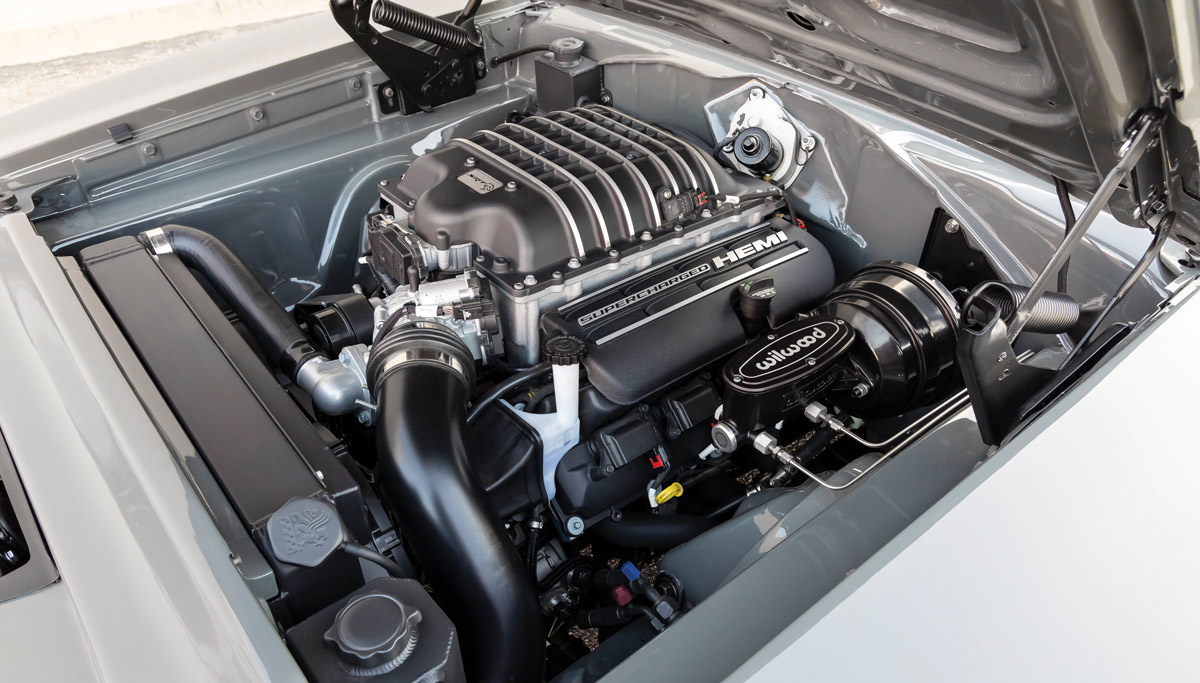
The ’21 supercharged Hellcat (6.2L or 378 inches) residing in this ’68 Charger produces an ample 717 hp and 650 lb-ft of torque, which is deliverable power to the rear wheels via an Inland Empire Driveline driveshaft. (The Redeye Hellcat version has 797 hp, and the Super Stock version has a retina-detaching 807 hp just in case you need more.) This Hellcat is featured in its stock trim but does have 2-inch-diameter aftermarket headers from Tube Technologies that then dump into the 3-inch stainless steel exhaust pipe and make a direct line to a pair of Flowmaster headers. All the exhaust system fabrication was dialed up at HHR. Linked to the supercharged Hellcat is the factory ZF eight-speed transmission with a 4.71 First gear, which makes acceleration a priority for this ’68 Dodge Charger. Overall power is delivered to the 8.75-inch Dana 60 rearend that spins a 2.62 ring-and-pinion. Not only is this Charger set up to accelerate, but it is also capable of an overwhelming top speed with its 0.67-second overdrive gear.

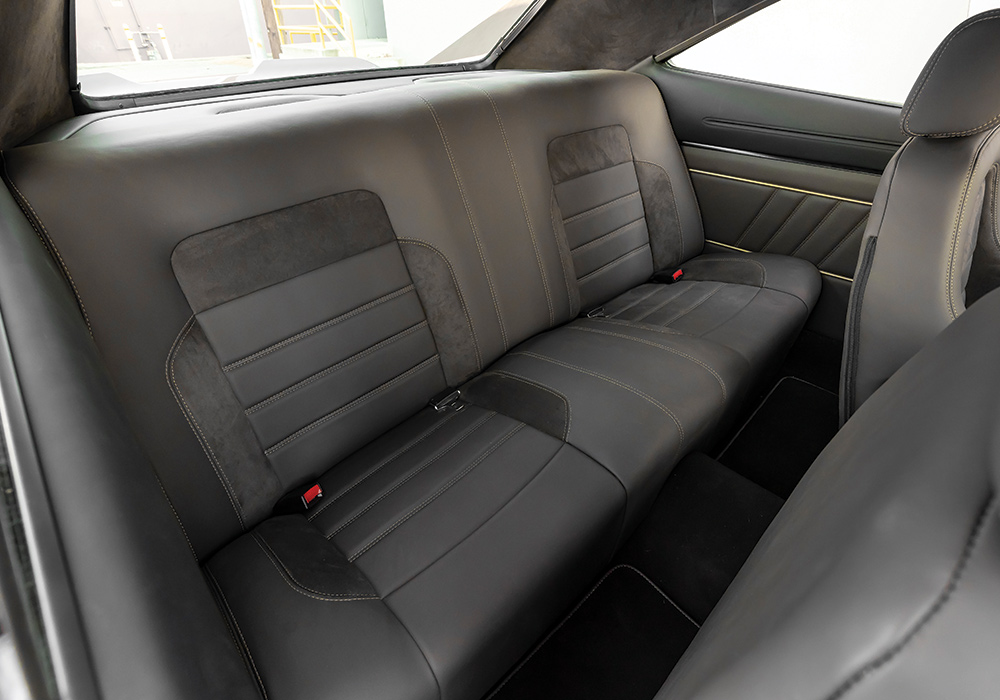
The HHR crew knew what was needed to make this a modern Pro Touring ground pounder and, at the same time, feature amazing looks. In front, the grille opening was reshaped while the front bumper was redesigned and then cut and tucked to give a snug and flowing fit to the front. The rear bumper was also cut and tucked, cleaning up the rear lines. Additional reshaping can be seen in the front and rear valance as well as the rear panel. Also, in the back, the wheelwell was re-radiused, the corners were reshaped, and the rear fender caps were removed. The Dodge Charger did receive a “haircut” with the removal of the side marker lights (mandated in 1968 for all cars), factory identity emblems, and door handles. The Charger received a rear wing that was made from components from a modern Charger rear wing. Receiving the nod for the abundant amounts of bodywork fell to California Autoworx, and from there they painted the Charger in Chrysler Destroyer Gray with black vinyl factory-style trunk wraparound stripes. (An interesting backstory on the paint. The Destroyer Gray was introduced in 2017 for Chrysler’s performance cars. Some would say that it is devoid of color and it has no metalflake in it. It was discontinued in 2019, thus making it a very limited production color.)

Here’s one last backstory on the ’68 Dodge Charger. This is for movie buffs. Recall the movie Bullitt and the bad guys chasing our hero Steve McQueen in his Mustang Fastback. The extended chase scene shows a brand-new ’68 Dodge Charger chasing McQueen through the streets of San Francisco (or that’s what they would have us believe) before crashing into a gas station and exploding. But the takeaway from this scene was the number of hubcaps that came off the Charger. Now, by my count, a ’68 Charger has four hubcaps, but in this famous movie chase scene, five were lost!
Well, if you are going to select a ’60s-era muscle car to bring forward and match with one of today’s powerplants, you would be hard-pressed to do better than the ’68 Dodge Charger coupled with a ’21 Dodge Charger Hellcat V-8.