
Modern Rodding Tech
InTheGarageMedia.com
A man in a green shirt measures the chrome wheel of a black classic car body inside a workshop.
1. With the wheels and tires mocked up at ride height, Colin Radford measured between them to determine the width of the new Rhoades Racing 9-inch rear axle housing from JEGS.
Pony Tales
Rear Suspension Updates for a Classic Mustang
By Ron Ceridono Photography by Tate Radford
W

hen Colin and Sue Radford chose an early Ford Mustang fastback for their next project, they were ready to start with a car that was not perfect. While that’s a very kind way of describing the condition of the car they found, Colin saw its potential. Even though the body resembled a gunny sack full of walnuts, it needed a new floor, the engine and transmission were missing, the Radfords, along with their grandson, Tate, took on the challenge. It took many hours in the shop and a long list of replacement sheetmetal parts from Golden Star Classic Auto Parts to restore the body to excellent condition, and all-new front suspension parts from Classic Performance Products (CPP) to replace the worn-out originals. (Previous stories: https://bit.ly/4pVwHii, http://bit.ly/48PvToV, http://bit.ly/4nAVbvy, https://bit.ly/3KVt5g0.) The next step in reviving this old Pony was the installation of a new rear axle and suspension components from JEGS.

As part of future plans, which include installing a healthy FE Ford V-8 and a manual transmission, the decision was made to replace the original 8-inch rearend with a more robust option. After browsing through a JEGS catalog and exploring their website, Colin selected a 60-inch-wide, 9-inch Ford housing from Rhodes Race Cars. Found under JEGS PN 794-16-0001-60, these axle housings are made from mild steel and feature a 1/4-inch-thick 4130 steel face plate that mounts the centersection, along with heavy-walled 3-inch axle tubes. These housings are sold without axle ends, allowing the tubes to be cut to the desired length to achieve the required tread width.

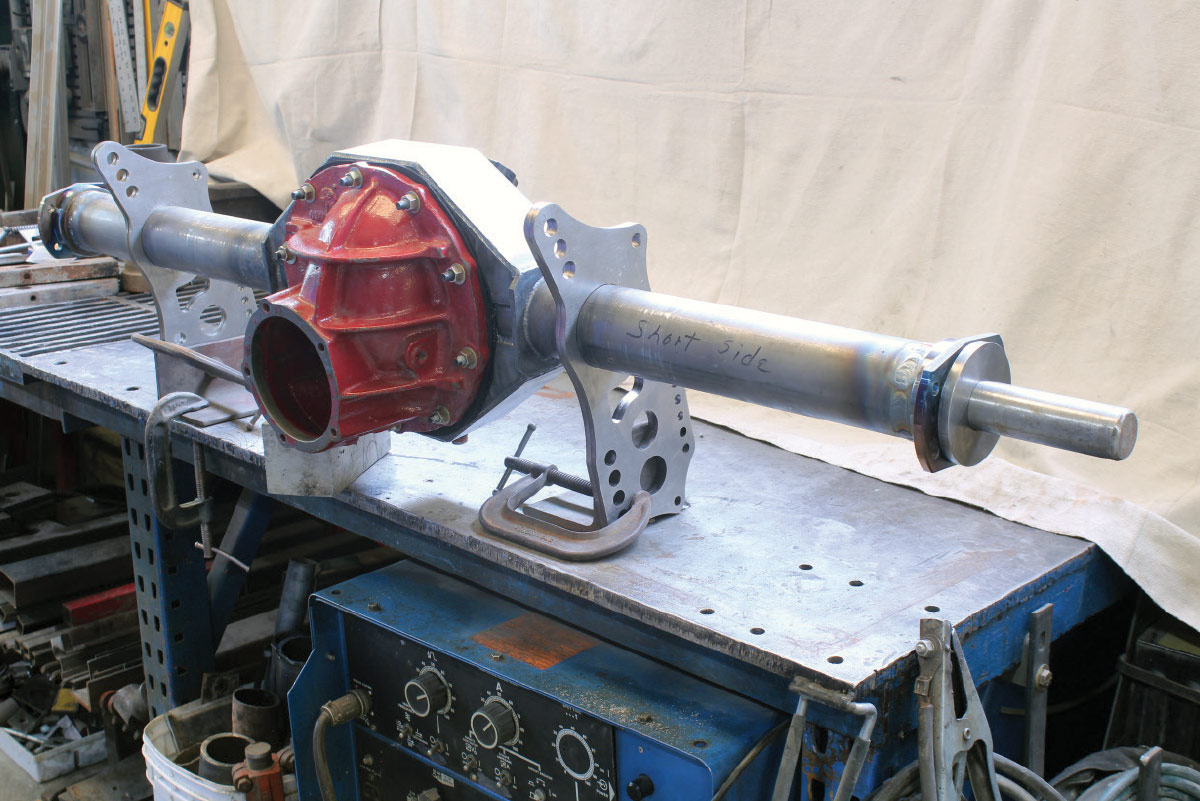
Once Colin established the necessary tread width, axle ends from JEGS (PN 555-62642) were welded onto the housing. These axle ends accept the large Ford wheel bearings (3.150-inch od) and come with ends that have a “stepped down” portion designed to slide into the end of the OEM axle tubes and weld on. However, for this application, the reduced-diameter projection had to be cut off as it wouldn’t fit into the thick-wall fabricated housing.

When installing the ends on an axle housing, it is crucial that the axle bearings are perfectly aligned with the differential side bearings. Any misalignment will put the axle bearings in a bind, leading to premature failure. The way to install axle ends on a housing correctly is by using a dedicated fixture. It consists of inserts that fit into an empty third member housing, a solid 1-1/2-inch bar that is longer than the width of the housing, and another pair of inserts fit into the axle ends to hold them in the proper location for welding.

For a centersection, Colin selected a JEGS Ford 9-inch third member assembly with a Trac-Lok limited-slip differential (PN 555-60692). These assemblies begin with a new nodular iron housing and are assembled with new bearings, seals, a heavy-duty Daytona pinion support, and a choice of popular gear ratios. In this case, a 3.70:1 ring-and-pinion combination was chosen.

As the axle housing was a custom width, custom axles were also required. To make getting axles that fit perfectly, JEGS offers Allstar Performance “cut-to-fit” axles with extra-long splines that can be trimmed as necessary. For our application, JEGS supplied one 29-1/2-inch axle with 10 inches of splines (PM 049-ALL67501) and one 33-inch axle with 9 inches of splines (PN 049-ALL67503). These axles come with Ford “big” tapered wheel bearings and the retaining sleeves in place.

At this point, we should explain the difference in Ford late-style “big” rear wheel bearings. Depending on the application, Ford used either sealed ball bearings or tapered roller bearings in 9-inch assemblies. As the name implies, the ball bearings are packed with grease that is sealed inside, while the tapered bearings are lubricated by the rearend’s gear oil. While sealed ball bearings are more than adequate for most street applications, tapered bearings have a higher load-carrying capacity and withstand greater side loads (from hard cornering, such as in road racing or autocross) than ball bearings due to the greater contact area between the rollers and the race. Although both bearings have the same 3.150-inch od, where confusion can crop up is with the id; the sealed bearings measure 1.5312 inches while the tapered bearings measure 1.563 inches. That means the axles are different diameters where the bearings ride; consequently, specific axles are required for each type of bearing. Although bearings can’t be swapped between axles, the entire assemblies (axles and bearings) will interchange.

Thanks to JEGS, the Radford’s fastback has a custom width, a Ford 9-inch rearend built entirely with aftermarket parts. Next time, we’ll show the Mustangs’ new rear suspension as we continue telling Pony Tales.

Exterior view of a clean, unpainted custom metal axle housing with long tubes extending from a central differential.
2. Our Rhoades Racing–fabricated axle housing features a billet aluminum fill plug and a drain plug at the bottom of the housing. Rhoades Racing’s axle housings are available in mild steel or chromoly, with widths up to 60 inches. Mild steel or chromoly back braces are also offered.
Interior view of an empty custom metal axle housing showing the internal welds and pinion hole.
3. Rhoads Racing fabricates 9-inch axle housings in mild steel that come with 3-inch axle tubes (shown). Chromoly housings feature 3-1/2-inch axle tubes. A variety of options, including back braces, suspension brackets, and axle ends are also available.
A man in gloves uses a pipe cutter on a metal axle tube attached to a differential housing in a machine shop.
4. To reduce the housing to size, Colin used a pipe cutter to cut the mild steel axle tubes, as it makes a straight, clean cut.
Close-up of a hollow, silver metal axle tube showing the thickness of the steel and a beveled edge.
5. To ensure weld penetration, the ends of the axle tubes have been beveled.
A vertical metal ruler measures the height of a custom axle assembly.
6. Before welding the axle ends, the four-link suspension brackets were slid into position.
Perspective view of a solid steel alignment shaft passing through a red painted differential carrier.
7. Our good friend, the late Wayne Atkinson, made this alignment fixture for welding the ends on 9-inch Ford axle housings. An empty differential housing with machined bushings positions the alignment bar in the center of the bearing bores.
A long steel alignment shaft labeled "Alignment Shaft for 9-inch Ford Rear End" resting in a red differential housing.
8. On the outer ends of the alignment bar, there are a pair of alignment bushings that fit into the axle ends and hold them in place during welding. The alignment bar is a slip fit in the differential bushings.
Two polished steel circular metal flanges with four bolt holes each, used for axle housing ends.
9. JEGS 9-inch Ford axle ends accept the large 3.150-inch od bearing (either sealed or tapered style).
A red differential carrier assembled into a custom silver axle housing with metal brackets, clamped to a workbench.
10. With the mockup centersection bolted in place, the alignment bar is slipped in place, and the axle ends are positioned for welding.
Close-up of a welded metal flange on a steel axle tube, showing heat discoloration and a precise circular weld.
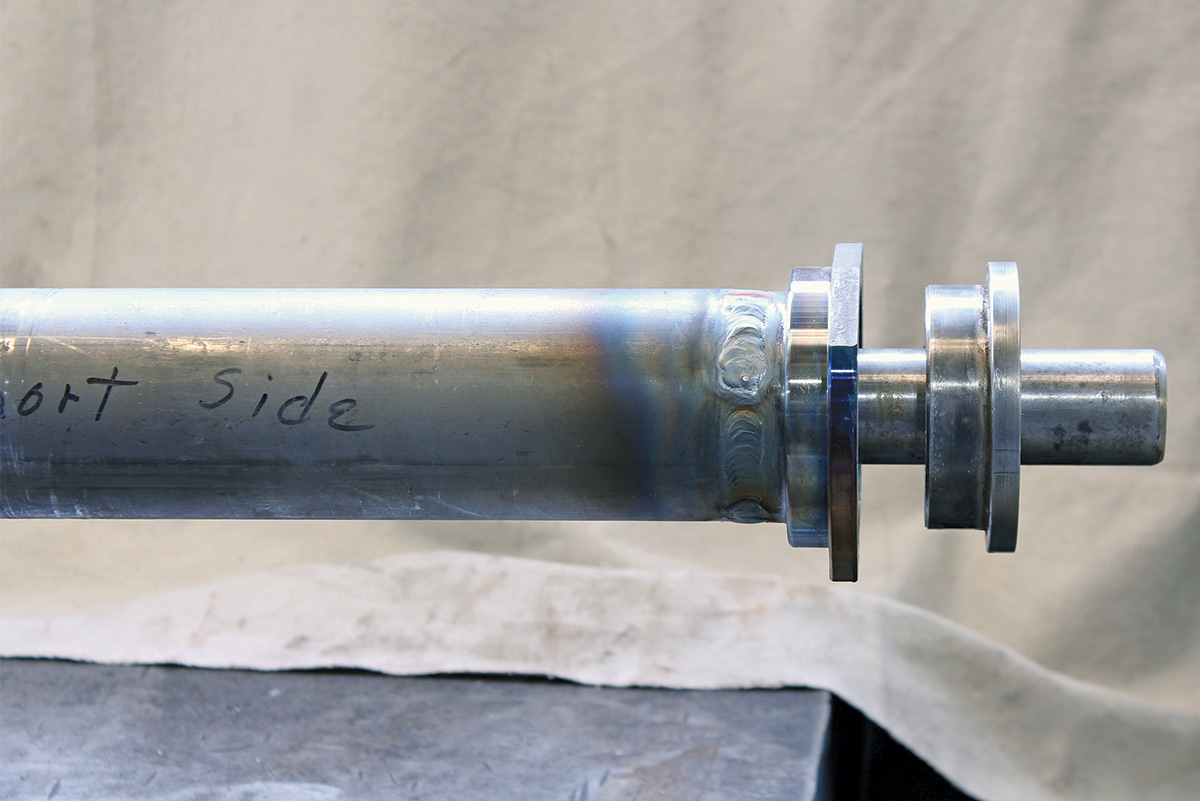
11. During welding, the alignment fixture holds the axle ends in their proper position. After the welds have cooled, the alignment bushings are easily removed, confirming that proper alignment has been maintained.
Top view of a red differential carrier with a black yoke and a white identification tag attached.
12. The new JEGS Ford 9-inch third member assembly comes preassembled and ready to install. It comes with a 1310-series U-bolt–style pinion yoke, which is a common size for multiple applications.
Detail of a differential assembly showing a large ring gear with yellow marking compound and heavy-duty bearing caps.
13. JEGS nodular iron case features 2.891-inch carrier bearings, a high-quality 3.70:1 gearset, and a clutch-style positraction differential available for 28- or 31-spline axles.
Two long, custom steel axle shafts with splined ends and circular flanges resting on a white surface.
14. Allstar cut-to-length axles feature extra-long splines to enable shortening of the shafts as needed. The shafts are equipped with new-style large Ford tapered wheel bearings already installed.
Angled view of two steel axle flanges with multiple bolt holes, attached to long drive shafts.
15. The Allstar axles are drilled for 0.687-inch press-in style wheel studs and accommodate multiple wheel bolt patterns, including 5-on-4.5, -4.75, and -5 bolt circles. The axles feature 0.470-inch-thick flanges with a 5.94-inch od and a 3.06-inch hub register to help center most rotors and drums.
A 10-piece kit of black Ford 9-inch housing studs sealed in clear plastic packaging.
16. JEGS supplied the press-in studs (PN 555-60661) to secure the differential case to the axle housing.
Using a yellow tape measure to check the distance between a bearing and the axle housing flange.
17. With the centersection in place and the axles installed, Colin determined how much each shaft needed to be shortened.
A person using a silver marker and a yellow tape measure to mark a specific point on a splined metal shaft.
18. Colin followed the “measure twice, cut once” rule, then marked the axles for shortening.
A technician using a high-speed cutoff wheel to create sparks while cutting a splined steel axle shaft.
19. With lines all around the axles to follow, the axles were cut with an abrasive disc on an air-powered grinder.
Close-up of a freshly cut and beveled splined end of a steel axle shaft resting on a workbench.
20. After trimming, the ends of the axles were beveled slightly to help them slide into place.
A yellow and black spray can of JEGS Brake & Parts Cleaner standing upright against a light grey fabric background.
21. To prevent contaminating the new differential assembly with debris from grinding and cutting the splines of both axles, they were doused with JEGS brake and parts cleaner (PN 555-7231) before installation.
Two flat, U-shaped metal mounting plates with four bolt holes each, resting on a light grey textured surface.
22. Included with the Allstar axles are the retainers for large bearing housing ends. Unlike the solid style, the U-shaped design lets them be installed after pressing the bearings onto the axles.
Close-up of hands installing a silver metal axle flange with several protruding bolts onto the end of a steel axle tube.
23. Along with the bearing retainers, brackets for the CPP disc brakes were also bolted in place. When measuring for the rearend width, the thickness of the brake drum or rotor must be included.
Under-car view of a custom silver rear axle housing installed with high-performance coilover shocks and adjustable suspension links.
24. Here is the newly installed 9-inch. The four-link coilover rear suspension also comes from JEGS.
A small white plastic bottle of JEGS Limited Slip Differential Axle Additive Concentrate with a red applicator tip.
25. To prevent clutch-style limited-slip differentials from chattering, JEGS offers a friction modifier to add to the gear oil. It can be used with conventional and synthetic gear oil.

Modern Rodding
VOLUME 7 • ISSUE 64 • 2026