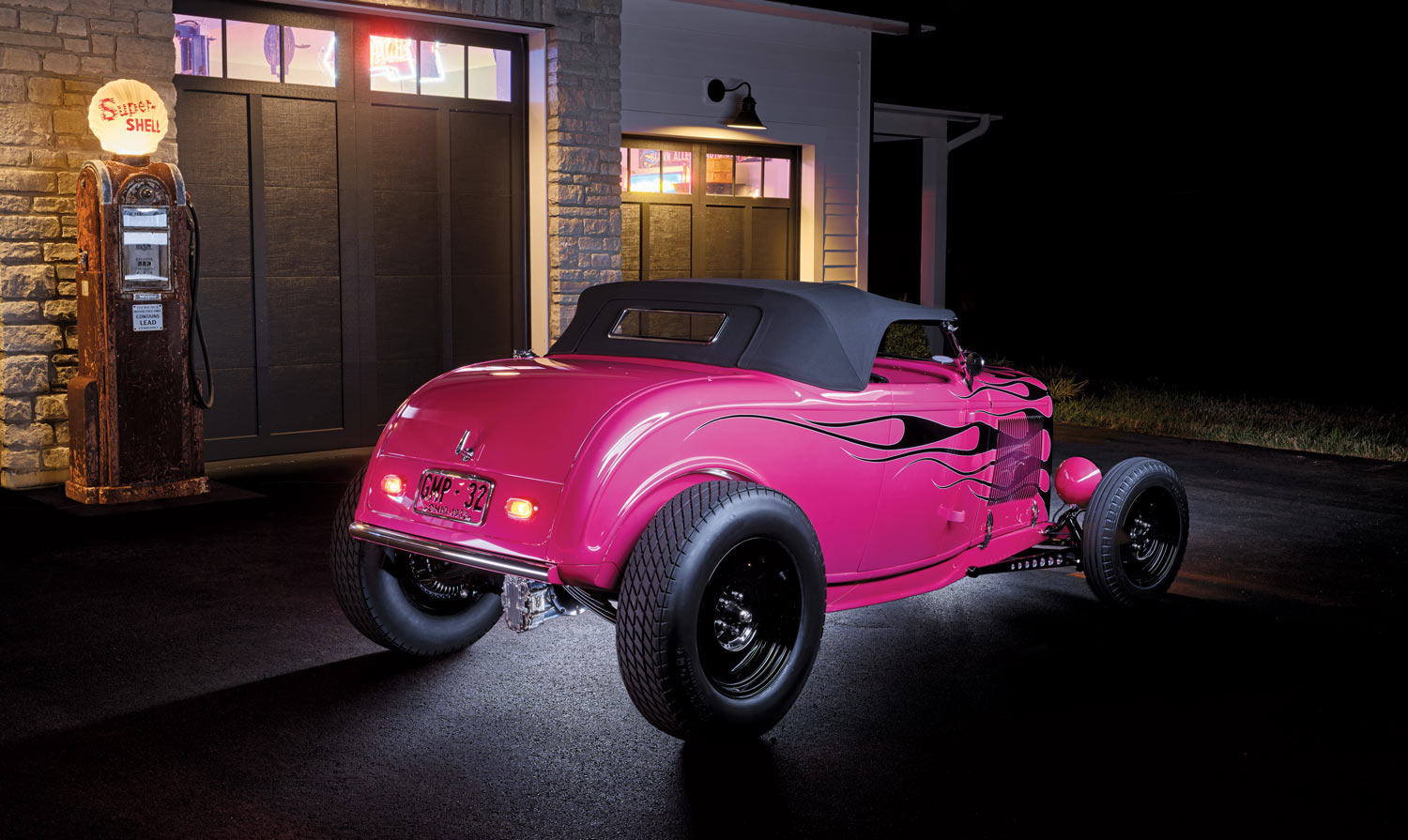


 Photography by NOTSTOCK PHOTOGRAPHY
he bustling atmosphere of the Pomona Fairplex echoed with excitement as car enthusiasts gathered for the 74th Annual Grand National Roadster Show. Vibrant colors and polished chrome, but one build caught everyone’s eye—a stunning, striking masterpiece that drew a crowd around it like moths to a flame. But it didn’t stop there as this 1932 Ford highboy roadster, owned by MeKenzie Murphy, went onto the 2nd Annual Triple Crown of Rodding, capturing the Best Street Rod and a stunning array of other awards.

To my right I asked Alan Johnson of Johnson’s Hot Rod Shop (JHRS), “Why don’t you tell me about this beauty? I’ve dubbed it the pink roadster, but you can give me its true name!”
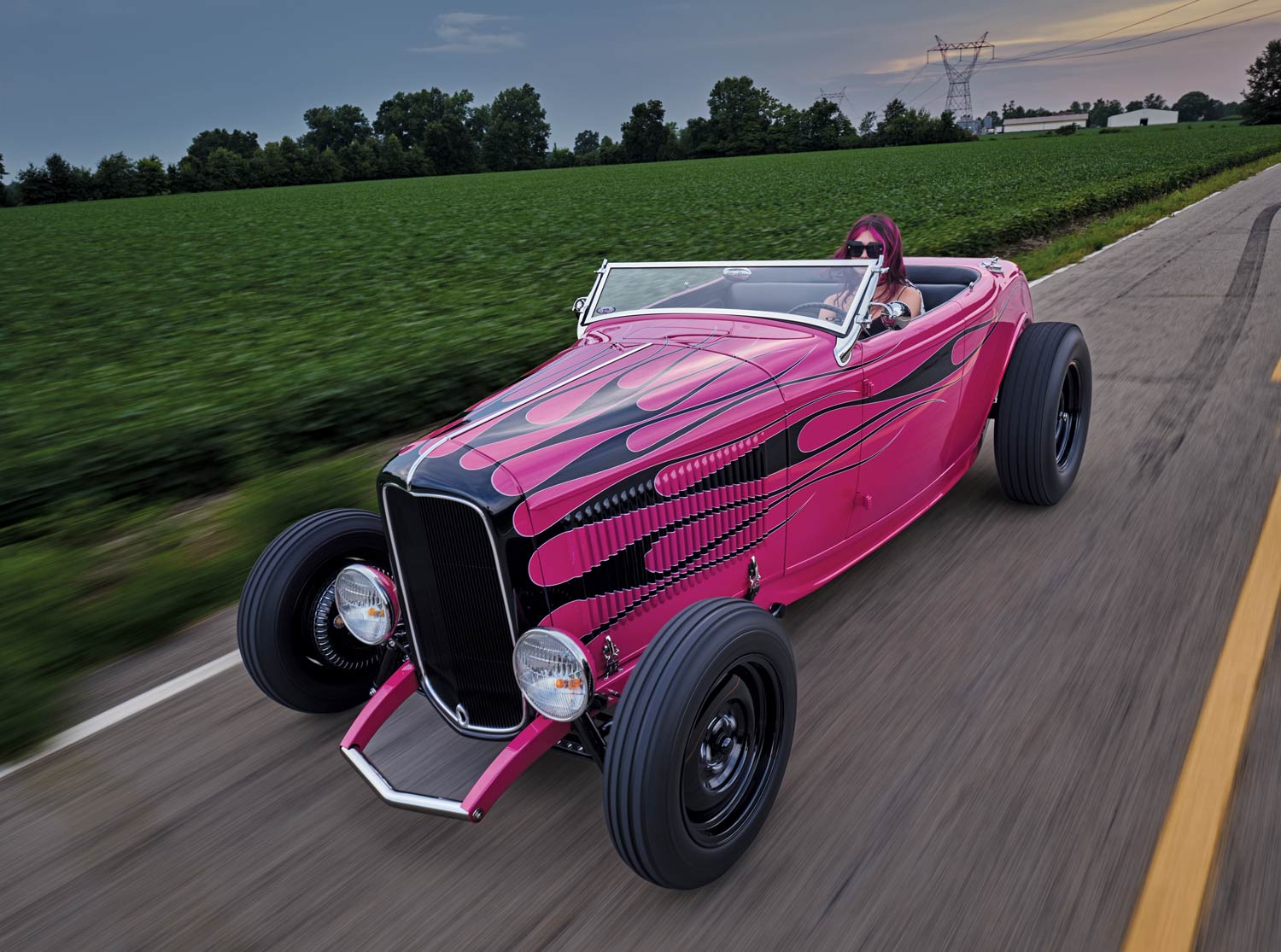
Johnson chuckled. The hot rod was indeed a sight to behold. Its brilliant color was hard to describe—a dazzling magenta that shimmered in the light, accentuating the meticulous craftsmanship that went into its creation. “You’re right—naming it simply ‘Pink’ would be a disservice,” Johnson remarked. It is a custom candy pink from Axalta, with the final bodywork and paint all accomplished at JHRS.
The cockpit area of the body was extended 4-1/2 inches, coupled with a JHRS stretched 2-inch Rootlieb steel hood, plus a curved lower hood panel completing the hood to the bodyline at the corners. From here, a 2-inch chopped windshield is leaned back 25 degrees from stock. It should also be noted that the rear quarter-panels and bodyline were reshaped. There is also a custom-fabricated JHRS top with a Rod Top covering.
Now, let’s talk about the tires and wheels. Johnson quickly launched into the specifications: “Firestone by Coker Dirt Track ribbed fronts measuring 5.00-16 with Firestone by Coker measuring 8.20-18, a classic dirt track grooved appearance on the rear. Vintage look, modern processing!” However, there is more, as the wheels were made from 6061-T6 aluminum by JHRS in a 16×5 measurement to represent the 1940’s Ford steel wheel. (Currently, no one is making this wheel in an 18×7 size.)

As Johnson painted a picture of MeKenzie’s journey, he recounted how her family had been intertwined with his shop for years—a bond that brought about this remarkable build. “At first, I wasn’t sure about the concept of a pink hot rod,” Johnson admitted, laughing. “Angie [his wife] was more open to it than I was, but I was sold once we began discussing what MeKenzie wanted.”
He described how they collaborated with Gary Ragle of Ragle Designs, who brought their vision to life through renderings, eventually settling on the vibrant magenta that matched MeKenzie’s childhood dreams. “We tried many colors, but none seemed right until we finally decided on this candy coating. It was tricky, but the results speak for themselves.”
A work of art by Josh Shaw, who had the honor of designing the “Ohio-style” flames that adorned MeKenzie’s childhood pedal car. “The flames echo the pink of the pedal car, showcasing that playful spirit,” Johnson explained.
Johnson goes on to reveal more fascinating details about the build. He points to the stretched wheelbase, the custom modifications, and the thought that went into every component—the repurposed parts that give the vehicle style and function.

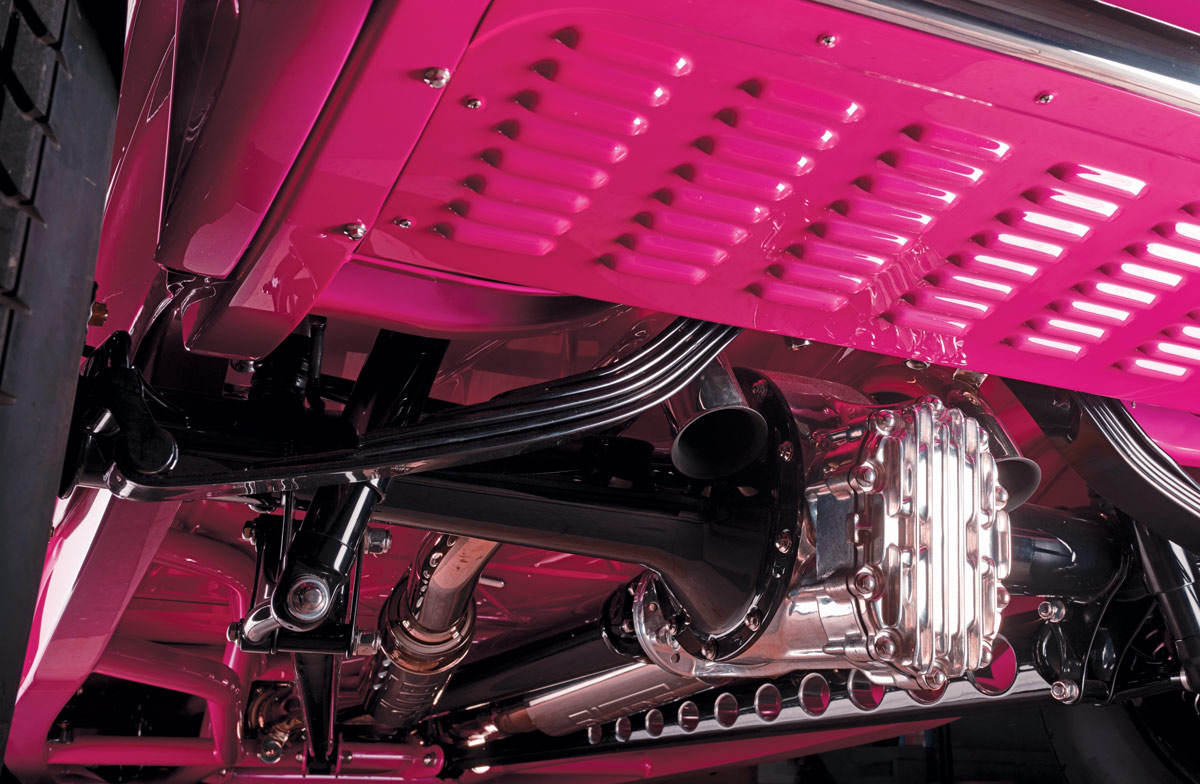


Backed up to the small-block Chevy is a Bowler Performance 4L60E with an electronic overdrive and a JHRS custom-made shifter. A Driveline Performance driveshaft is the go-between for the trans and the Winters quick-change rearend.
As mentioned earlier, the perimeter is based on Shadow Rods framerails. Once in-house, JHRS stretched the wheelbase by 2 inches while the rear was kicked up and bobbed. The customarily exposed Deuce gas tank, now a Rick’s Tanks, resides within the trunk. The front axle is a Pete & Jakes 5-inch drop chromed-and-drilled I-beam attached to a pair of Pete & Jakes early Ford spindles. Ridetech tube shocks and a Vega steering box with JHRS steering arms are included. Front braking is reminiscent of the early Kinmonts in front and back. The JHRS Kinmont kits feature 10.5-inch rotors with four-piston Wilwood calipers in front and drums in back. A JHRS Hole Shot brake pedal and a Wilwood master cylinder assist in the stopping. Sticking with attention to detail, you will see polished stainless ARP fasteners throughout the build.
An American Autowire harness positioned at JHRS allows the flow of “juice” to keep the gauges, the Vintage Air Gen II A/C system with heater and defroster, and the remainder of the roadster electrics running. Another focal point within the interior is the JHRS stainless four-spoke wheel controlling the Ididit steering column. The bench seat is a custom piece by JHRS inspired by what one might see in a modern Bugatti. Heaters are also buried within the seating to make those brisk morning drives more comfortable. The seat is covered in black Garrett leather, while the carpet is black Mercedes Wilton wool. The skillful stitchwork is more of the JHRS handiwork. Note the pair of seatbelts are by Juliano’s.
Every aspect of the car, from the neat layout of the gauges to its intricate flame design, was a labor of love that told a story of a passionate family and a bright young woman finding her place in the world of hot rods. “We’ve created a car that can be enjoyed, one that’s about style, comfort, and—most importantly—fun!” Johnson concluded, looking around at the audience that was now thoroughly captivated.
As the tour of the pink roadster came to an end, I thanked Johnson. What a pleasure it has been to learn about this incredible build with him. “Cheers to creativity, craftsmanship, and the spirit of the open road,” he said, wrapping up with a smile that reflected the joy this car represents.