
Modern Rodding Tech
InTheGarageMedia.com
1955 Chevrolet Bel Air gasser with matte black paint and Blasphemi lettering, sporting a custom drag race build
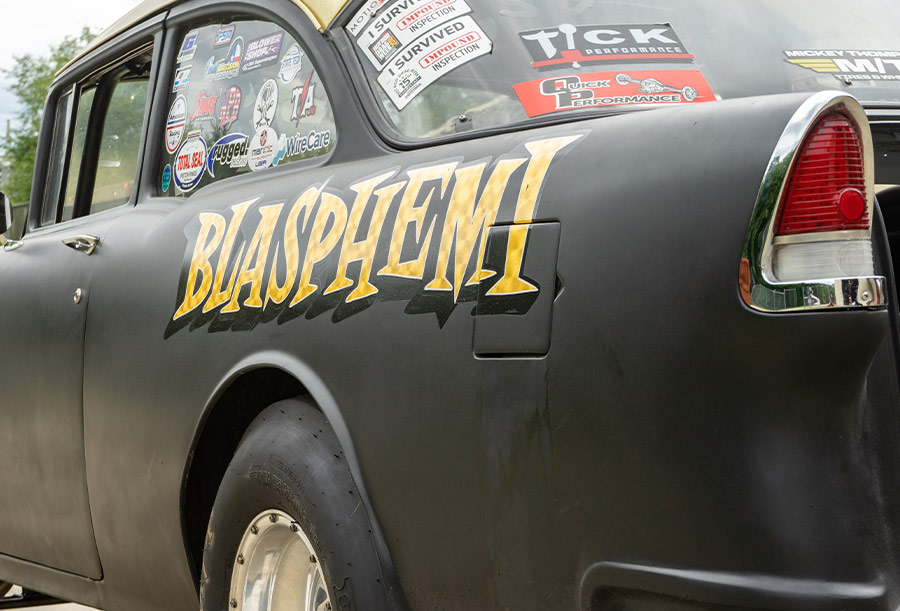
1. Mike Finnegan’s 1955 Chevy “Blasphemi” is powered by a blown and injected 528ci Hemi. The gasser has run a best of 161 mph with an 8.52 e.t. There are likely even more impressive numbers to come.
Making a Good Gasser Great typography
Swapping a Straight Axle for an IFS
By Ron Ceridono Photography by Camren Beattie
T

wo of the most recognizable names on the contemporary hot rod scene are Mike Finnegan, host of Finnegan’s Garage and co-host of the Road Kill television series, and “Blasphemi,” his supercharged Hemi-powered 1955 Chevrolet gasser. Recently, Finnegan became involved with another well-known name, Scott’s Hotrods ’N Customs, when he decided to convert his Chevy from a straight axle to an independent front suspension.

Of course, there were those who were quick to criticize the decision to remove the straight axle from a traditional gasser, but there were a number of reasons for making this suspension swap. Blasphemi was known for pulling amazing wheelies, but when the Chevy did come back to the earth, the suspension would compress enough that a variety of frontend components would hit the Hemi’s oil pan hard enough to do damage.

Switching to a dry-sump system with its shallower pan didn’t solve the problem, as there was still interference with the pump lines. Raising the car to increase axle, tie rod, and draglink clearance did little to help the clearance problem and did a lot to make the car handle badly. The car didn’t launch well, and shifting into Fourth gear at 150 mph on the top end of the dragstrip would drop the supercharged Hemi’s rpm right in the middle of its torque curve. That would cause the rear tires to spin, making the car move around somewhat unpredictably. It was indeed an eye-opening and sphincter-puckering experience for the driver, and the car was unhappy in that situation, too. The decision was to convert to an IFS to solve all the persistent challenges to getting Blasphemi down the quarter-mile.

While there were various race-related reasons to swap the straight axle for an IFS, improving its ride and handling qualities on the road were also considerations. While not something that race cars usually have to deal with, Blasphemi can rack up a thousand or more miles during drag and drive events, traveling to various racetracks while towing a trailer with tires and tools. Finnegan has even been known to take his kids to school in the Chevy, undoubtedly making him the coolest dad in the drop-off line.

While there were already many good reasons for replacing the straight axle, a return road incident involving an immovable object and Blasphemi’s front suspension pushed the suspension modification to the top of the “to-do list” and prompted a call to Scott’s Hotrods. As Finnegan explains, “I called him and said, I know you don’t normally do this, but I’d like to build a one-off frontend with a lot of travel and a ridiculous crossmember that looks out of place. They did just that, and it came out awesome.”  

Based on a custom crossmember, the Scott’s Hotrods frontend uses their tried-and-true tubular control arms, Wilwood spindles and brakes, manual rack-and-pinion steering, and Viking coilovers. The new crossmember cures all the clearance issues, and 7-1/2 degrees of caster helps the car stay straight. With 8 inches of total suspension travel, the increased suspension droop at the launch not only helps transfer weight to the rear tires but wheelies now result in the front tires being a foot off the ground instead of three, and the “landings” are much softer and don’t upset the chassis. Thanks to the new suspension system and steering, Finnegan reports the car is much easier to drive and “happier” and safer on the top end, too. At this year’s Drag Week, he said, “On one of the first passes we made today, we wheelied, and from the driver seat I thought it was a 4-foot wheelie, but it was only about a foot.” Mike added, “Because the wheels droop so much, it’s an exciting sensation.

While an IFS under a gasser may be sacrilegious by some, at the peak of their popularity, there were several record-holding gassers with A-arm front suspensions (some of us can remember the ball joint spacers for jacked-up frontends that were once popular). Given Finnegan’s success in making a good gasser better with this IFS conversion, there’s no point in arguing that these cars must have a straight axle, and Blasphemi proves that point.

Front suspension and steering setup of the 1955 Chevrolet Bel Air gasser, featuring a tubular frame and reinforced components
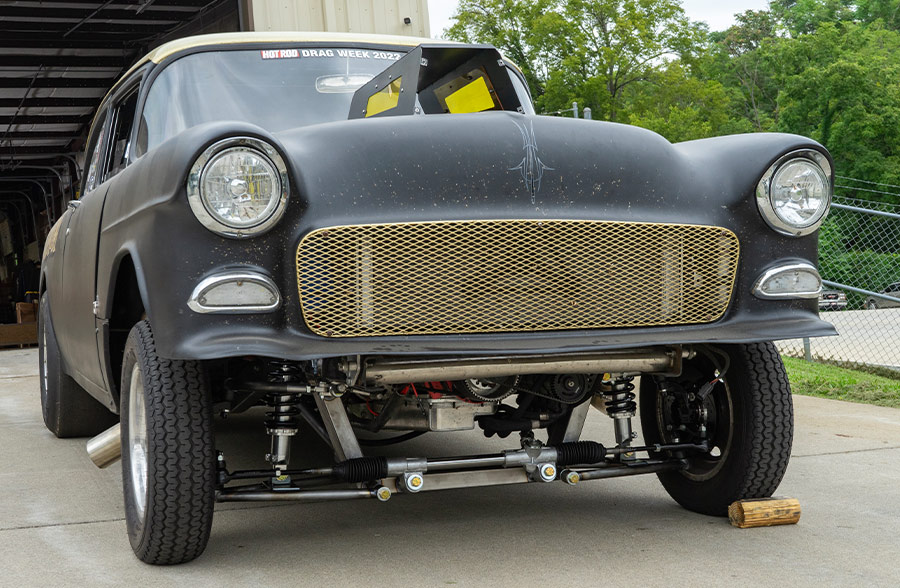
2. Scott’s Hotrods ’N Customs fabricated a unique independent front suspension with coilovers to replace Blasphemi’s straight axle and leaf springs.
Close-up of the belt system and accessories under the hood of the 1955 Chevrolet Bel Air gasser
3. The original straight axle front suspension was due for an update, particularly after a return road mishap caused some damage—note the bent tie rod.
Mechanic working on the front end suspension of the 1955 Chevrolet Bel Air gasser, with attention to the steering rack
4. The front axle assembly was rolled out from underneath the Chevy, once the steering, springs, and brake lines were disconnected.
Detailed shot of the custom fuel and ignition lines beneath the 1955 Chevrolet Bel Air gasser
5. A Jim Meyer rectangular tube frame replaced the original ’rails years ago but would remain with minor modifications. Scott’s Hotrods now offers a weld-on Gasser IFS Front Clip made from mandrel-bent 2×4-inch tubing for stock frames.
Sparks flying during modification work on the chassis of the 1955 Chevrolet Bel Air gasser
6. The first step in the suspension update was to remove the spring hangers on both sides. Scott’s Sev Blake was responsible for the IFS installation.
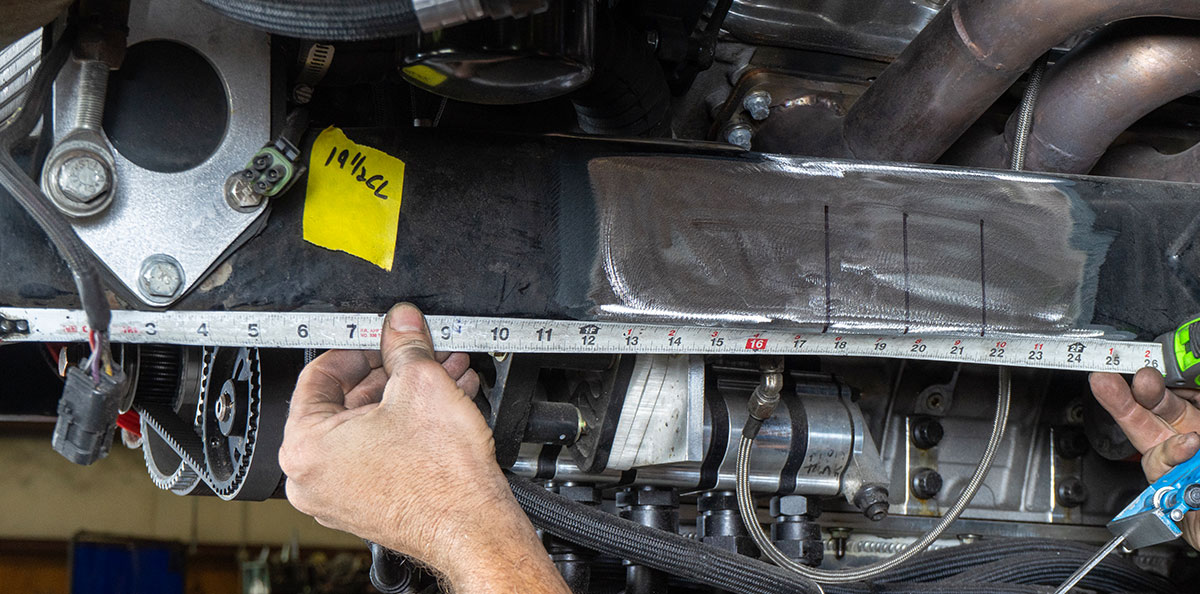
Measuring the crossmember for fitting in the custom chassis of the 1955 Chevrolet Bel Air gasser
7. Careful measurements were taken to locate the new front crossmember so the wheelbase would be unchanged.
Complete front suspension assembly kit laid out, likely for installation on the 1955 Chevrolet Bel Air gasser
8. This is a typical Scott’s IFS kit with tubular control arms, rack-and-pinion steering, and coilovers. For Blasphemi’s application, an entirely new crossmember was required.
Custom crossmember and suspension arms mounted under the 1955 Chevrolet Bel Air gasser chassis
9. The deep-drop front crossmember, made from 2×4-inch, 3/16-inch wall tubing, was necessary to maintain the gasser’s stance and provide the desired suspension travel.
Final suspension adjustments being made on the 1955 Chevrolet Bel Air gasser during chassis fabrication
10. Scott’s upper and lower tubular control arms are TIG welded and come with Hyper-Flex X-Treme Duty polyurethane bushings.
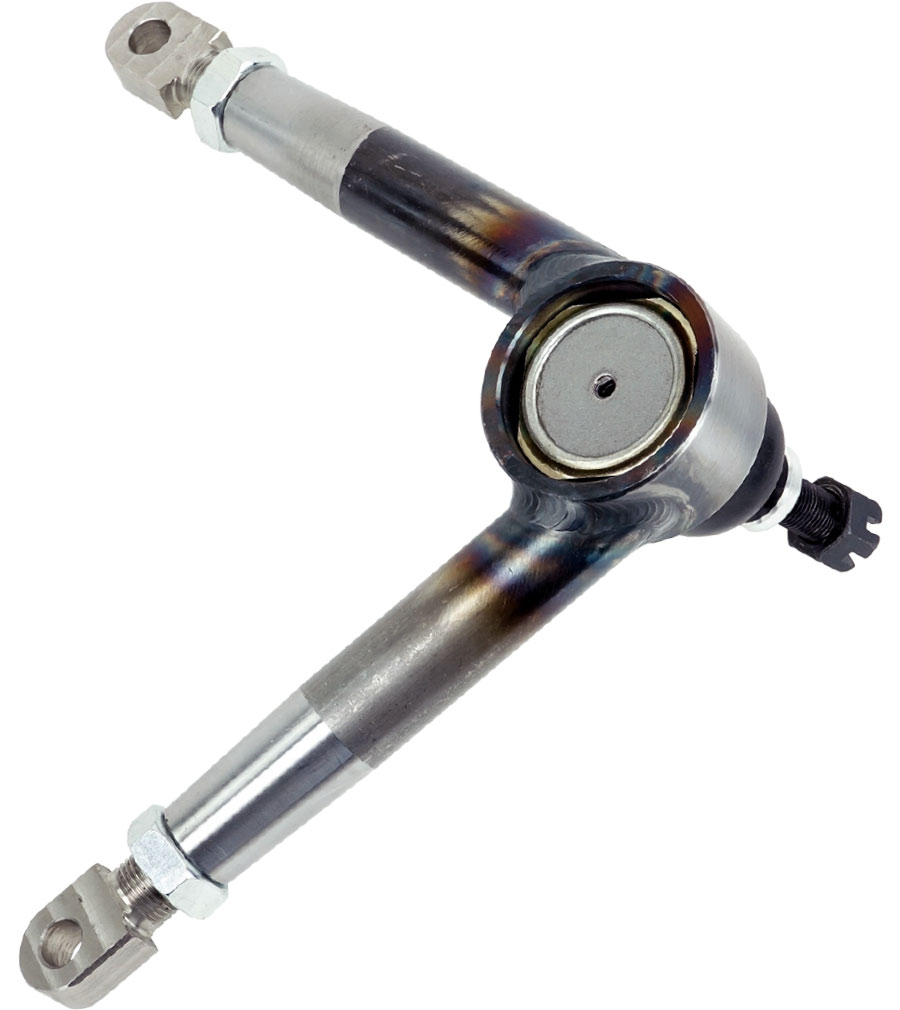
Tubular control arm for the 1955 Chevrolet Bel Air gasser front suspension, showcasing robust construction for drag racing
11. Scott’s upper control arms use unique treaded ends that provide straightforward caster and camber adjustments.
Custom front suspension and crossmember fabrication under the 1955 Chevrolet Bel Air gasser during chassis work
12. Here the passenger side upper control arm has been attached to the stainless steel pivots.
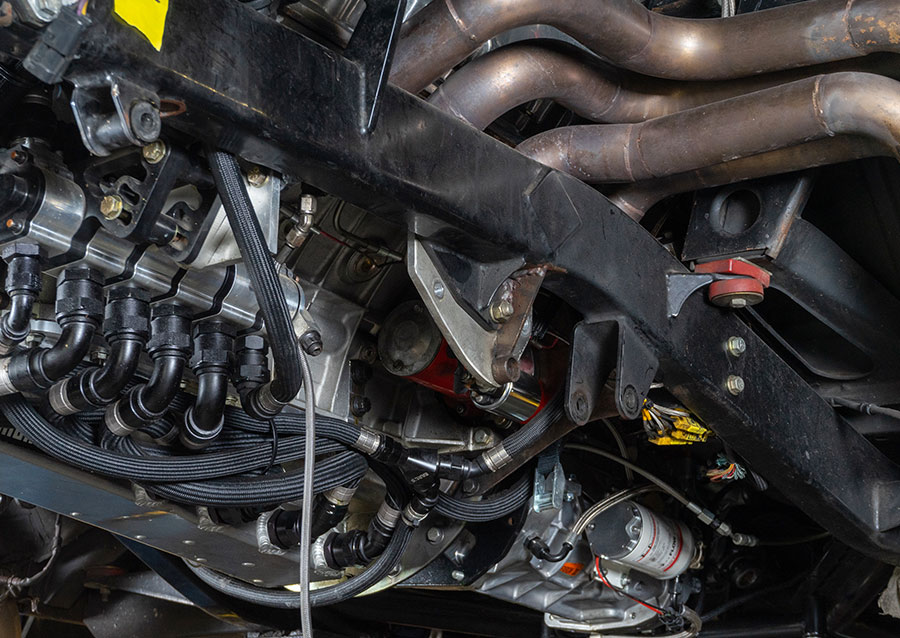
Close-up of the engine bay and custom tubular frame setup on the 1955 Chevrolet Bel Air gasser project
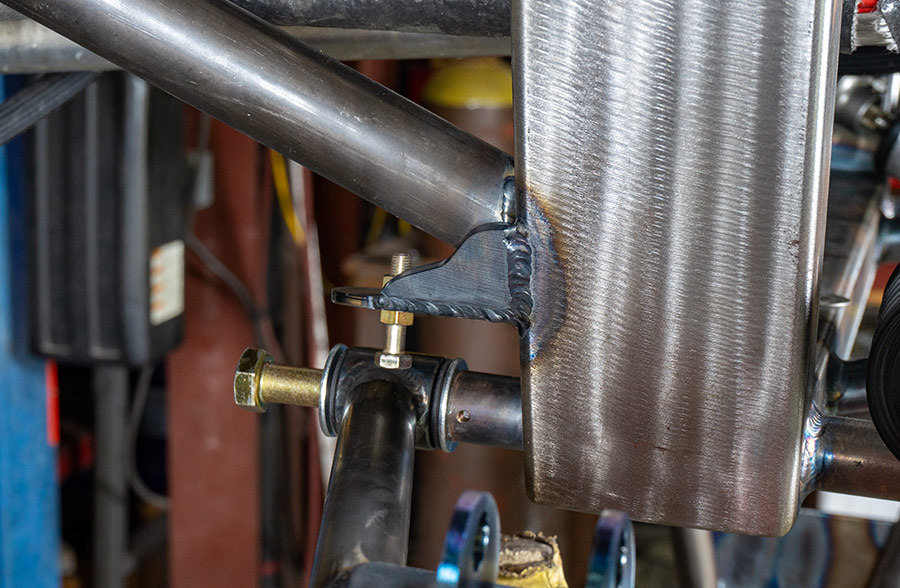
13. Due to the long suspension travel, it was necessary to notch the framerails for upper control arm clearance.
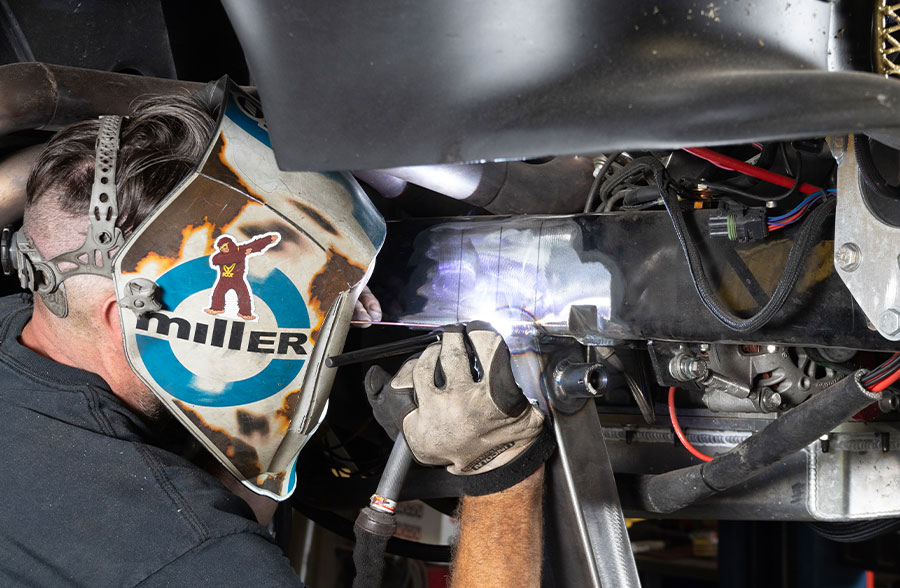
Welding in progress on the custom front suspension of the 1955 Chevrolet Bel Air gasser for added reinforcement
14. With the crossmember located, it was welded in place, and the notch for the control arm was boxed.
Mechanic installing the front suspension components under the 1955 Chevrolet Bel Air gasser chassis
15. The ball joint cups in the upper and lower control arms have been angled to accommodate the 8 inches of suspension travel without binding.
Front disc brake assembly installed on the 1955 Chevrolet Bel Air gasser, featuring high-performance components
16. Wilwood Pro Spindles are used along with Wilwood aluminum hubs and 11-inch drilled-and-slotted rotors.
Wilwood caliper for the 1955 Chevrolet Bel Air gasser's braking system, known for its superior stopping power
17. The front brake package is completed with Wilwood four-piston calipers.
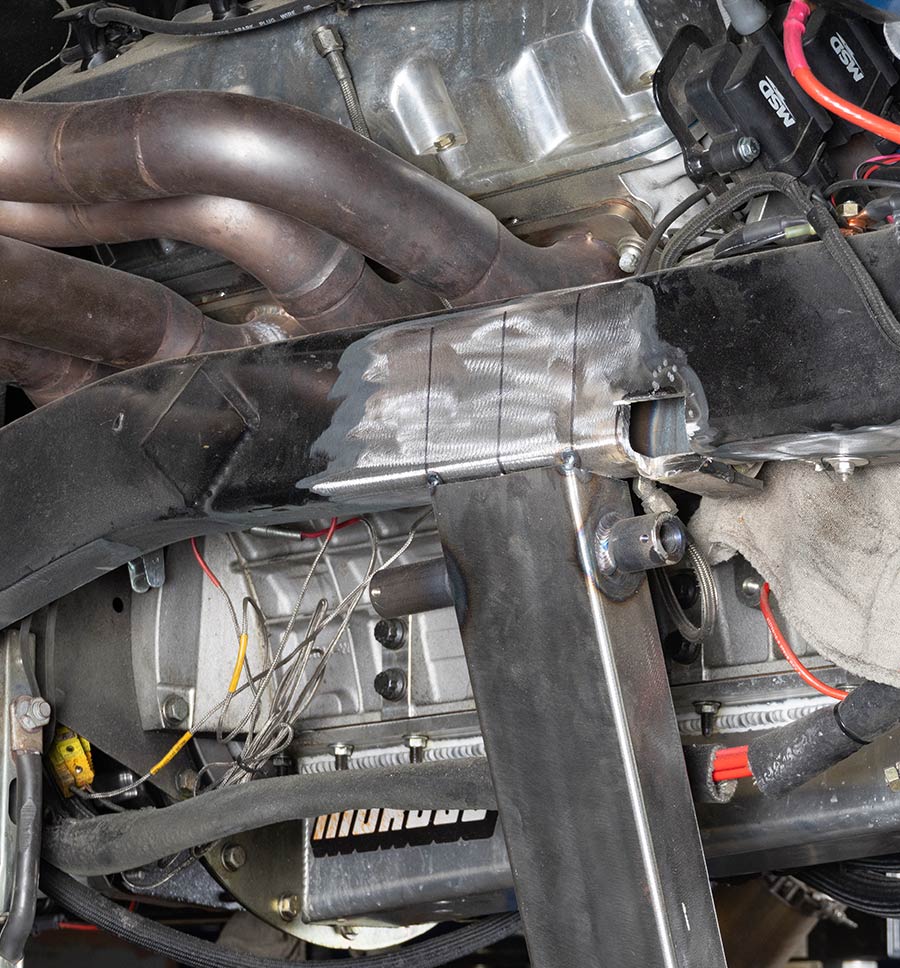
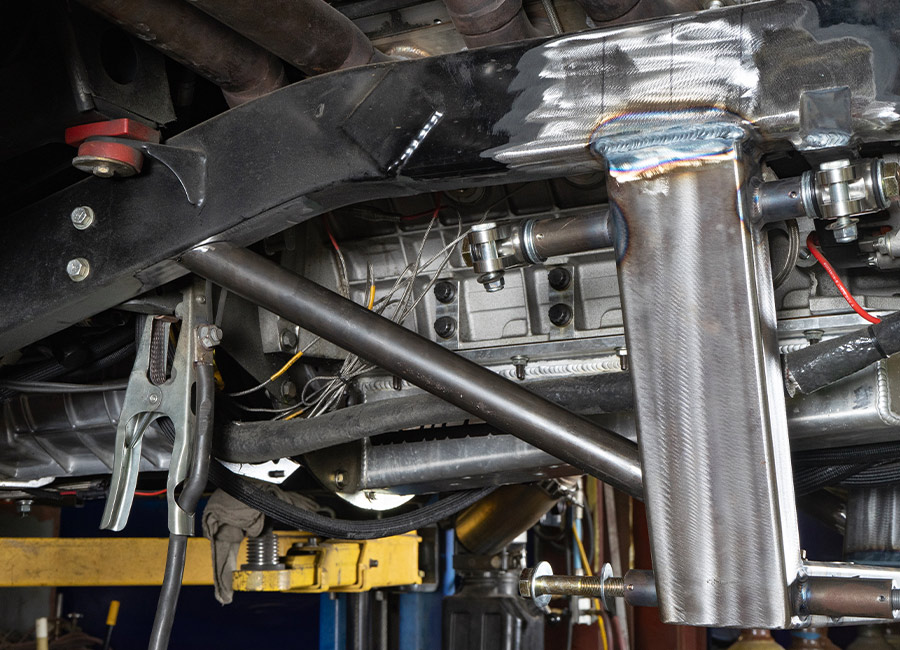
Chassis detail showing a reinforced crossmember in the 1955 Chevrolet Bel Air gasser’s front end
18. A diagonal bracing between the front crossmember and the framerails was added on each side for more strength.
Rack and pinion steering system for the 1955 Chevrolet Bel Air gasser's precision handling and performance
19. The manual rack-and-pinion steering improved the “road feel” and eliminated clearance problems with the original draglink.
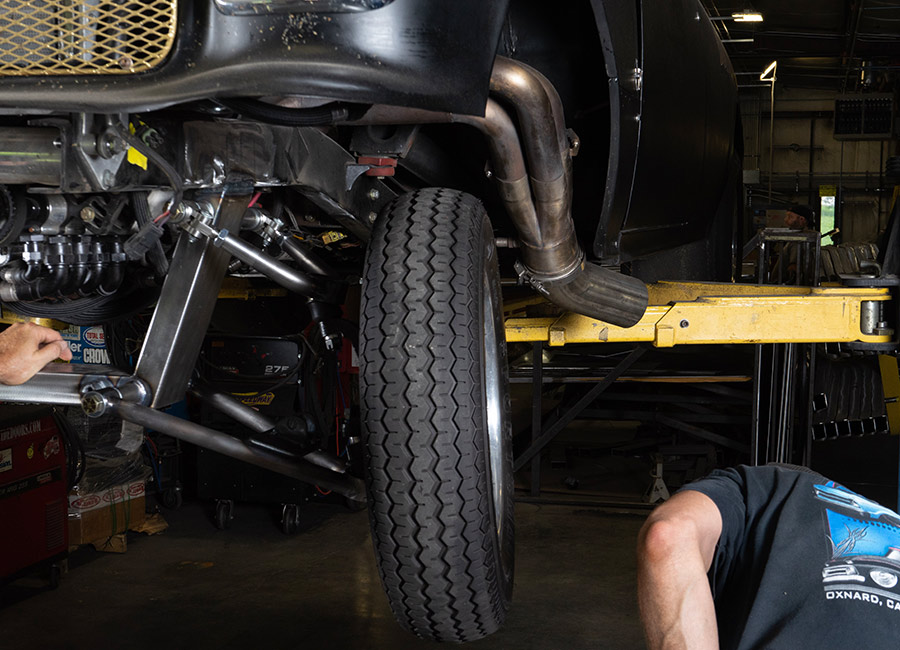
Mechanic mounting the front wheel onto the 1955 Chevrolet Bel Air gasser, completing the custom suspension installation
20. Thanks to the IFS, the front wheels can move up without fear of damaging the dry-sump components. Compression is 3 inches compared to 2 inches for the straight axle.
Mechanic working on the 1955 Chevrolet Bel Air gasser, adjusting the front suspension components during installation
21. Full extension with the IFS has more than 5 inches of drop compared to less than 2 inches with the axle, which really helps with weight transfer off the line.
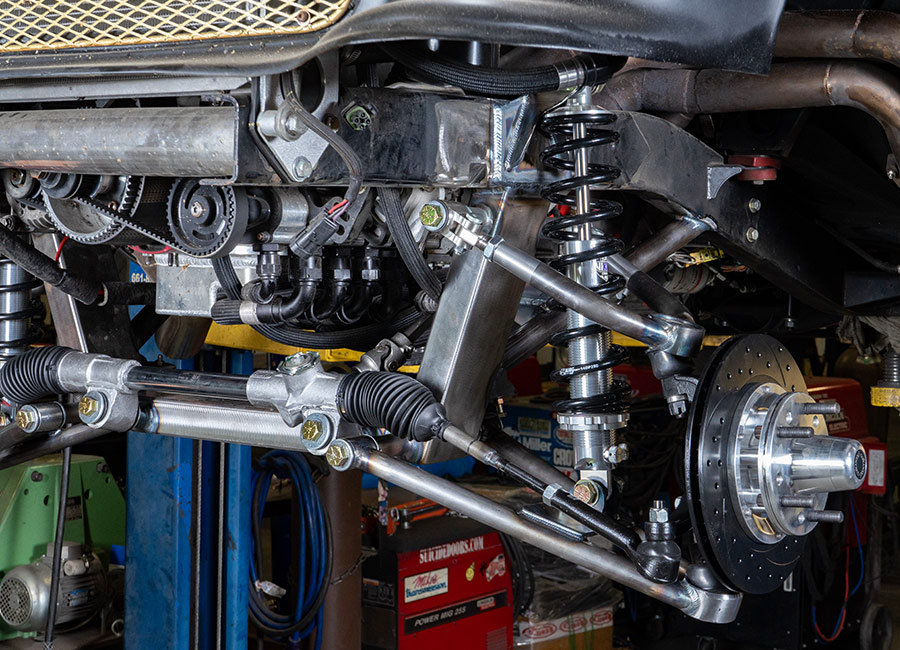
Front suspension setup on the 1955 Chevrolet Bel Air gasser, showcasing tubular control arms, coilovers, and disc brakes
22. Viking coilovers are used up front. They feature high- and low-speed compression damping along with rebound damping adjustment.
Complete weld to underside of frame to suspension 1955 Bel Air
23. Suspension stops were added to keep the Viking coilovers from bottoming out during full suspension compression.
Finished and put back together 1955 Bel Air after suspension job.
24. While the look of the new suspension takes some getting used to, there’s no denying its effectiveness, and that’s what’s important.
Rear View of 1955 Bel Air Gasser, showcasing custom racing name
25. Blasphemi has become one of those “legend” hot rods that everyone can identify with and discuss regarding its exploits. Once again, it is capturing the attention of the hot rod world with its new Scott’s Hotrods Gasser IFS. Let’s see how well the gasser corn accepts this derivation from the quintessential straight-axle front suspension.
SOURCE
Modern Rodding
VOLUME 5 • ISSUE 51 • 2024