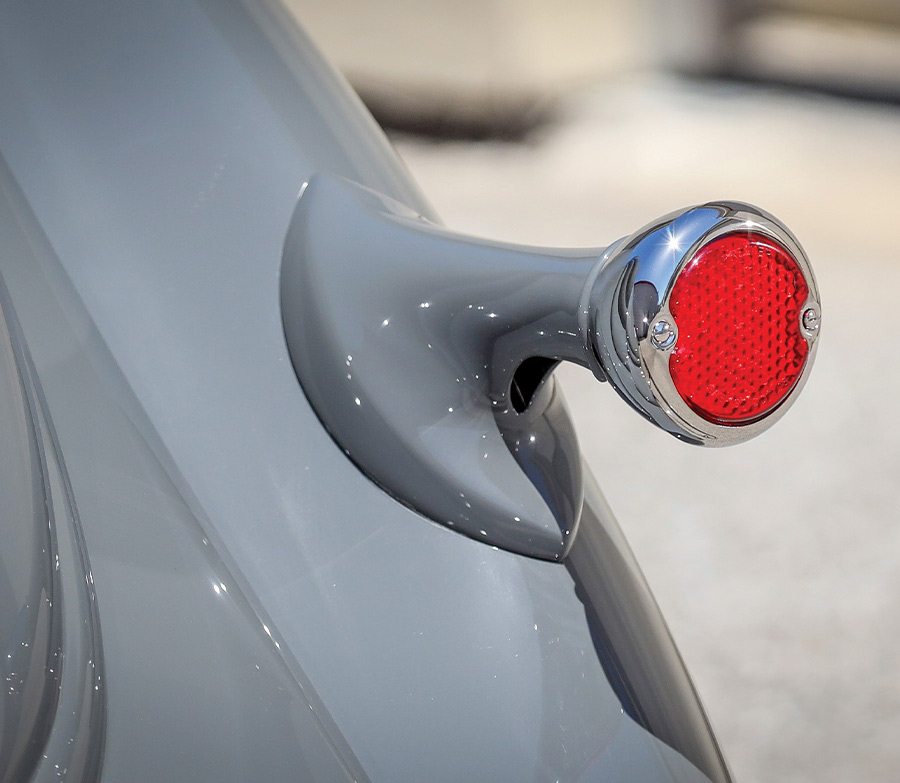


 Photography by Michael Christensen
he 1936 Ford three-window coupe is a good-looking car, but it has often been pushed aside just a bit and is thought of as a “sleeper.” The 1936 Ford coupe, Model 48, was an update beginning in 1935 over the previous 1933-1934 (Model 40). It was caught in-between two styling changes, starting in 1935, and then once again in 1937.

Inside, the dashboard is based on a stock 1936 Ford coupe but modified at Brizio’s to accept a complement of Classic Instruments Classic Series gauges with the Brizio logo printed onto the faces. From here, an Enos wiring panel is used; all of it was installed at Brizio’s by Jim Vickery, who also included the Vintage Air A/C system in the wiring program. The tilt steering column is an Ididit with a Juliano’s banjo-style wheel. Next up is a Glide Engineering bench seat now covered in gray leather, including the door and kick panels. The headliner was done in Mohair, along with automotive gray carpeting stitched at Sid Chavers Company—a longtime favorite of Brizio’s to handle any stitchwork.


The chassis is based on a Total Cost Involved fully boxed frame that houses a TCI IFS, Ridetech coilover shocks, and a TCI sway bar. The steering is by way of a rack-and-pinion, along with GM 11-inch rotors and calipers, all pressed into service. In the back, a Ford 9-inch gearset is used, spinning 3.0 gears along with Currie axles and a Driveline Specialties driveshaft. The rear shocks are more Ridetech coilovers working with a TCI four-bar setup. Braking comes from Wilwood, and it also uses 11-inch rotors, four-piston calipers, and a Wilwood 15/16-inch bore master cylinder. Rolling stock comes from Wheel Vintiques steelies that measure 6×15 and 7×15 and are all wrapped with Michelin Defender radial rubber: 205/65R15 and 235/75R15.
Maybe the 1935 Ford coupe hasn’t received the attention it should have from the rodding world, but we can’t blame Hans for not putting in the effort