


 Photography by Michael Christensen
here is a long list of great-looking 1936 Ford three-window customs. Jack Calori’s 1936 Ford three-window custom dates to 1947-48 and has set the bar ever since. More recent efforts include Hollywood Hot Rods’ 1936 Ford three-window custom coupe. The 1936 Ford three-window has long been regarded as the prime platform for building a custom ride.
Nick Ruggiero’s custom continues this tradition. This project marks the second collaboration among Nick, Bill Ganahl of South City Rod & Custom (SCR&C), Joe Compani of Compani Color, and Chris Plante of Chris Plante Upholstery. Their combined craftsmanship is evident throughout Nick’s 1936 Ford three-window custom featured here in Modern Rodding. The original plan was to build a primered hot rod without hood sides for a stripped-down look. But as often happens, the vision evolved. The team began to see the car as a more fully realized custom, prompting Nick and Ganahl to refine the concept and focus on even finer details. The car had passed through a few shops before it came to rest at SCR&C, so some parts and infrastructure were already in place. The car arrived in rough primer, minus any color, and in a sad state. Unfortunately, the condition left something to be desired, so nearly everything had to be redone.


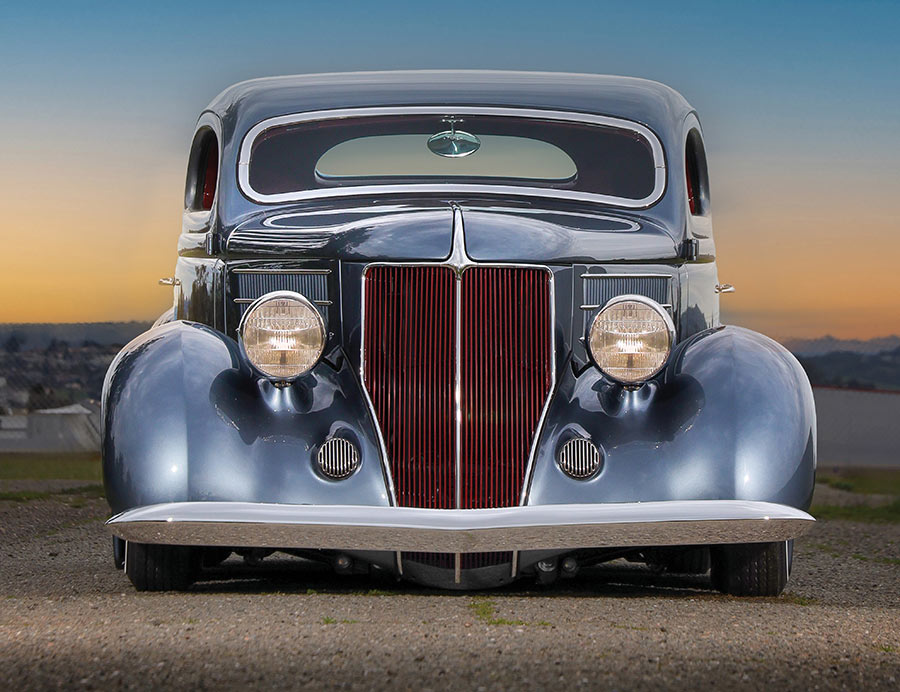
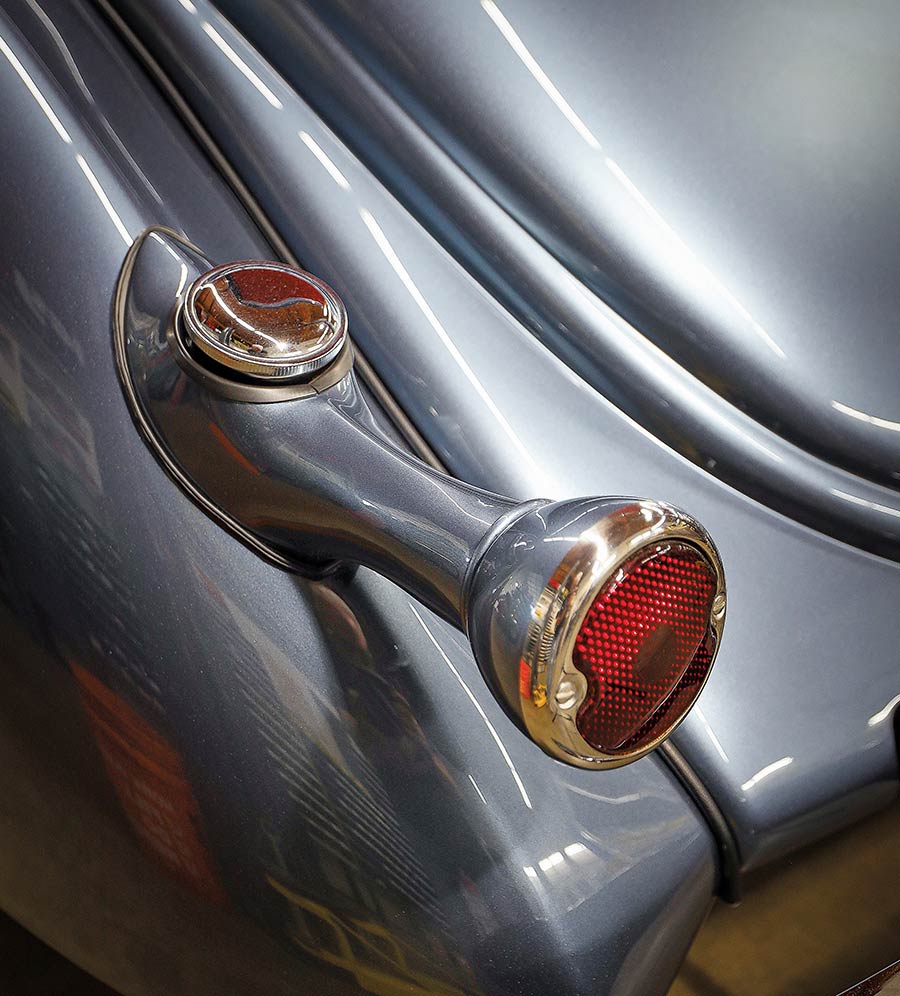
Ganahl says the 1936 Ford three-window body already had a 4-inch chop when it arrived, likely done in the ’50s. Additional custom touches include 1937 Lincoln Zephyr bumpers, front and rear. Up front, the fender seams were filled and the headlights lowered. In back, the taillight stands were shortened—note the gas filler in the driver-side stand—and the spare-tire mount and its holes were filled in on the decklid area. SCR&C also fabricated the grille bullnose from brass and then plated it, while the rest of the grille surround received the shop’s custom treatment to complement the maroon grille. The exterior rearview mirrors and the single driver-side windshield wiper were also removed.
After the body modifications, Compani Color completed the final sheet metal prep and paint, applying a subdued custom blue that lets the car’s styling and stance speak for itself. (Editor’s note: Congratulations to Joe Compani of Compani Color, founded in 2012. After spending his early years learning at Roy Brizio Street Rods, he was inducted into the Grand National Roadster Show Hall of Fame this year. —B.B.)
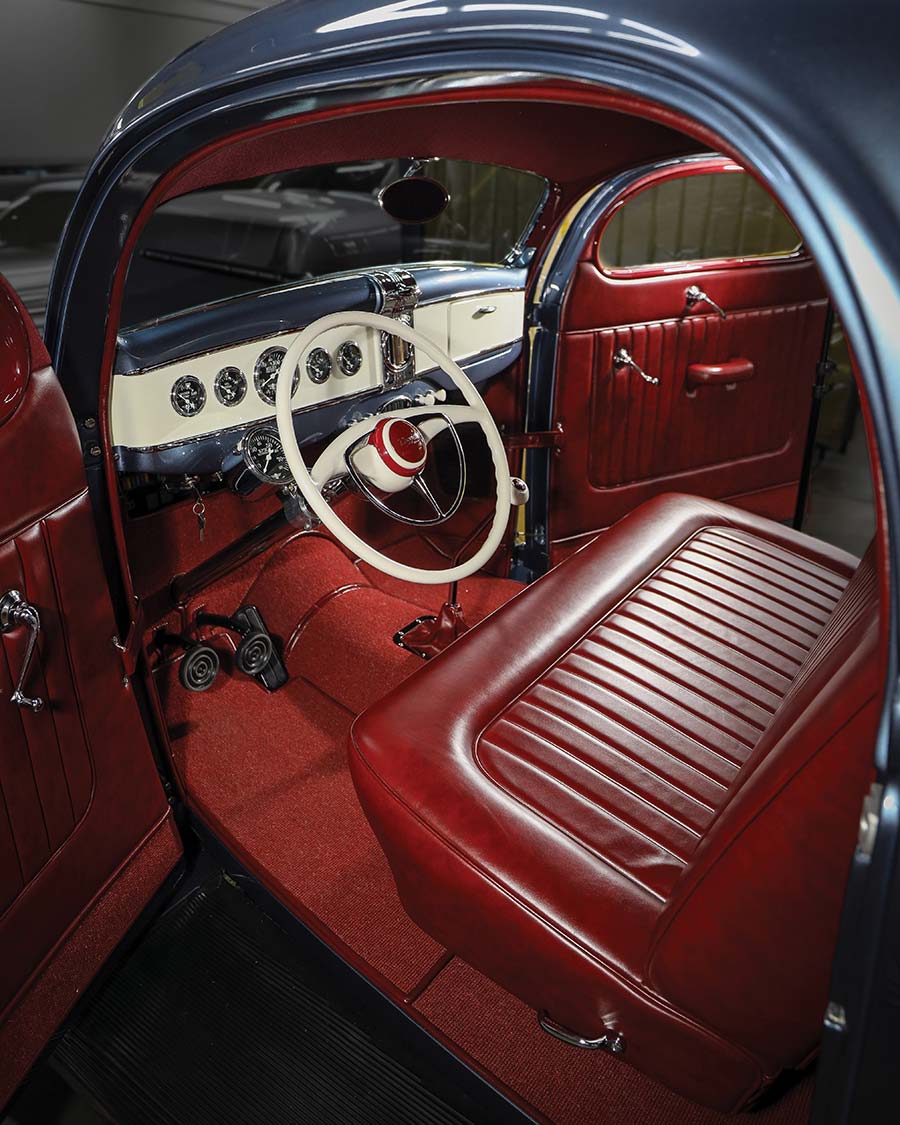
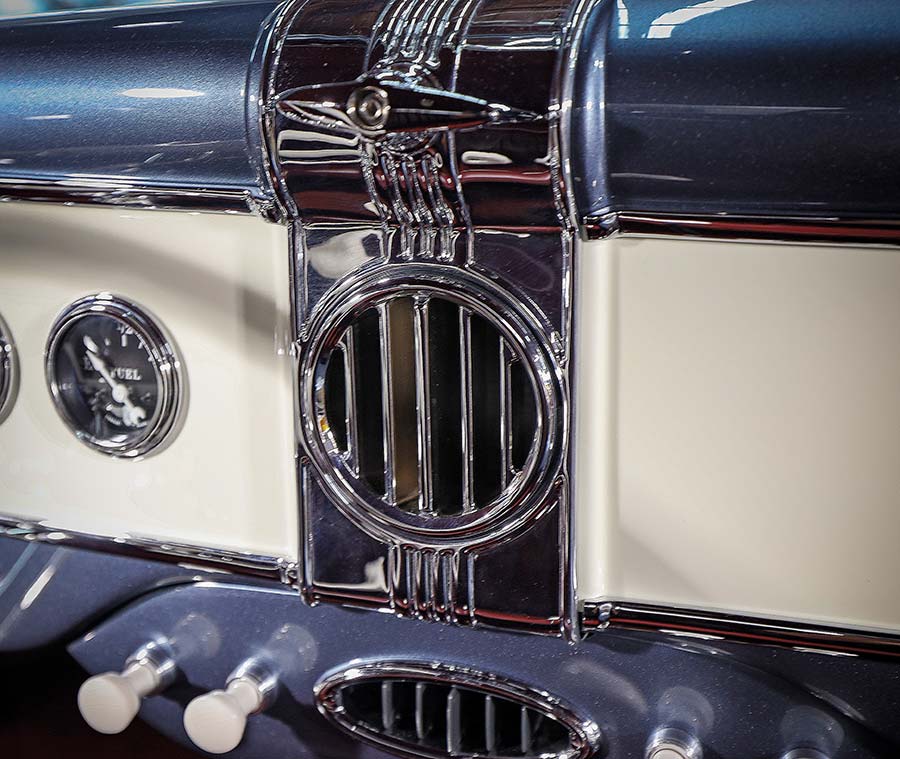

SCR&C started with stock framerails and modified the chassis to accept Slam Specialties air suspension, a Heidts Mustang II IFS with tubular A-arms and spindles, and a rear C-notch. Custom-mounted shocks work with the airbags at both ends. Out back, a custom triangulated four-link, air suspension, Ford 9-inch rearend, and drum brakes handle the rear suspension. Up front, GM discs and calipers are fed by a Corvette-style master cylinder, while a Wilwood master cylinder operates the hydraulic clutch. The drivetrain uses a McLeod flywheel, pressure plate, and clutch from American Powertrain, paired with a modified TREMEC five-speed transmission. Power comes from an iron-block Chevy 350 fitted with an Edelbrock polished intake, Holley Sniper II EFI, MSD electronic distributor and coil, and Taylor plug wires. An OPTIMA battery, Powermaster alternator and starter, Sanderson headers, and 2-1/2-inch exhaust with glasspack mufflers round out the package. Oldsmobile Rocket valve covers add another touch of detail. Cooling comes from a polished-aluminum water pump, an aluminum radiator painted black with an electric fan, and a Billet Specialties Tru Trac serpentine system. Fuel is supplied by a Tanks Inc. tank with an in-tank Holley pump. The small-block Chevy is painted in the same maroon used elsewhere on the car, creating a strong contrast against the cream-colored firewall.
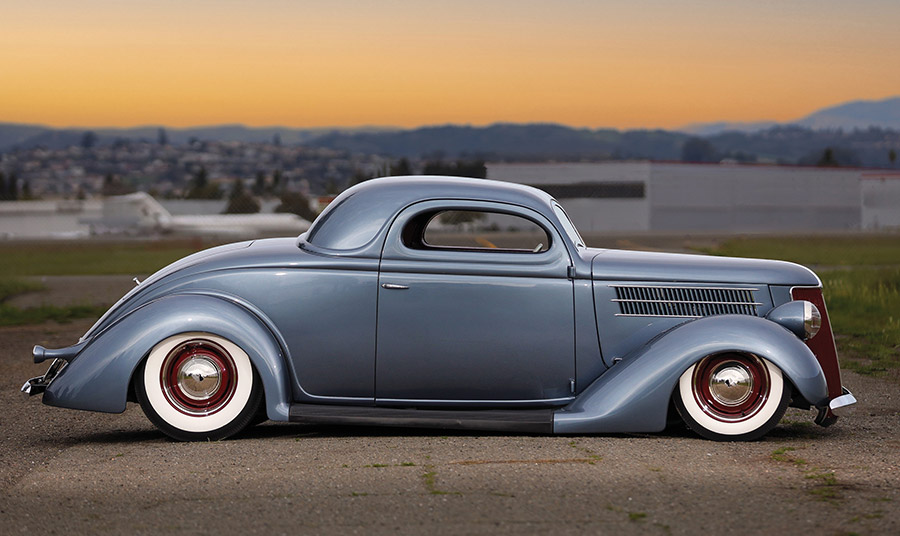

For those who managed to attend this year’s Grand National Roadster Show, you probably saw this 1936 Ford three-window custom in the SCR&C booth in Building 4. Or, if you attended the Sacramento Autorama, you saw the three-window capture the Custom D’Elegance award. Nice going.