


John Mumford’s Last 1932 Ford Roadster Build
 Photography by Michael Christensen
any have heard or said, “This is my last project.” Such is the case for John Mumford from the Bay Area in California. John tells us that this is the last 1932 Ford he will build. When speaking with John’s collaborator on many of these projects, Roy Brizio of Roy Brizio Street Rods, he tells us John has said the same thing to him. Brizio has built 20-plus hot rods for John, including several AMBR contenders, and in 2013 took home the perpetual America’s Most Beautiful Roadster 9-foot trophy. We don’t doubt John’s sincerity, however, we have heard these sentiments. Given John’s passion for hot rods, we will reserve a spot for a future “table of contents” entry for another effort. Brizio agrees!


The first and only stop was to see Ed Pink and Bob Brandt of Ed Pink’s Garage. Pink tells us that this is the last Cammer he will build in his illustrious career. (He’s in his early nineties and figures it’s time to enjoy the open road a bit more with his 1929 Ford highboy roadster, another Brizio statement hot rod.) The 427 SOHC Cammer is familiar territory for him and his partner, Brandt, at the “Garage.”
Pink and Brandt have developed a street package for a Ford SOHC Cammer V-8. However, this latest build for John and Brizio wasn’t your basic, if such a thing exists, Ford 427 SOHC V-8. This time, Robert Pond Motorsports (RPM) was brought in, along with one of their aluminum blocks and a pair of heads.
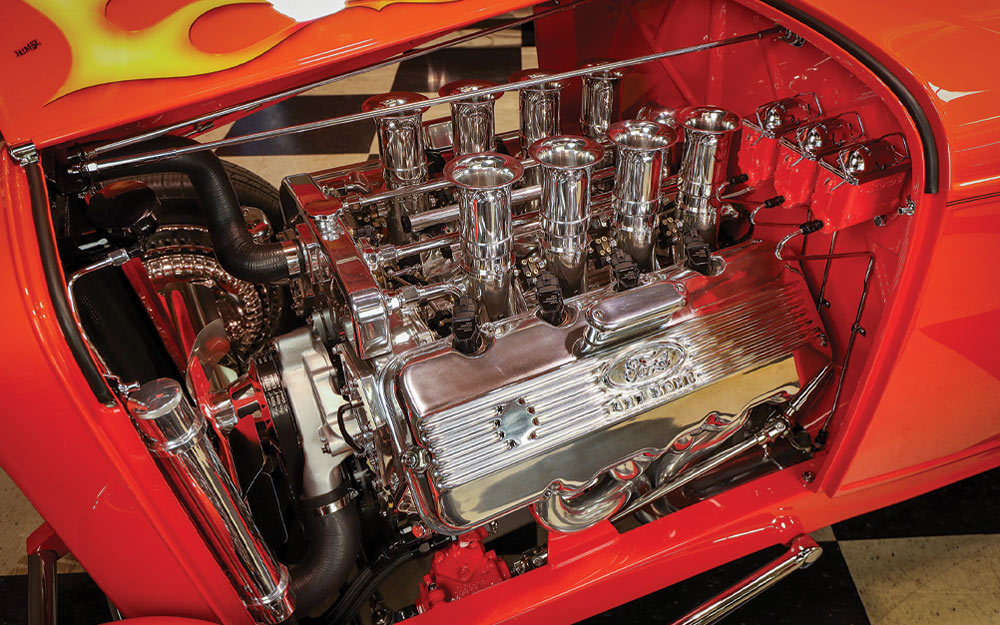
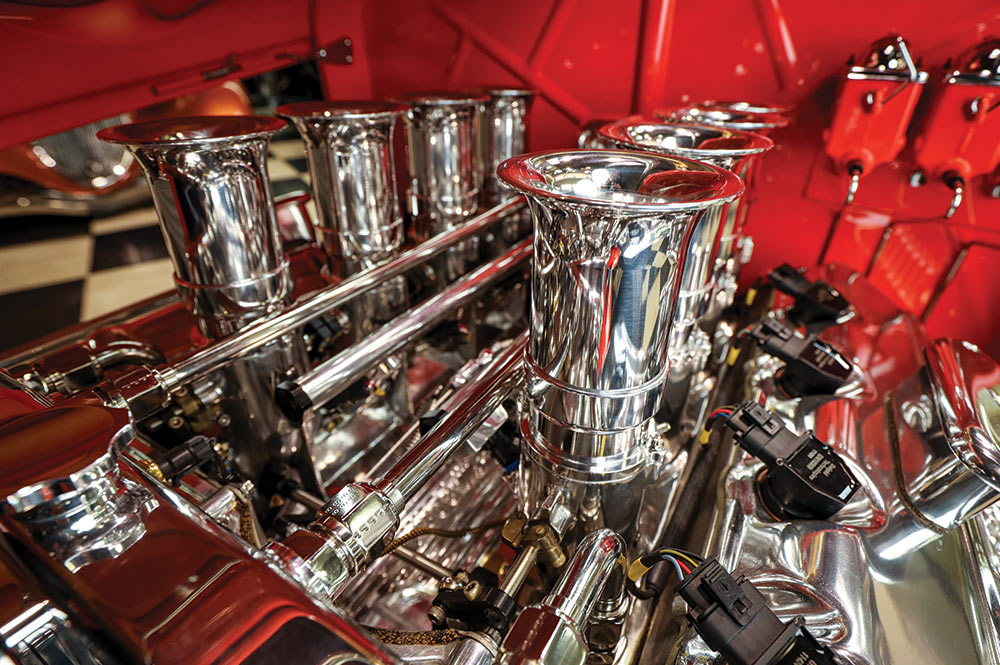
RPM offers the Cammer block and heads in aluminum and cast iron (like the original), but they weigh an additional 2 to 3 pounds due to the lack of lifter provisions. A special oil return hole at the back of the block also distinguishes it. RPM provides 427 SOHC cylinder heads, which are direct replacements for the original heads but enhanced with five extra boltholes for superior gasket sealing. It’s important to note that ARP hardware is used on the heads and throughout the engine build. These heads are CNC ported for about 15 percent improved performance compared to stock. Engineered with a 1/2-inch-thick deck and reinforced cam towers, these heads come bare and are fitted with 11/32 guides and a 119cc chamber, making them the best and strongest SOHC heads ever. They include billet cam bearing caps to ensure durability under pressure. Topping off the massive aluminum cylinder heads are polished aluminum RPM valve covers that reflect the lineage of this powerful V-8. Other internals feature forged aluminum 9-to-1 pistons and a custom Ed Pink’s Garage cam grind. The Pink’s team selected the RPM Cammer aluminum block with a 4.232-inch bore and 3.785-inch stroke (like the original). Still, it can be expanded to a bore of 4.310 inches with a 4.375 crankshaft capable of achieving 510 ci. The SOHC also utilizes a remote oil filter system.


Connected to the Cammer is a TREMEC TKO 600 five-speed utilizing a Modern Driveline package with a clutch, pressure plate, and a billet flywheel. A Lokar shifter with a leather-wrapped shift ball is also present to help you select the proper gear. Linking the powertrain is a custom steel driveshaft leading to the polished and painted Winters Champ quick-change that houses 3.78 gears and Winters 31-spline axles.
The frame is constructed with a Total Cost Involved set of Deuce boxed ’rails, featuring 1-1/2-inch tube crossmembers. Stratton of RBSR was responsible for the chassis and ensured the installation of an 11-gallon gas tank from Tanks, which rests in its factory location at the rear between the framerails. At the front is a chrome 5-inch drop Super Bell I-beam axle paired with Super Bell spindles, QA1 adjustable tube shocks, and a chrome-plated multi-leaf transverse spring equipped with reversed eye shackles. The remainder of the front suspension features plated and drilled radius rods from Johnson’s Hot Rod Shop (JHRS), Borgeson-Vega steering, and a Mullins column. The rear suspension includes JHRS chrome ladder bars, a 3/4-inch sway bar, QA1 coilover shocks with 220-pound coils, and an RBSR Panhard bar. The braking system utilizes the JHRS Kinmont Safety Stop disc brake kit (with Wilwood calipers and 10.5-inch vented rotors), complemented by Wilwood multiple reservoir master cylinders (for brake and clutch) and Moal Coachworks swing pedals. At the corners is a complete set of E.T. Indy-style polished billet wheels measuring 5.5×16 and 7×18, while Michelin 205/60R16 and 265/65R18 tires with scrubbed sidewalls provide the rolling stock.
The dashboard is a steel reproduction of a Brookville Roadster piece that now houses a restored, original, large-diameter six-pack of Stewart-Warner gauges by The Gauge Guy. Note the roadster does have the Moal Coachworks pedal assembly with a Lokar “spoon” throttle. Jim Vickery of RBSR wired the roadster by installing a custom wire system that runs from front to rear. Another notable interior piece is the Mullins steering column, featuring a Bell four-spoke leather-wrapped wheel. The custom bench seat was stitched in dark blue leather by Sid Chavers of Sid Chavers Co. John tells us he has no plans for ever putting a top on this hot rod. (Editor’s note: You must like those highboy roadster drivers—a brave lot.) There will be plenty of cool breeze on one’s face and bugs in the teeth for this hot rodder.
We hope this isn’t John’s last 1932 Ford, but if it is, what a way to go out! The roadster did take home Best Interior and Best Undercarriage in 2025’s AMBR competition. Not bad for an everyday driver with all 650 hp!
