

ven when Flatheads dominated in the early days of hot rodding, the side effects of a hopped-up engine meant that dealing with stripped ring-and-pinion gears, broken axles, and hubs with sheared keys was almost guaranteed. Things only worsened in the early ’50s as overhead valve V-8s pushed the Flathead Ford and other early engines aside. The cure for rearend woes was often those wide and heavy assemblies found under Oldsmobiles and Pontiacs (both were out of production after 1964) until Ford unknowingly came to the rescue. Since its introduction, Ford’s 9-inch rearend has become the preferred performance axle assembly for modified vehicles.
Produced from 1957-86, the Ford 9-inch is Hotchkiss style, which is to say the case containing the third member with the ring-and-pinion assembly is removable as a unit, making gear changes relatively simple. Of course, the real reason for the popularity of the Ford 9-inch is its strength, primarily due to the relationship of the ring-and-pinion gears. To provide increased tooth contact the hypoid distance, which is the offset between the ring gear and pinion centerlines, is greater than that found in most rearends. However, while this greater tooth contact does increase strength, the design has some drawbacks; a certain amount of efficiency is lost due to increased friction, and gear noise increases noticeably (often referred to as nine-whine).
To replace the venerable 9-inch rearend, Ford introduced the 8.8 axle assembly. It was first used in 1983 under Ford trucks and most V-8–equipped cars from 1986 on. These rearends are the Salisbury design, which has the third-member components mounted in the axle housing with a removable rear cover on the back side. This style of rearend makes gear changes much more involved compared to a Hotchkiss. Another difference between the 9-inch and 8.8 is the method of retaining the axles. The 9-inch uses pressed-on bearings and lock rings on the axles, which are held in the housing with retainers bolted to the flanges on the axle tubes. If an axle should break, the wheel will stay attached to the housing. By comparison, the Ford 8.8 axles are held in the housing by C-clips inside the differential case. That means a broken axle, along with the wheel and tire, can come completely off the car (there are C-clip eliminator kits that resolve that problem, and rear disc brakes act as retainers, to some extent).
The obvious question is, why did Ford replace the 9-inch with the 8.8? There were several reasons—cost being one. The Salisbury housings use a cast centersection with pressed-in axle tubes, all of which makes them cheaper to produce, but there were marketing considerations that influenced the change as well. The 8.8 is more efficient thanks to less hypoid angle than the 9-inch, which helps gas mileage ratings, a major concern for consumers. The 8.8 gears are quieter in operation, which is a customer satisfaction factor. New car buyers want the most miles per gallon possible while listening to the stereo, not the gears in the rearend.
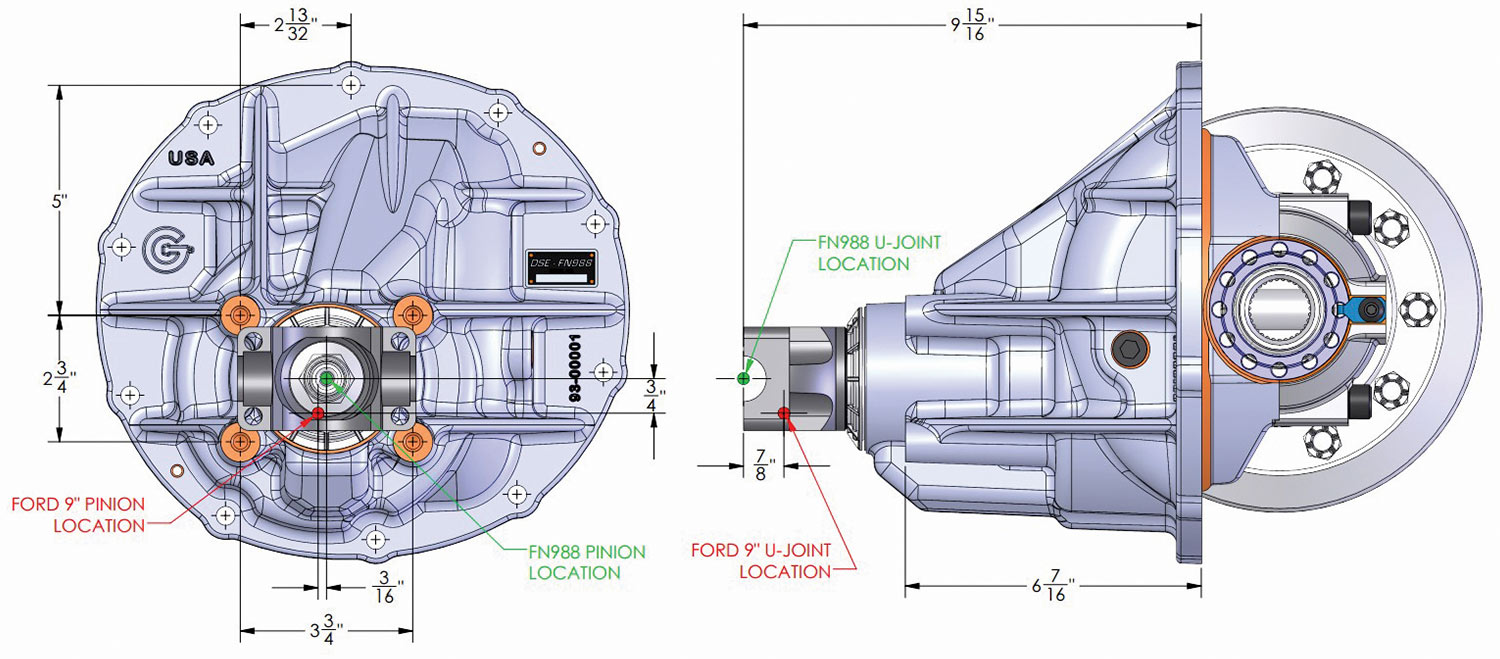
When Detroit Speed & Engineering (DSE) began investigating alternatives to the 9-inch, they found that the 8.8 rearend could reliably absorb an amazing amount of punishment, as was proven by Ford racers, notably the 5.0 Mustang crowd. So, the idea was born to combine the best features of the 9-inch and the 8.8 and create the FN988. The hybrid FN988 uses a 9-inch style Hotchkiss carrier, which makes setting up the ring-and-pinion considerably easier than the Salisbury design as well as swapping gearsets. In addition, the C-clips are eliminated as the axles are retained like a 9-inch.
While the 9-inch Ford rearend is tough to follow, there’s much to appreciate about DSE’s FN988. It’s more efficient than the 9-inch thanks to reduced internal friction, which arguably may offer a performance and mileage increase. Certainly, the reduction in gear noise will be a welcome change. Since the 8.8 gearset is strong enough for all but the most abusive applications, it’s a good option for hot rodders, and DSE has made a good thing better with the new FN988.


 SOURCE