
Modern Rodding Feature
InTheGarageMedia.com

Part Car and Part Truck

The ’32 Ford Sedan Delivery is Truly Part Car & Truck
By Brian BrennanPhotography by Michael Christensen
I

n the world of early hot rods, the ’32 Ford is the iconic year. Whether it be a roadster, coupe, sedan, phaeton, or truck, the ’32 Ford is one many, if not most, hot rodders would truly wish to own. For decades, the Deuce has faithfully withstood the test of time by retaining its desirability. Why? There are many reasons, but the one-year-only design is so darn good looking, and the introduction of the Flathead V-8 adds to the Deuce lore. In 1932, Ford manufactured approximately 275,000 units. (We aren’t sure what the number is, but that’s another story.) During this production run, Ford converted around 400-plus Tudor passenger cars into sedan deliveries, a light duty truck. It is reported that 58 of these sedan deliveries came with the new Flathead V-8 while the remaining 340-plus were four-cylinder equipped. Today, it is believed there are less than 20 known survivors.
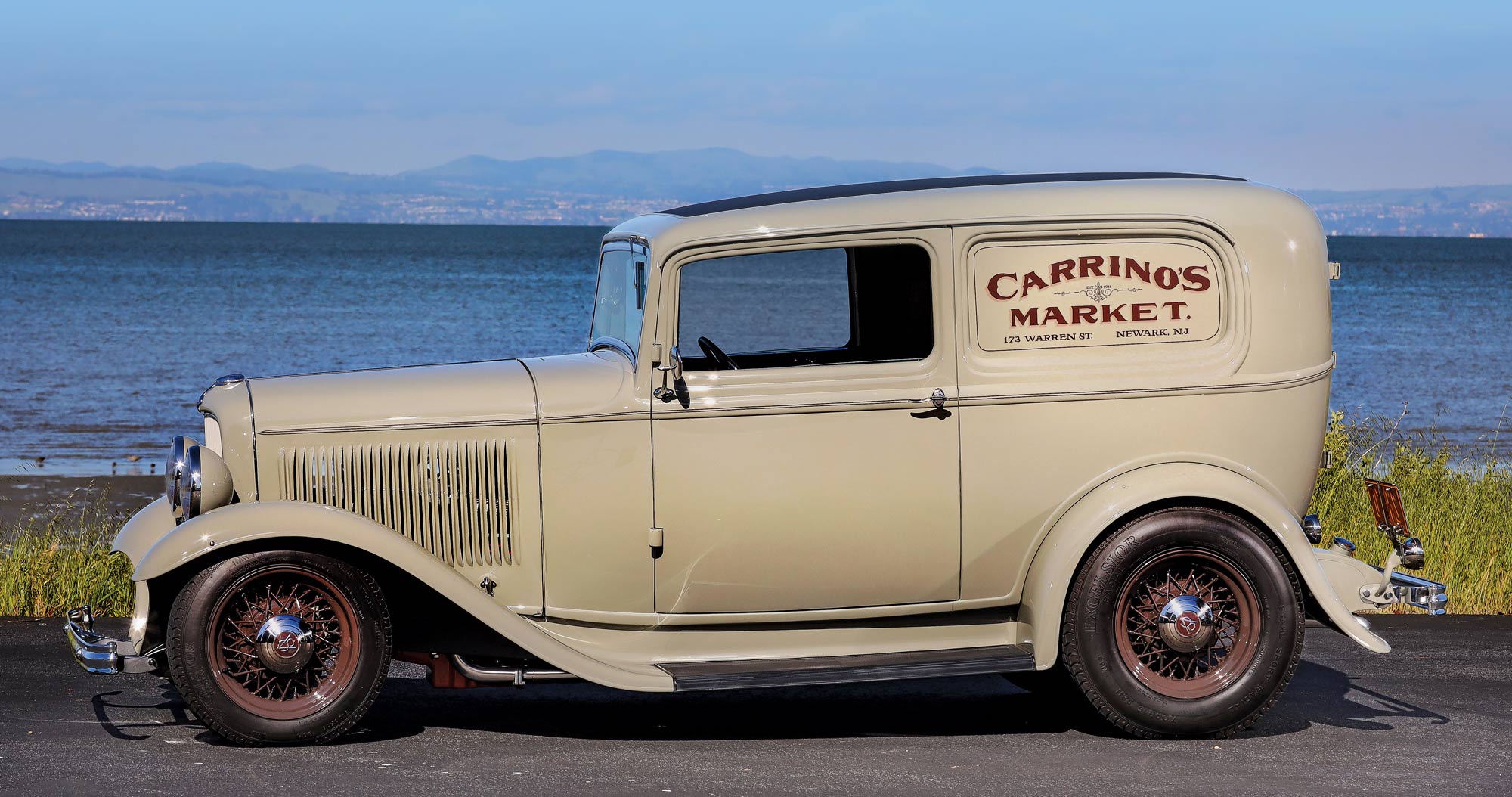
side view of off-white ’32 Ford Sedan Delivery
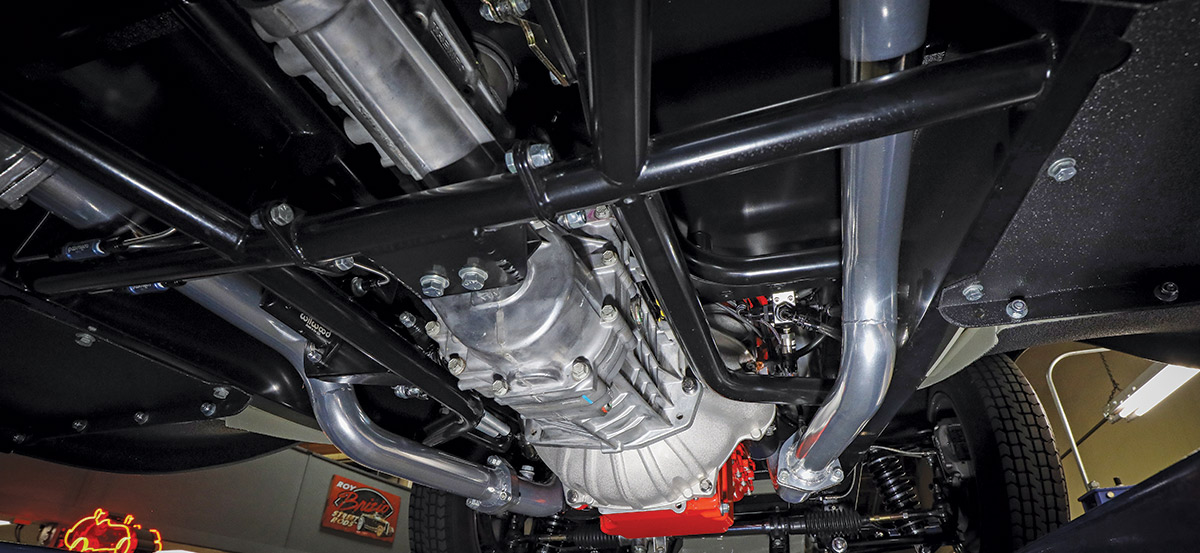
chassis view of ’32 Ford Sedan Delivery
The ’32 Ford sedan delivery you see before you belongs to Nick Testa of SoCal and was built at Roy Brizio Street Rods. It is a rare sight, not because it was produced by Ford but because it wasn’t. Let me explain. It’s a Tudor sedan featuring one of 40 kits developed by Doug McRae. Kemp’s Rod & Restoration has completed 16 of these Tudor to sedan delivery conversions, one of which is kit #8. Thinking this sounded familiar, we researched and found that in the June ’09 issue of R&C, a tech story appeared on the conversion from sedan to sedan delivery on this very hot rod by our good buddies author Tim Bernsau and builder Kemppainen. At the time, the sedan, soon to be a sedan delivery, belonged to John Stimac. Kemppainen also added the faux-tina to the new door so that the freshly added sheetmetal would match the remainder of the newly minted sedan delivery.

As mentioned, the body is a ’32 Ford Tudor sedan converted into a sedan delivery. In time, Julian Alverez came to own the patina’d sedan delivery. Now, Alverez and Nick have known each other for some time. As such, both were familiar with each other’s hot rods. Once, Alverez, who drove his sedan delivery with his gear in the back all the time, came by and color-sanded Nick’s wife’s ’55 Chevy. At that time, it was mentioned that someday Nick should own the sedan delivery. As life has a way of doing things, circumstances arose and Nick ended up with the sedan delivery. From this point, he turned it over to Brizio so that he and his crew could get on with making the sedan delivery more to Nick’s liking. As for the rest of the sheetmetal, it is factory-made, including the original hood. The rear wheeltubs were massaged so the oversized wheels and tires fit comfortably. Darryl Hollenbeck of Vintage Color Studio handled the body- and paintwork. Hollenbeck mixed up a custom batch of PPG tan and sprayed it onto the sedan delivery. From here, Real Ralph handled the lettering and striping.

3/4 rear view of ’32 Ford Sedan Delivery
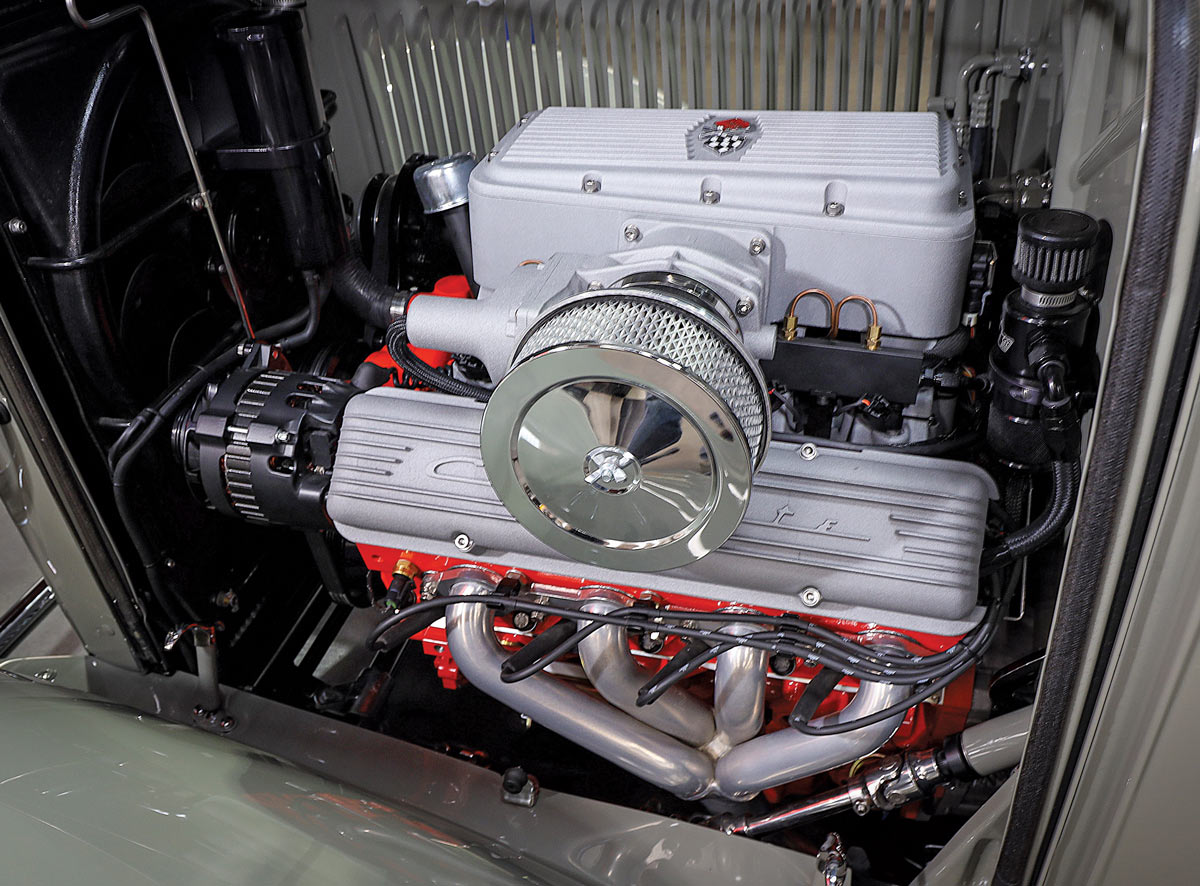
engine of ’32 Ford Sedan Delivery
Note the lettering on the side of the delivery. “Carrino’s Market” is the name of Nick’s great-grandparents’ butcher shop in Newark, New Jersey. They opened it after coming over on the boat to the “new country” and becoming American citizens. The store was opened in the early 1900s (possibly in the late 1890s) and remained open until 20 years ago.

Sid Chavers, yes, the upholstery guru, recommended placing a name on the side. After some thinking, Nick, after speaking with his last living uncle, decided it was a “go.” He asked what the name of his great-grandparents’ market was … it was “Carrino’s.” It was his grandmother’s maiden name. Now you know the rest of the story.
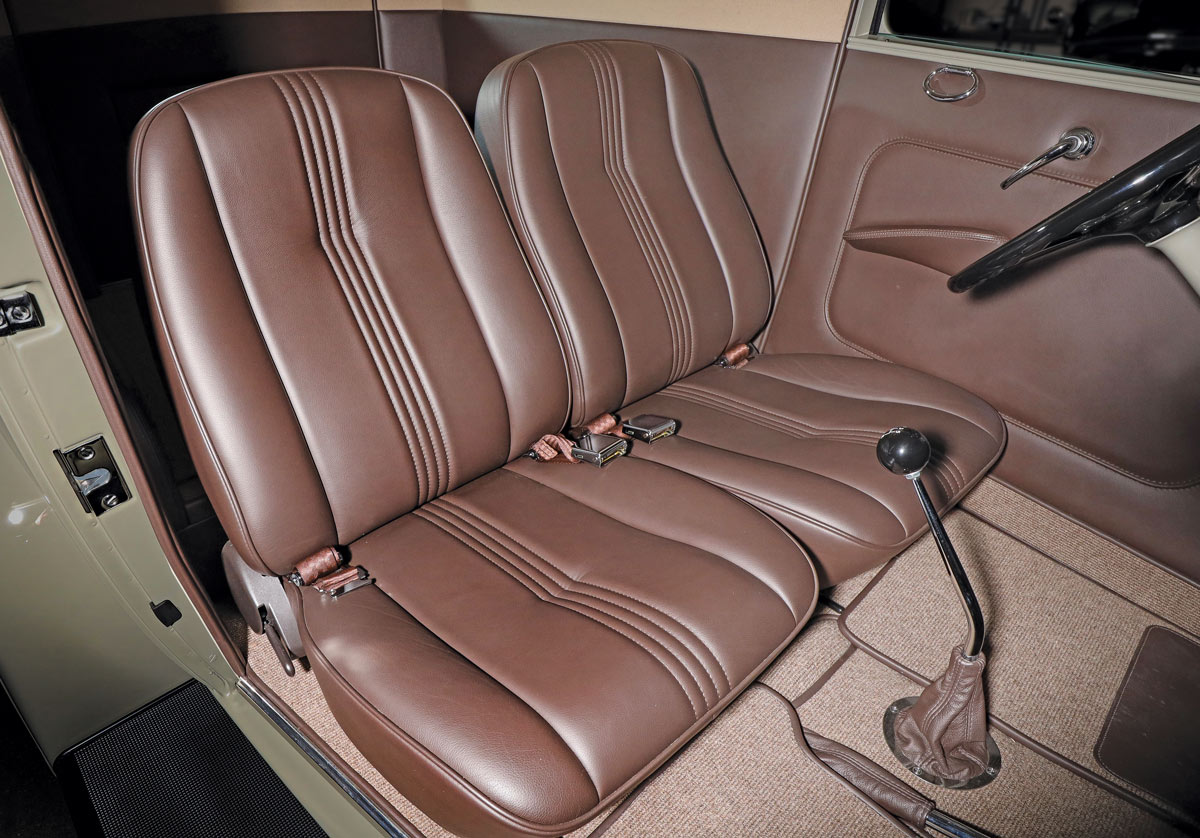
seats of ’32 Ford Sedan Delivery
dashboard of ’32 Ford Sedan Delivery
trunk of ’32 Ford Sedan Delivery
As vintage looking as the sedan delivery may look, what resides underhood is anything but old. Brizio opted to pull out the old small-block Chevy and, in its place, drop in a Don Hardy Racing Engines all-aluminum LS3 that features 376 ci, 10.7:1 compression, internal balanced, hydraulic roller cam, all eventually leading to 430-plus horsepower. Now, while all that sounds just fine at first blush, we see what would have been an old Rochester mechanical FI, something from a ’63-65 Corvette. The LS Classic Series from Lokar pays homage to the ’63 Corvette fuelie cars. The conversion comes with a distributor, MSD plug wires, coil relocation kit, and the forward-mounted faux oil inlet pour spout. Lokar also supplied the reminiscent Corvette “as-cast” seven-fin valve covers. A Holley Terminator computer system, a Billet Specialties air cleaner setup, and a Tanks 11-gallon tank with an Aeromotive submersible fuel pump are used. Other engine accessories include the Powermaster alternator and starter in a flat black finish, an orange engine color painted and smoothed Edelbrock water pump, and an electric SPAL fan with a Matson’s radiator for the cooling chores. Providing the “juice” is an Optima battery located behind the seating while Brizio’s Jim Vickery’s custom wiring harness distributes “life” to all the hot rod’s electrics. The exhaust system is based on Sanderson headers measuring 1-5/8 inches in diameter that flow into 2-1/4-inch custom exhaust tubes running through a pair of Flowmaster Hushpower Pro mufflers, all fabricated into one free-flowing system by Brizio’s Jack Stratton. Backed up to the V-8 is a TREMEC TKO 600 five-speed manual run through its paces via a Lokar shifter. A Modern Driveline flywheel, clutch, and disc transfer the power smoothly from the engine through the trans and rearward to the Kugel fully independent rear suspension.
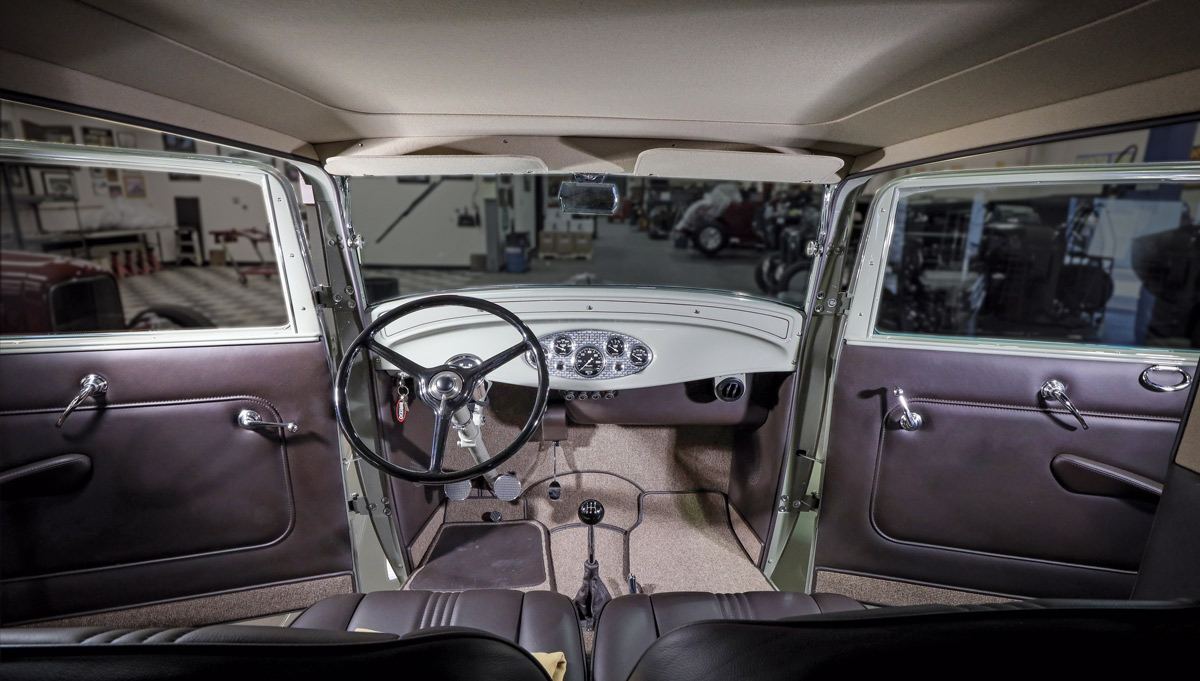
view of front seats, dashboard, and gearshift inside ’32 Ford Sedan Delivery with front doors open
The chassis is based on Total Cost Involved framerails that Stratton then fully boxed and implemented tubular Y-crossmembers. From here, you will find Kugel Komponents fully independent suspension at the corners with single QA1 adjustable coilover shocks in the front and the rear; the gearing is 3.70. The steering is rack-and-pinion while the column is a stock ’32 Ford, then topped with a Dennis Crooks restored stock Deuce wheel. Also at the corners is the Wilwood disc brake package utilizing four-piston Dynalite calipers; rotors are inboard in the rear. The brake system is brought to bear through the Brizio pedal assembly with Lokar pedal pads and a Wilwood master cylinder. The rolling stock comprises Wheelsmith wire wheels measuring 16×6 and 16×7 with the Ford “V8” logo cap. From here, the Excelsior Stahl Sport Radial by Coker is used, with 5.00R16 in front and 7.00R16 in back.

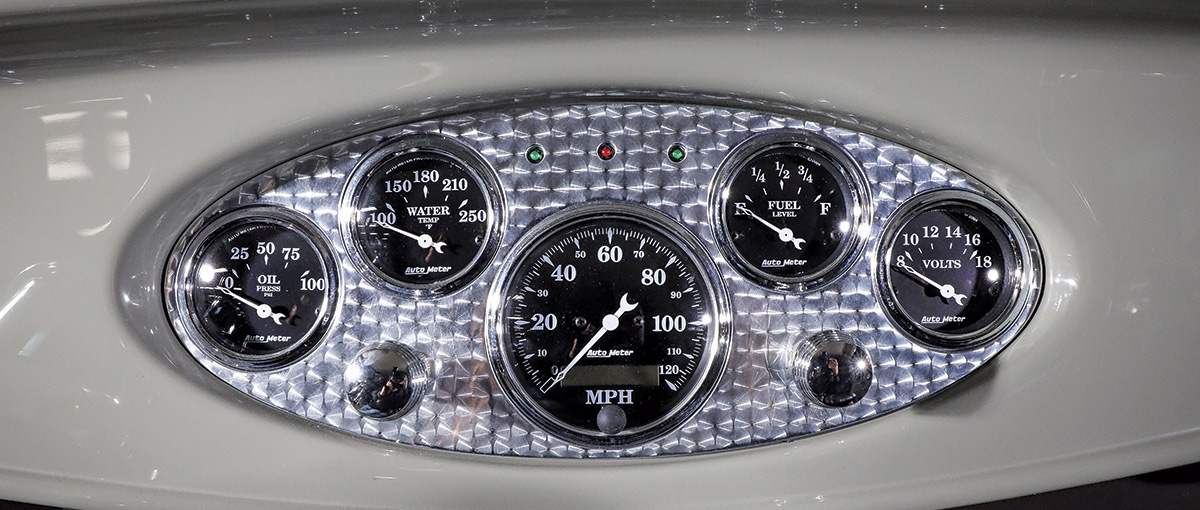
Inside, the original ’32 Ford dash is now outfitted with a J&B Microfinish dash panel (engine turn pattern) and houses an Auto Meter five-pack of gauges. The Sun 8-grand tachometer is a “knee knocker” (sort of) as it is mounted to the factory steering column. The three Vintage Air A/C controls are centered and mounted (flip down to use and up to hide) just below the dash on their own panel, while the A/C registers are also below the dash, mounted to the bottom in front of the driver and passenger. The ignition key is mounted bottom far left on the dash. The seating is a pair of Cerrello buckets now upholstered in brown leather, lap belts, the headliner is in a Wilton wool, and the carpeting is a German square weave, all handled by the master himself—Sid Chavers of Sid Chavers Company.

We aren’t the only ones who thought this was a great-looking example of a sedan delivery. The ’32 Ford sedan delivery of Nick’s took home First in Class at the 2024 Grand National Roadster Show. Job well done.

(Editor’s note: If you are interested in doing something like this, Kemp’s Rod & Restoration kits are still available. Drop them an email at kemp@up.net.)
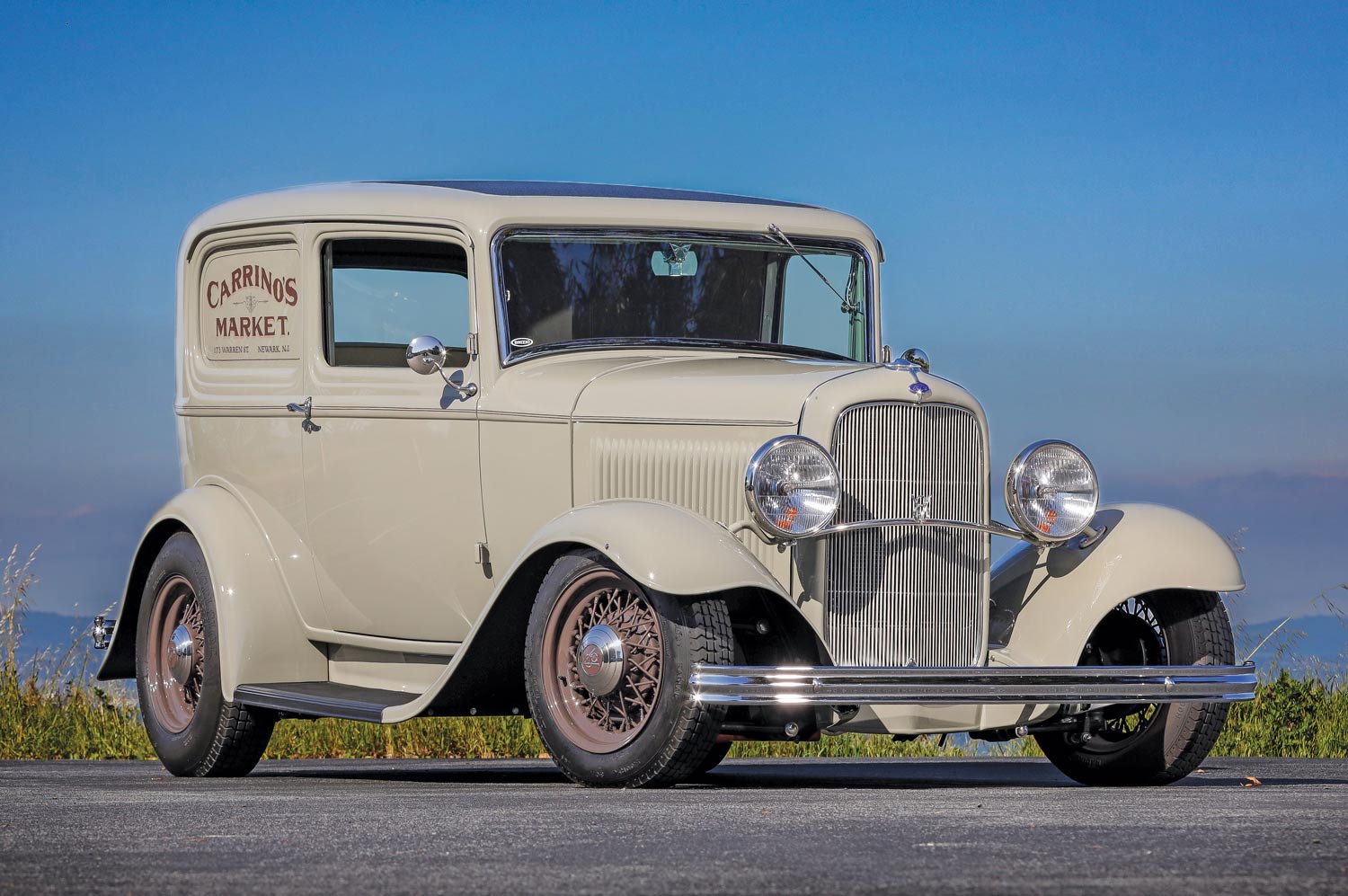
3/4 front view of ’32 Ford Sedan Delivery
Modern Rodding
VOLUME 5 • ISSUE 47 • 2024