

Modern Rodding TECH

InTheGarageMedia.com
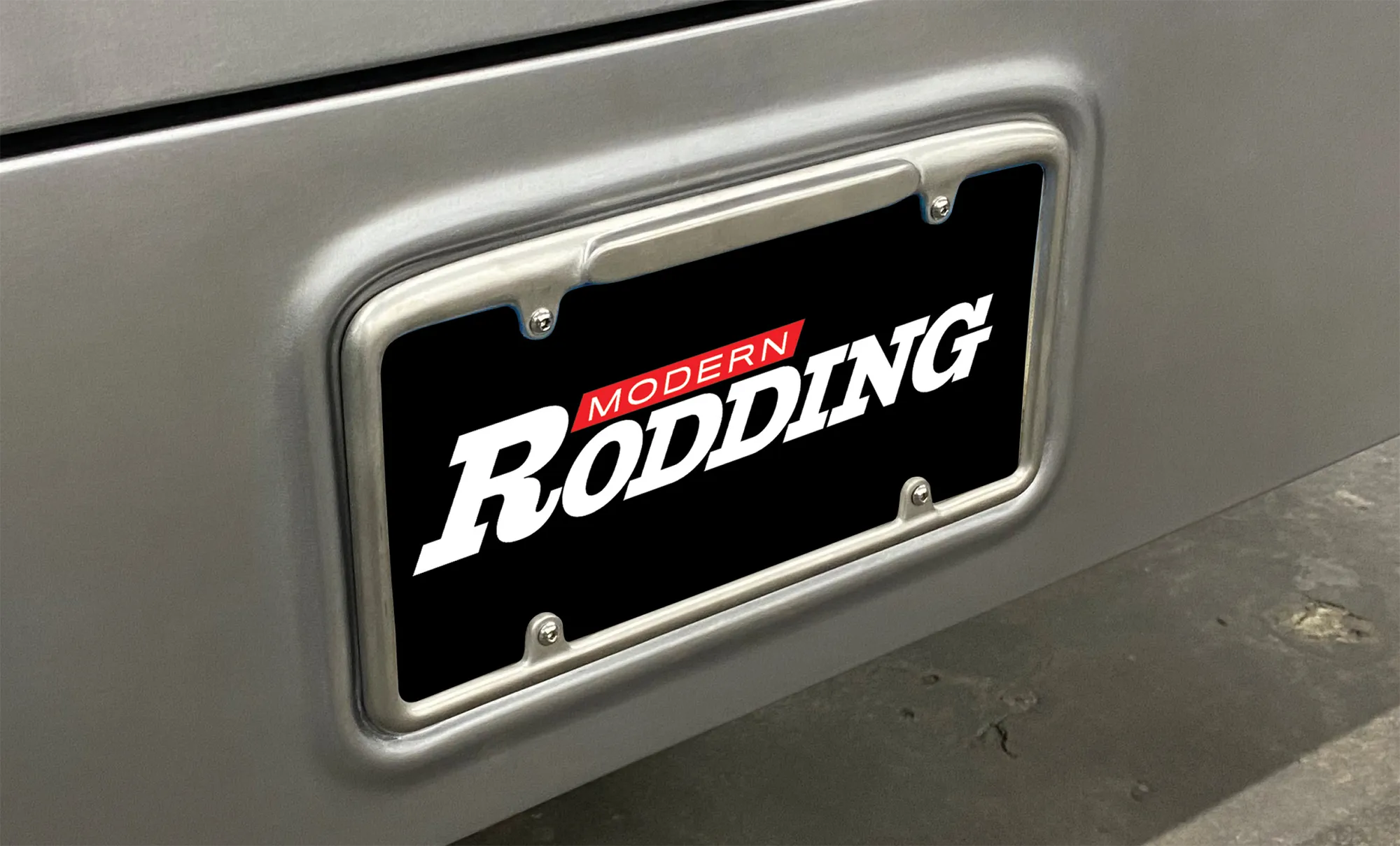
A close-up shows just how seamlessly this detail flows into the panel, the sign of top-quality metalworking.
1. A close-up shows just how seamlessly this detail flows into the panel, the sign of top-quality metalworking.
Recessing A License Plate
Handy Sheetmetal Working Ideas to Use
By Ron Covell Photography by Brian Limberg
B

rian Limberg, the founder of Tin Man’s Garage (TMG) in Sycamore, Illinois, is no stranger to high-level metalworking. He has been refining his craft for many years, and his team has received some of the highest honors achievable. Last year they received the Al Slonaker award at the 2022 Grand National Roadster Show in Pomona, California, with the outstanding ’36 Willys pickup they built. In this article we’ll focus on a beautifully executed recess for a license plate, which TMG crew member Elijah Schroeder fitted to the rear of a ’37 GMC cabover bed that they built from scratch.

The main forming tool used for this project is a Pullmax machine, and while there are other tools that could do this job, an “electric reciprocating” machine has several advantages—one of the most important being the ease of making specialty tooling to precisely create the desired profile on the panel.

Elijah started by making a simple foam mockup for one corner of the recess, which allowed him to visualize the fit with the illuminated license plate frame they selected. The goal was to put a raised rib in the panel, leaving a recess just slightly larger than the frame’s outside dimensions, with the rib nearly as high as the frame. The rib profile has a soft lead-in on the outside, with the inside a bit sharper to complement the design of the license plate frame. He sanded the foam mockup by hand, and once he was satisfied with the contours, it was used as a guide to make the tooling to do the forming.

The tooling consists of two blocks of steel—one male and one female—that fit together with a one material thickness gap between them. Mounting shafts were tack welded to the dies to match the square collets in the Pullmax machine. The dies were tested on a straight strip of scrap material and once they were tuned to form the profile exactly as desired, they were finish welded to the shafts. The male die had to be relieved to traverse the tight-radius corners. This was carefully done with hand tools, then the dies were polished.

When forming details like this in a Pullmax, the blank needs to be moved precisely, allowing the feature to be formed to the right size and contour. This was accomplished by using a fence on the Pullmax. A blank was made with a 1-9/16-inch border outside the raised rib. The edge of this blank was held tight against the fence, and the lower die was raised a little each time the part was rotated through the oscillating dies, until the full depth was reached. As you can see in the photos, the rib was formed so cleanly that very little tune-up work was required.

The final step was to cut an opening in the rear panel of the truck, then weld the newly formed panel into place and metal finish it. As you look through the photos you’ll see the key steps in the process.

The first step was hand carving a block of polystyrene insulation foam to visualize the proportions of the raised rib and the recess for the license plate.
2. The first step was hand carving a block of polystyrene insulation foam to visualize the proportions of the raised rib and the recess for the license plate.
Once the desired profile was finalized, two blocks of steel were contoured to make the male and female dies.
3. Once the desired profile was finalized, two blocks of steel were contoured to make the male and female dies.
These dies are designed to work in a Pullmax machine. A fixture is being used here to ensure the alignment of the stems that hold the dies in the machine.
4. These dies are designed to work in a Pullmax machine. A fixture is being used here to ensure the alignment of the stems that hold the dies in the machine.
The dies are tried out in the machine. The shafts are only tack-welded at this stage in case any adjustment is required.
5. The dies are tried out in the machine. The shafts are only tack-welded at this stage in case any adjustment is required.
Here’s a test strip of metal that’s been run through the dies. The flange on the left guides the metal in a straight line as it runs through the dies.
6. Here’s a test strip of metal that’s been run through the dies. The flange on the left guides the metal in a straight line as it runs through the dies.
The male die needs to be relieved to allow it to make the tight-radius curves in the corners. The material to be removed is outlined with black ink.
7. The male die needs to be relieved to allow it to make the tight-radius curves in the corners. The material to be removed is outlined with black ink.
Another view of the dies and the test piece. The test shows that the dies are meshing perfectly.
8. Another view of the dies and the test piece. The test shows that the dies are meshing perfectly.
Here’s a test piece used to check the die’s action as they navigate the tight corner. In this case, the edge of the panel is guided by a fence on the machine.
9. Here’s a test piece used to check the die’s action as they navigate the tight corner. In this case, the edge of the panel is guided by a fence on the machine.
After the dies are shaped, tested, and proven, the working surfaces are polished so they will leave a smooth finish on the panel.
10. After the dies are shaped, tested, and proven, the working surfaces are polished so they will leave a smooth finish on the panel.
Here’s the fence used to guide the edge of the metal, for both the straight runs and the curves.
11. Here’s the fence used to guide the edge of the metal, for both the straight runs and the curves.
This is the finished piece after running the panel through the dies repeatedly, working incrementally toward full depth. You can see the fit against the license frame is spot-on.
12. This is the finished piece after running the panel through the dies repeatedly, working incrementally toward full depth. You can see the fit against the license frame is spot-on.
The formed piece of metal is tested to find the perfect location on the rear panel. Then it’s clamped into place and the edges are scribed for trimming.
13. The formed piece of metal is tested to find the perfect location on the rear panel. Then it’s clamped into place and the edges are scribed for trimming.
The center of the panel is trimmed out here in preparation for butt-welding the license recess into place.
14. The center of the panel is trimmed out here in preparation for butt-welding the license recess into place.
Clamps are used to align and secure the panel for the tack-welding.
15. Clamps are used to align and secure the panel for the tack-welding.
A TIG welder is used to tack-weld the panel, with the tacks spaced about 5/8-inch apart. After tacking, the joint is worked with a hammer and dolly to stretch the tacks, straightening any distortion.
16. A TIG welder is used to tack-weld the panel, with the tacks spaced about 5/8-inch apart. After tacking, the joint is worked with a hammer and dolly to stretch the tacks, straightening any distortion.
After welding and hammering, the welding bead is sanded flush.
17. After welding and hammering, the welding bead is sanded flush.
Blue Dykem is used to show the low spots as the panel is carefully metal finished.
18. Blue Dykem is used to show the low spots as the panel is carefully metal finished.
With the metal finishing completed, it’s impossible to see the welded joint.
19. With the metal finishing completed, it’s impossible to see the welded joint.
The finished panel is mounted back on the bed of the truck. This is a cool detail that really adds a lot of class to the project.
20. The finished panel is mounted back on the bed of the truck. This is a cool detail that really adds a lot of class to the project.
SOURCE
TIN MAN’S GARAGE
(815) 991-5308
tinmansgarage.com
Modern Rodding

VOLUME 4 • ISSUE 35 • 2023