


 Photography by Wes Allison
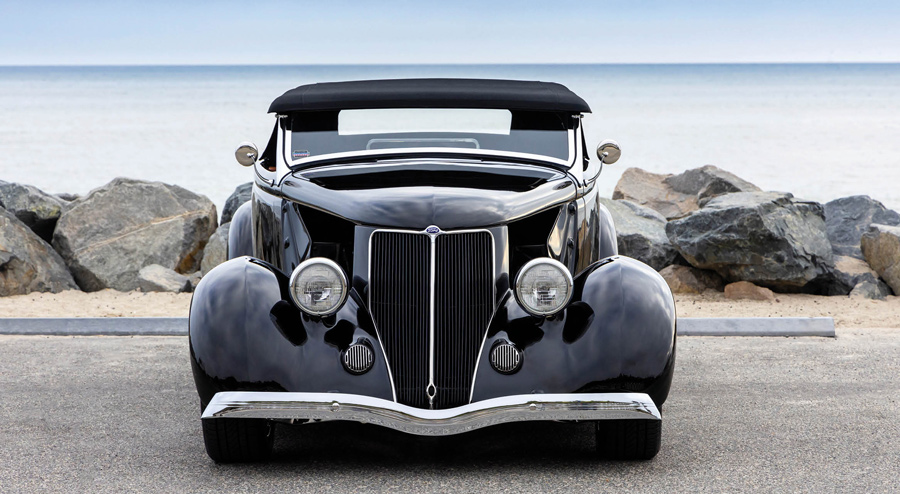
t is amazing that every year the list of homebuilt hot rods that turn out for competition for the America’s Most Beautiful Roadster award grows. This past year was no exception. One of the favorites in the highly competitive field was a ’36 Ford roadster belonging to Danny Hyde of SoCal. He’s my neighbor, well, he lives a few miles down the road, but the fact is for the past eight years I wasn’t aware such a build was going on. But there is plenty more to this story.
Let’s go back up to about 1984 when Danny decided it was time and moved from Connecticut to the Orange County suburbs in Southern California. So far so good. But this ’36 Ford was a five-window coupe and not a roadster. You see living on the East Coast dictated that a roof and side glass be part of any practical hot rod. In fact, Danny and his then ’36 coupe made the drives to the NSRA Street Rod Nationals in Columbus (Ohio), St. Paul (Minnesota), Memphis (Tennessee), and Louisville (Kentucky). Oh, did I mention that he also made trips to a number of Goodguys events on the West Coast, including Merced and Bakersfield, California, and a trip to Bonneville. We aren’t sure how many miles that is but we do know it would take a calculator to figure it out. Now you are beginning to think that this was Danny’s one and only ride. Well, it wasn’t. As it turns out he had the time to build a barn full of Fords beginning with a ’29 Ford roadster and an extended cab pickup, a ’31 roadster, a ’32 roadster, ’37 and ’38 Tudor coupes, and a ’41 coupe. That’s the early Fords, then there were three ’50 Ford convertibles, a ’54 coupe, a ’54 Merc hardtop, and a ’51 Merc. Oh, did we mention he also built a ’75 Ford Ranchero.
Once he moved to SoCal the game changed. No doubt he would now need a roadster to avail himself of the Southern California vibe. As life has a way of altering our expectations, it was suddenly 2015 and he hadn’t begun his coupe-to-roadster transformation. This herculean feat was made even more remarkable by the fact he was 80 years old when he began and 88 years old when he unveiled the roadster at the Grand National Roadster Show (GNRS)—and he did much of the work himself. For anyone wanting to take on the task of converting a coupe to a roadster you are undertaking a massive amount of metalwork. This didn’t faze Danny as he dug out the cutting torch, various saws, the welding equipment, lots of accessible metal, cardboard for patterns, and on and on … until he had a ’36 roadster. It should also be mentioned that he did spend his lifelong career, now retired, as an autobody tech. In so doing he is extremely familiar with the ins and outs of working metal as well as fabricating from scratch. As is always the case, every hot rodder has friends who if it weren’t for them the job wouldn’t ever get handled.
In Danny’s case, the likes of longtime friend Bob Mariani came from the East Coast to the West Coast on multiple occasions. When it came crunch time Mariani was there burning the midnight oil on several occasions getting the ’36 ready for the GNRS. Along with Mariani more friends kicked in time and effort, such as Lon Phillips, Rod Sexton, Harley Brooks, Ron Mangus, and Allen Budnik, all waiting in the wings to help where they could. Some of these names probably sound familiar. Keep reading and you will see where everyone fits into this puzzle of a coupe turned into a roadster.


Getting the fuel fired falls to an MSD distributor and coil managed in conjunction with a set of Ford Performance plug wires all beginning with the trunk-mounted Optima battery then feeding the Powermaster duo of polished starter and alternator. Getting the fired gases out of the cylinder heads falls to a pair of heat-coated Sanderson 1-1/2-inch primary tube headers. From here they hook up and flow through the fully polished stainless steel exhaust tubing fabricated by Rod Sexton (a master in exhaust fabrication). Lastly, the Sexton exhaust system links to a pair of MagnaFlow mufflers that then exit the vapors via twin oval tailpipes.
Let’s remember we are talking about a ’36 Ford five-window coupe that has transitioned into a ’36 Ford roadster. It took Danny countless hours, untold patience, some creative thinking, and a lifetime of skills to pull off this maneuver. He has shown us all what can be accomplished and done to such a high state of clarity as to make us think we mere mortals could pull this off. Few can!
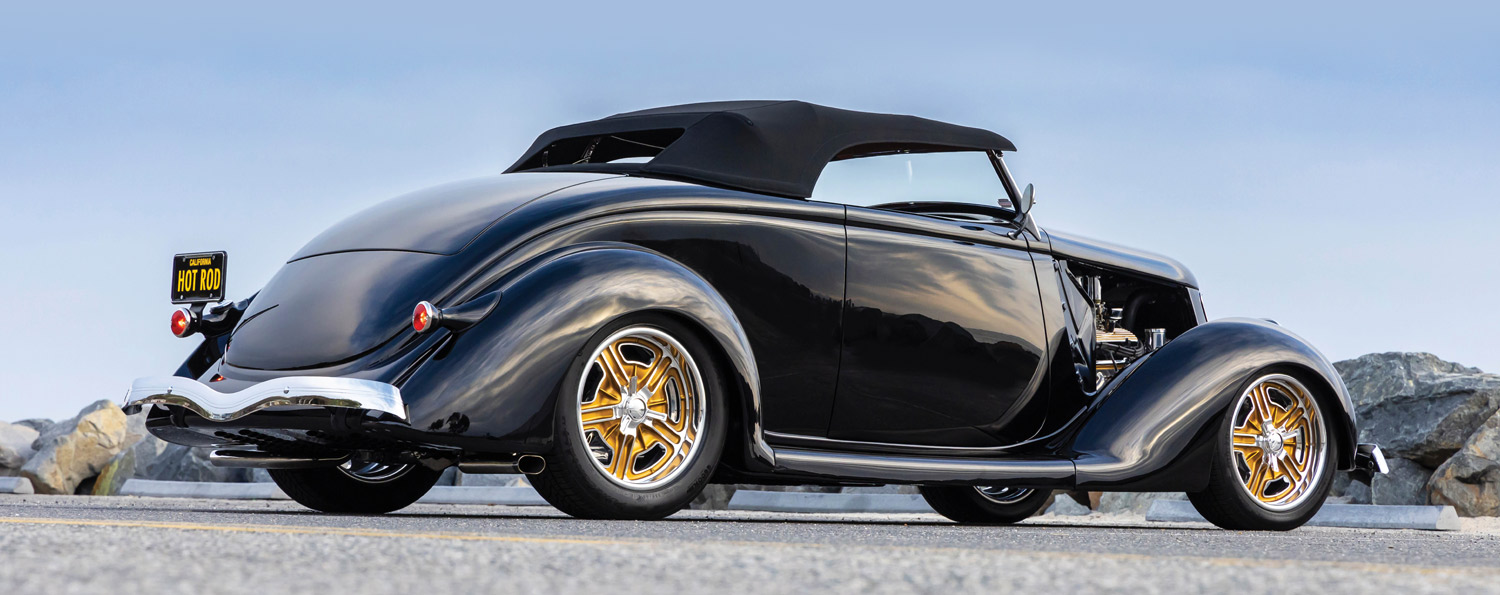
Basically, Danny took the ’36 Ford coupe body and shortened and narrowed it, then performed a wedge cut, turned the doors around, and laid back the grille and cowl. Here are some specifics on how and where the sheetmetal is cut or lengthened. The doors, aside from being turned around into “suicide” (opening in front rather than at the back of the door) operation, were lengthened 4 inches. From here there were an additional 6 inches cut out of the rear portion of the frame and flooring. There was an additional 1 inch out of the back of the frame and sheetmetal.

Danny is very proud of the fact that he continually massaged the sheetmetal to the point there is no body filler, just good ol’ metal finish. From here he finalized the bodywork so that his friend Harley Brooks could spray on the single-stage PPG Ultra-Black paint.
Inside Danny used a Speed33 metal dash with one of their engine-turned inserts that he then recessed into the metal dash. The new dash is now the home for a full set of six Stewart-Warner gauges brought to life through a Painless Performance Products wiring system that another friend Lon Phillips made all the connections. We mentioned earlier that a LimeWorks column is used but we should note there is a custom drop and resting on top of the column is a 45-plus-year-old vintage Bell four-spoke steering wheel. You may have noticed there are three pedals yet it’s an automatic! So, what’s the “third” pedal for? Danny, being an ex-racer, grew accustomed to braking with his left foot. So, he tied the two pedals together, allowing the roadster to stop using either pedal. The pedals have early Ford foot pads with Kugel arms while the throttle is a Lokar spoon-style that’s used along with the Lokar floor-mounted shifter. Note below the custom dash is an upholstered lower panel that houses the headlight, horn button, and ignition switches along with five center-mounted rocker switches. These five rocker switches control (left to right) the turn signals, electric fan, high/low beam, a pair of cooling fans that reside under the car to blow out high temps trapped by the bellypan, and the under-dashboard lights. The flawless stitchwork comes from Ron Mangus of Ron Mangus Hot Rod Interiors that includes the seating, carpeting, and the roadster top. The single-bench seat comes by way of Tea’s Design that is now covered in a light brown leather while the carpeting is done in black German square weave with Juliano’s seatbelts (not shown).
All of this was done to give a five-window coupe a makeover so that you will look at it as a roadster. We have to say that we believe it is a job well done, very well done.