

Modern Rodding Tech
A mechanic in a black t-shirt leans over the engine bay of a white classic car, carefully installing a new silver water pump and pulley system onto a high-performance V8 engine
1. Dean Livermore from Hot Rods by Dean handled the installation of the Vintage Air Front Runner on editor Brian Brennan’s Corvette. Here he installs the water pump. (The rumor that Brennan isn’t allowed to use tools isn’t entirely true; that rule only applies to power tools.)
Another Look at Vintage Air's Front Runner
The Automotive Version of a Better Mousetrap
By Ron Ceridono Photography by Brian Brennan
T

he saying “Build a better mousetrap, and the world will beat a path to your door” is often attributed to poet and philosopher Ralph Waldo Emerson. While his original wording was more eloquent, the modern version still conveys the idea. The challenge is to find ways to improve existing products, and enhancing hot rod parts is exactly what Vintage Air achieved with the Front Runner accessory drive system.

Mounting engine-driven accessories in a hot rod has always been a challenge, both in size and strength. Getting components tightly packed against the engine to fit into a small engine bay was tough. Designing brackets that were sturdy enough to prevent vibration, look clean, and properly align all the pulleys was also difficult. All those issues disappeared when Vintage Air introduced the Front Runner, their smallest drive package ever, offering a better solution for these problems.

As Vintage Air’s Rick Love explains: “We introduced the first Front Runner drive system (small-block Chevy) in late 1999. We trademarked the name as well. The criteria was to design and develop a robust and rigid platform that mounted strictly to the engine block so that deck height, head, and intake manifold choices were irrelevant.” By securely mounting all engine-driven components to a rigid platform, it was no longer necessary to pivot them to properly tension the required V-belt array. Instead, a serpentine belt is used with a spring-loaded tensioner, which eliminates the need for belt adjustments. Additionally, serpentine belts save space and can handle more tension to prevent slipping without stretching. Today, many modern engines, such as the GM LS Series and the Ford Coyote modular engines, require the integrated mounting approach that a Front Runner provides.

Included in the small-block Chevy Front Runner kit is a Stewart water pump. These high-flow, reverse-rotation pumps are unique because they feature dimensionally accurate mounting surfaces (the depth of the holes that attach the pump to the block). This allows for perfect alignment of the Vintage Air main bracket and pulley, something that can’t be guaranteed with OEM water pumps.

The Front Runner kit includes a Mechman “hairpin” (Denso design) high-output alternator with a 170-amp output (130-plus at idle). It comes with a heavy four-gauge charge wire, wiring kit with terminals, and a crimping die. These Vintage Air alternators use an ignition switch-activated wire to excite the alternator, as this method offers better load response than one-wire versions. While 170 amps should be enough for most applications, Vintage Air now provides a 320-amp alternator for extreme electrical demands. Regardless of the alternator selected, a ground wire from the lower alternator mounting bolt to the engine block is highly recommended.

It is logical that the Vintage Air Front Runner would include an A/C compressor. Front Runner kits feature a compact A/C compressor that uses R-134a refrigerant and comes with a bolt-on, O-ring compressor block. Placing the connections on the side of the compressor makes connecting the refrigerant lines easier.

As Brennan’s C3 Vette has been updated with a Detroit Speed & Engineering (DSE) front suspension system with rack-and-pinion steering, a power steering pump is required. Vintage Air’s GM TC power steering pump (often referred to as a Type II), included with the Front Runner, supplies the 1,800-psi peak pressure and 3-gal/min flow that the DSE rack requires. This pump is also appropriate for conventional GM power steering boxes.

Vintage Air offers Front Runners in various finishes. Brackets are available in machined or black anodized options. Compressors and alternators come in natural, polished, or chrome finishes. Pulleys, clutch, and tensioner covers are offered in chrome or black anodized. All kits include ARP fasteners.

Currently, Front Runner kits are available for small- and big-block Chevrolets, as well as GM LS, LS7, LT1, and LT2 engines. Additionally, Vintage Air recently introduced cast-aluminum Front Runner kits for LT1 and LS engines. And Vintage Air hasn’t forgotten about Ford enthusiasts—Front Runner kits are available for Ford small-blocks and Coyotes. These kits are compatible with most Coyote generations, though some may require a timing cover change.

Vintage Air Front Runner systems are not only compact and sleek in appearance, but they are also more efficient than V-belt-driven systems. Thanks to their thoughtful design and high-quality control, Front Runners are easy to install and virtually maintenance-free. Emerson may not have been a hot rodder, but he had the right idea.

A wide-angle, close-up view of a completed Front Runner engine accessory drive system installed on a V8 engine, featuring black serpentine pulleys, a high-output alternator, and a FiTech fuel injection system
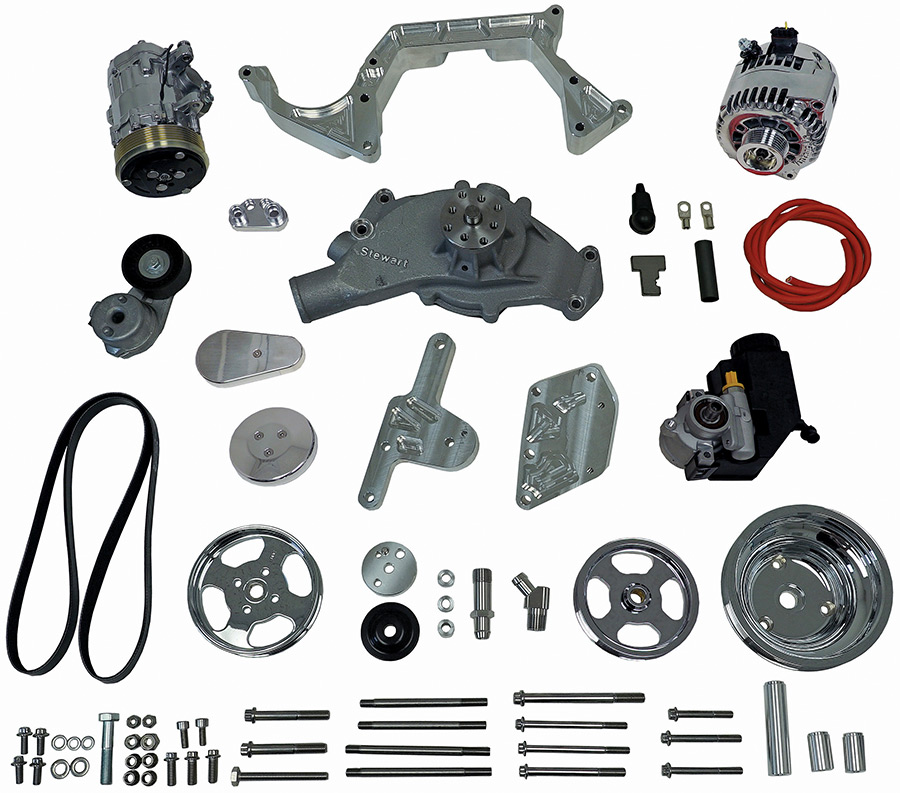
2. Vintage Air’s billet front accessory drive system for small- and big-block Chevys includes brackets, pulleys, water pump, high-amp alternator, A/C compressor, and drive belt—power steering pumps are optional.
A comprehensive product layout of a Front Runner engine accessory drive kit, including a Stewart water pump, high-output alternator, A/C compressor, pulleys, serpentine belt, and all necessary mounting hardware
3. Front Runner systems not only look great but they’re compact and provide solid mounting points for the engine-driven accessories. Additional benefits include the serpentine belt and the spring-loaded tensioner.
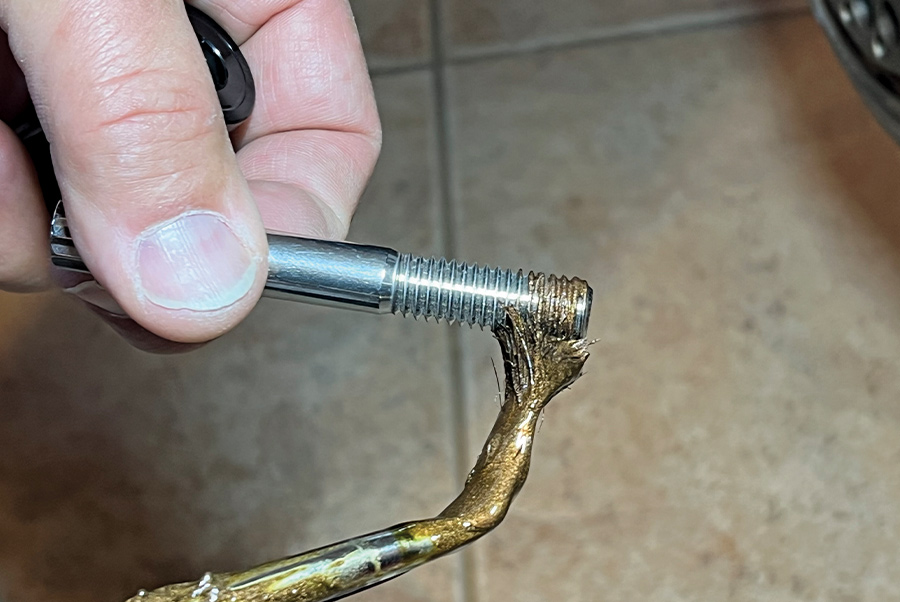
A close-up photograph of a mechanic applying a thick, bronze-colored anti-seize lubricant to the threads of a silver mounting bolt using a small brush to ensure proper torque and prevent galling
4. Included in all Vintage Air Front Runner kits are top-quality ARP stainless steel fasteners. Prior to installation, the threads must be treated with antiseize compound.
A close-up photograph of a mechanic using a silver socket wrench to tighten the bolts inside a black crank pulley, which is mounted on a Chevrolet V8 engine block featuring a "COMP Cams" timing cover
5. Vintage Air offers bright, chrome-plated pulleys or Mil 3 hard-coated black pulleys, as shown here. Note the four long studs used to mount the water pump.
A close-up photograph of a black anodized water pump pulley being mounted onto a silver Stewart high-performance water pump with high-strength silver fasteners
6. All engine-driven components have minimum and maximum speeds for proper operation. Front Runner pulleys were designed to provide optimal ratios throughout the most common engine rpm operating ranges.
A close-up view of a high-performance V8 engine block during assembly, featuring an orange engine block, polished aluminum valve covers, and a silver Stewart water pump with a black pulley installed
7. The included high-flow, reverse-rotation Stewart water pump features 3/4-inch ball/roller bearings that provide five times the strength of standard bearings. The precision-ground fan hub ensures perfect pulley alignment.
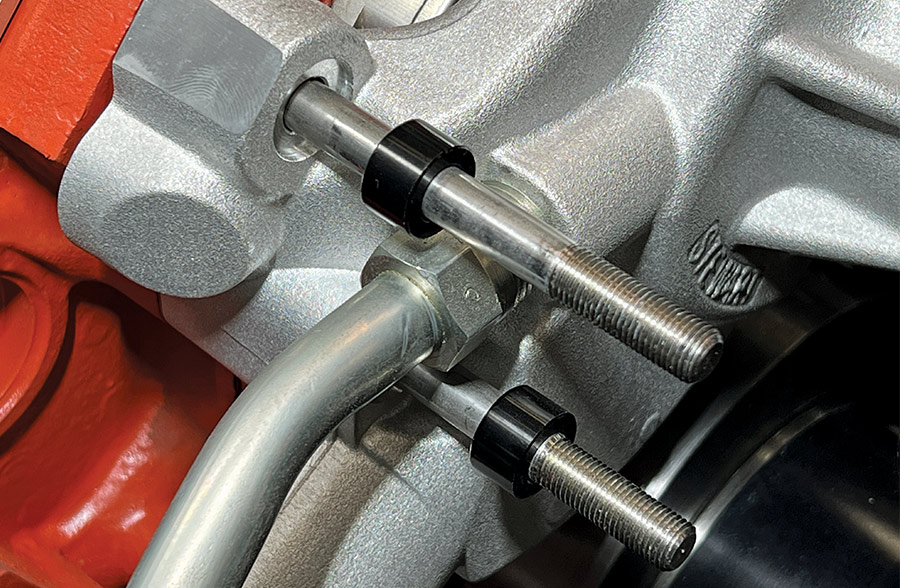
Close-up of black spacer bushings installed on mounting studs between a silver Stewart water pump and an orange engine block for a Front Runner accessory drive system
8. With the water pump installed, specific spacers are added to the four studs that were previously installed. Note the spot-faced mounting hole in the pump, which is typical of all four holes.
A close-up photograph showing the installation of a black anodized mounting bracket onto a V8 engine block, featuring high-strength silver studs and an engraved aluminum cylinder head
9. For power steering applications, the pump bracket slides over the lower water pump stud and bolts to the lower holes on the driver side of the block. For non–power steering applications, a pump delete bracket is included.
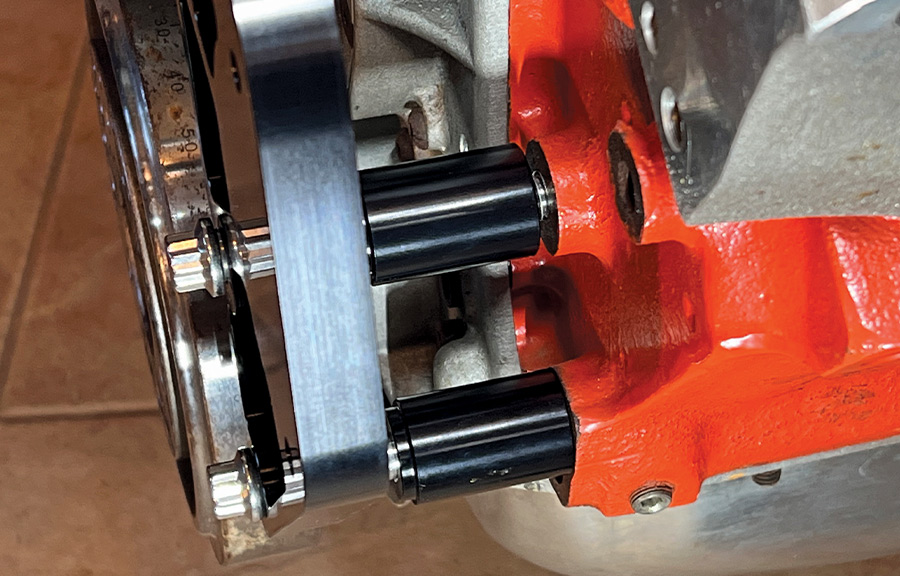
Close-up of black anodized spacers and mounting hardware securing a CNC-machined bracket to an orange Chevrolet V8 engine block for a Front Runner accessory drive system
10. Here, the spacers or standoffs between the power steering bracket and the tapped factory holes in the block are visible.
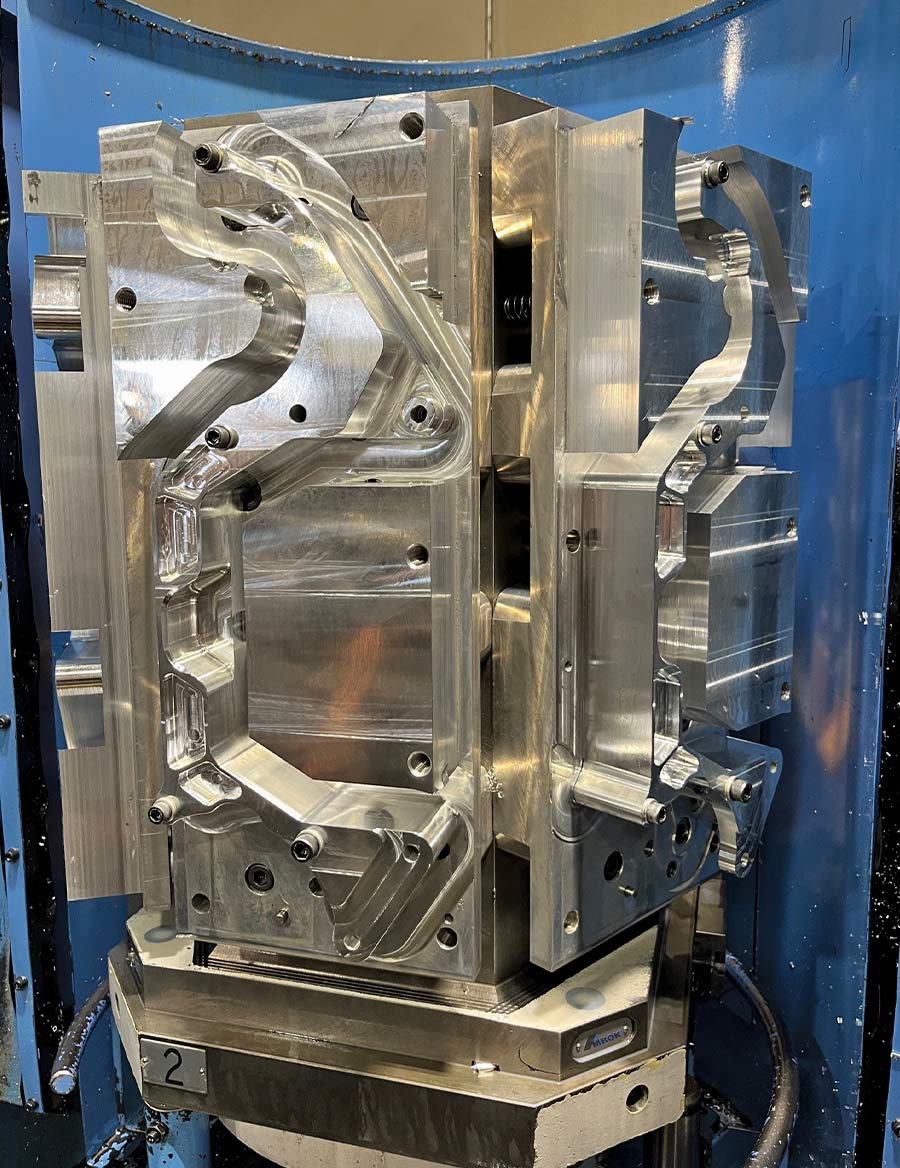
A large, multi-sided CNC machining fixture holding several polished aluminum Front Runner engine brackets during the precision milling process in an industrial machine shop
11. Vintage Air machines its billet Front Runner components in-house. Here, a solid block of aluminum is being turned into a main bracket for a small-block Chevy.
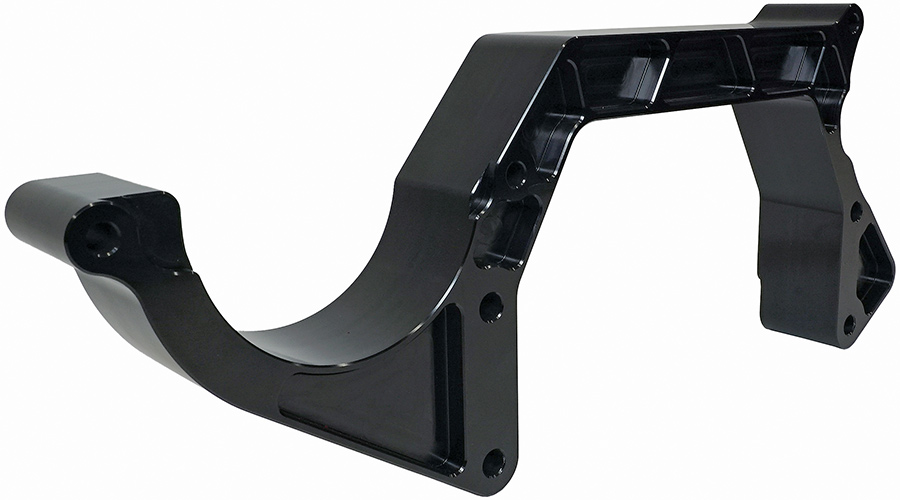
A finished, black anodized CNC-machined main mounting bracket for the Front Runner engine accessory drive system, shown from a three-quarter angle against a white background
12. Front Runner super-sturdy main brackets mount the alternator and the A/C compressor; they are available in black anodized (shown) or in a machined finish.
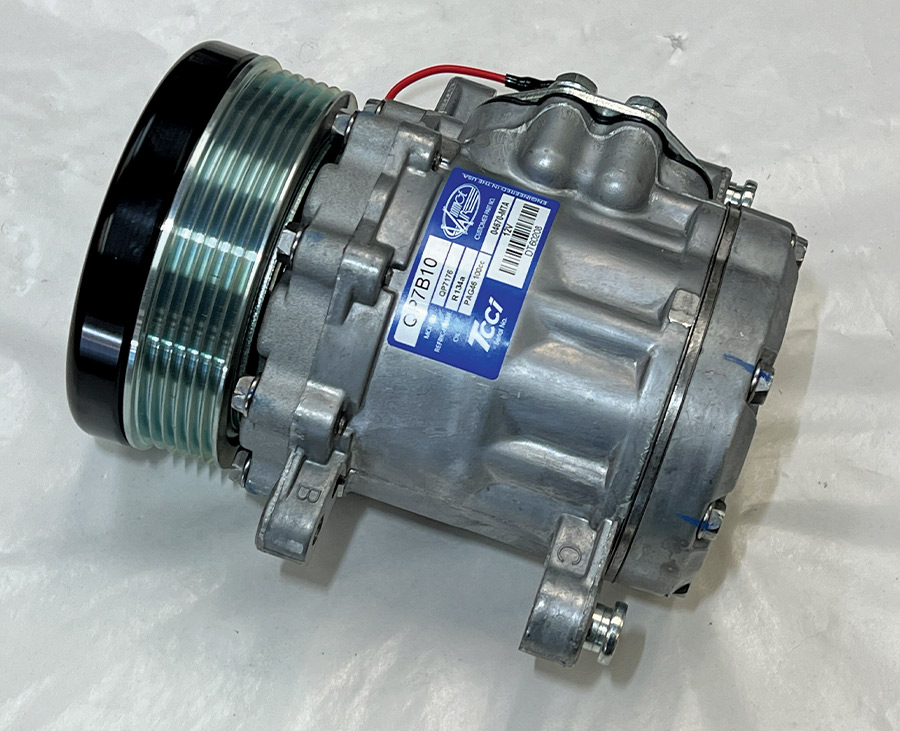
A high-performance TCCI air conditioning compressor for a Front Runner engine drive system, featuring a compact aluminum body and a black serpentine pulley, shown on a white surface
13. Included with all Front Runner kits is a Sanden or TCCI 7B10 compressor. These compressors ship with the correct amount of PAG oil; no additional oil is required.
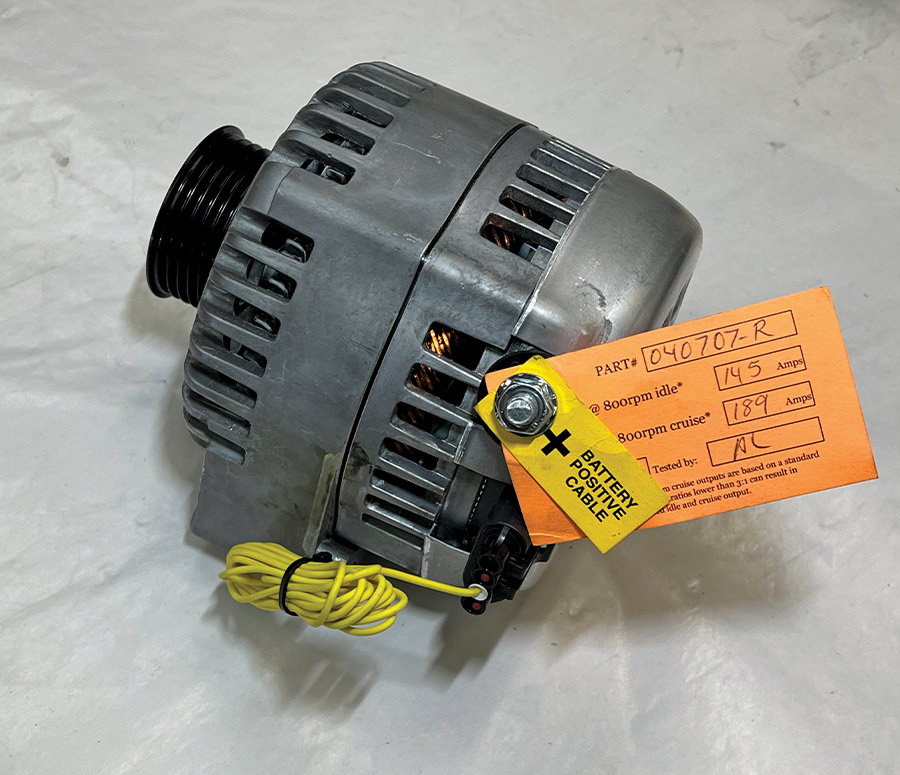
A high-output performance alternator for a Front Runner engine drive system, featuring a raw aluminum housing, a black serpentine pulley, and a testing tag showing 145 amps at idle
14. Our Front Runner was equipped with the standard alternator. Although it’s rated at over 130 amps at idle and more than 170 amps at cruise rpm, the test tag shows the actual output is higher.
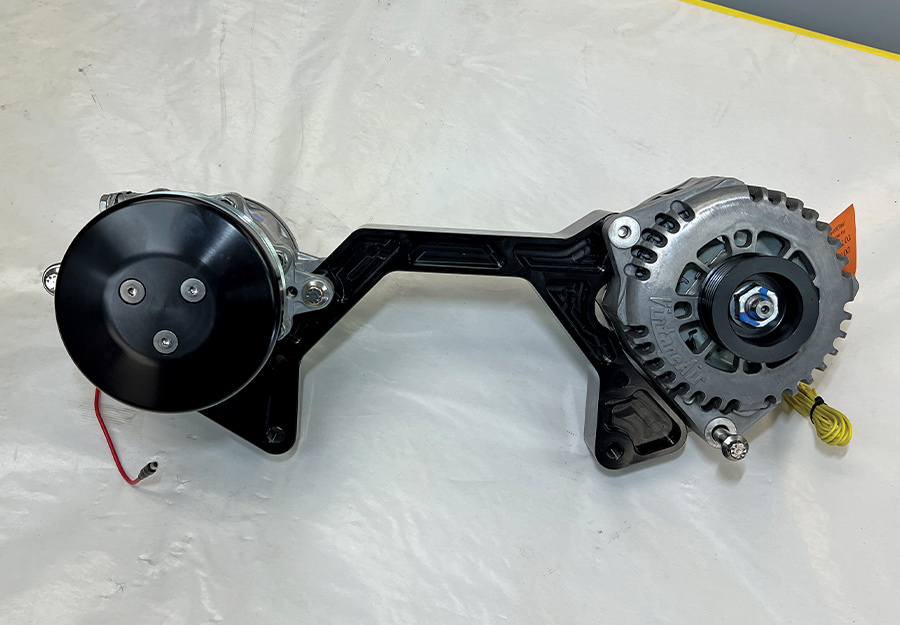
A top-down view of a partially assembled Front Runner engine accessory drive, featuring a black anodized mounting bracket connecting a high-performance A/C compressor and a high-output alternator
15. Here, the A/C compressor and alternator have been mounted to the main bracket. The included compressor clutch cover has also been installed.
A mechanic carefully lowering the combined Front Runner main bracket assembly—including the alternator and A/C compressor—onto the mounting studs of a Chevrolet V8 engine
16. With the correct spacers in place, Livermore slid the main bracket assembly onto the mounting studs.
A top-down view of a fully installed Front Runner engine accessory drive system on a high-performance V8, featuring a black anodized main bracket, silver A/C compressor, high-output alternator, and polished aluminum valve covers
17. On the driver side, the main bracket is secured with the supplied 12-point nuts; the alternator also bolts to the power steering bracket with the supplied hardware.
A macro photograph showing a yellow pencil pointing to a dowel pin alignment hole on a CNC-machined aluminum engine pulley to ensure precise timing and balance
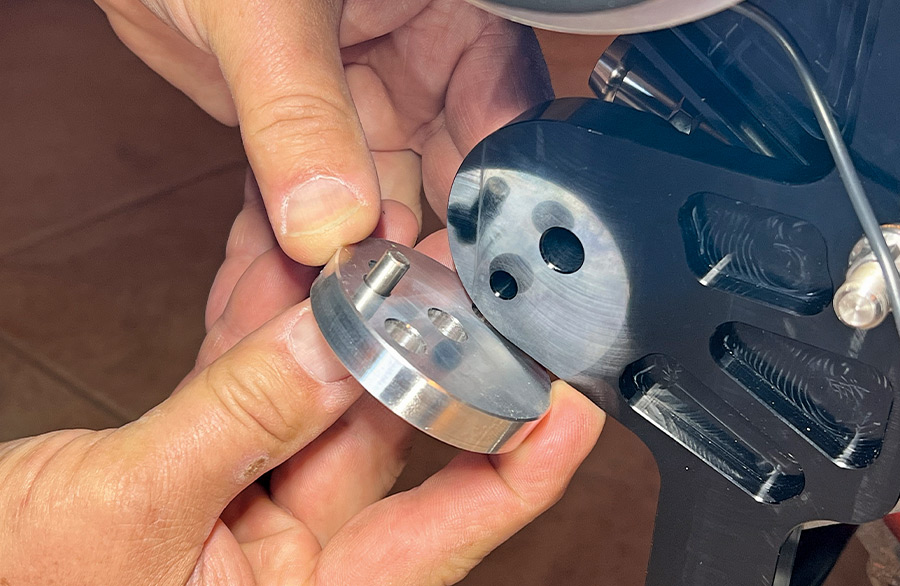
18. The spacer for the belt tensioner has two holes for the locating pin—one for power steering applications and the other for non power steering.
A close-up of a mechanic aligning a silver aluminum pulley hub with a black anodized engine bracket, showing the critical placement of the steel dowel pin for proper component clocking
19. With the pin in the correct position, the spacer is placed onto the tensioner bracket.
A close-up of a mechanic aligning a spring-loaded serpentine belt tensioner with a CNC-machined aluminum mounting hub on a black engine bracket
20. There are two pins on the tensioner that properly align it on the spacer. Note the pin in the “left” hole for this power steering application.
A partially assembled Front Runner engine accessory drive component, featuring a spring-loaded serpentine belt tensioner with a black pulley mounted to a CNC-machined black anodized bracket with spacers
21. With the tension mounted on the bracket, the assembly is ready to be installed. Dowel pin in tensioner bracket.
A close-up view of a black serpentine crank pulley installed on a silver harmonic balancer, mounted to an orange V8 engine block as part of a high-performance Front Runner accessory drive system
22. Chevrolet has carefully included the same threaded holes that were on the front of 1955-57 blocks for engine mounts on both sides. They also serve as great accessory mounting points.
A close-up shot showing a long black anodized spacer and high-strength silver bolt securing the lower engine accessory mounting bracket to an orange V8 engine block
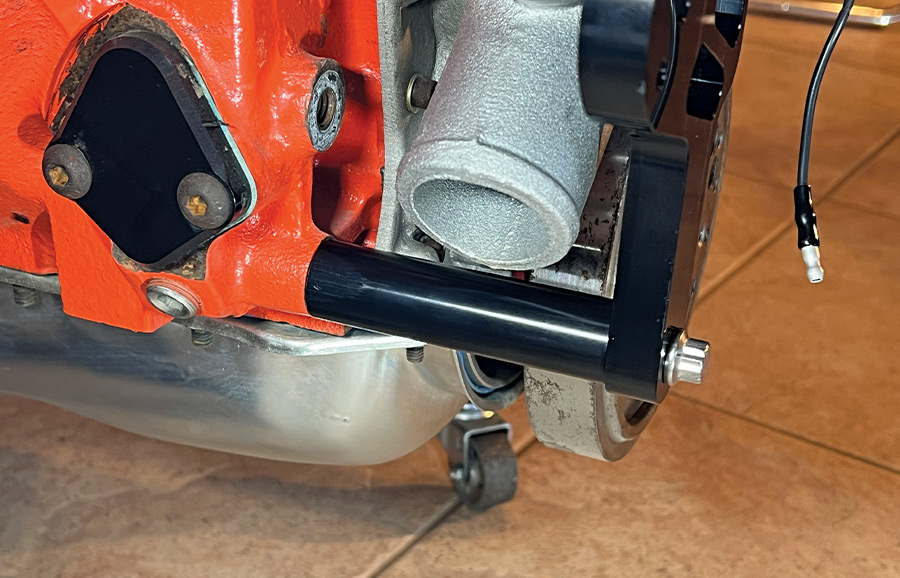
23. At the bottom of the tensioner bracket, two standoffs are used between it and the block (here, only the lower standoff is installed).
A close-up action shot of a mechanic using a silver ratchet and socket to tighten the mounting bolts on a black anodized engine bracket for a Front Runner serpentine drive system
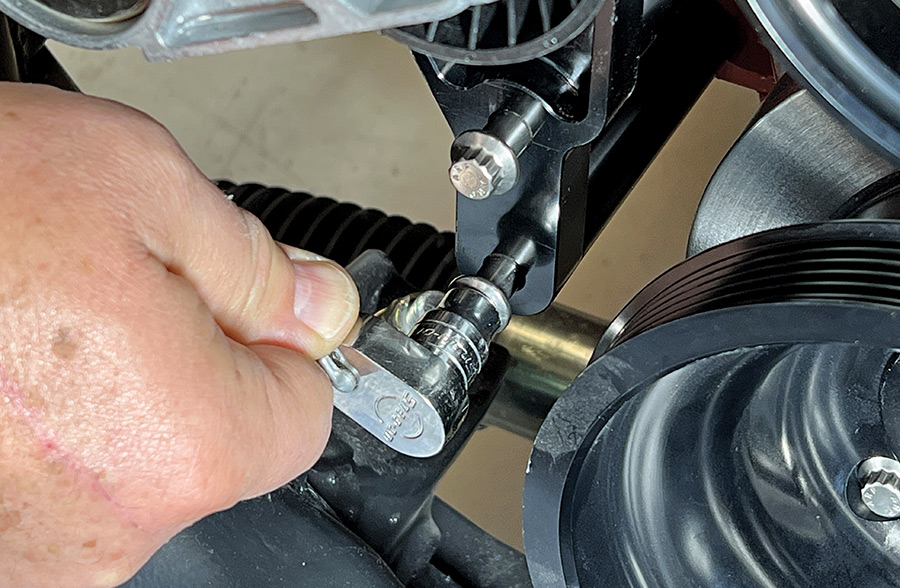
24. At the bottom, the tensioner bracket is mounted with the supplied 4-3/4-inch ARP 12-point fasteners. At the top, it fits over the water pump studs and is secured with 12-point nuts.
A close-up view of a spring-loaded serpentine belt tensioner fully installed on a black Front Runner mounting bracket, featuring a silver cast-aluminum arm and a black composite pulley
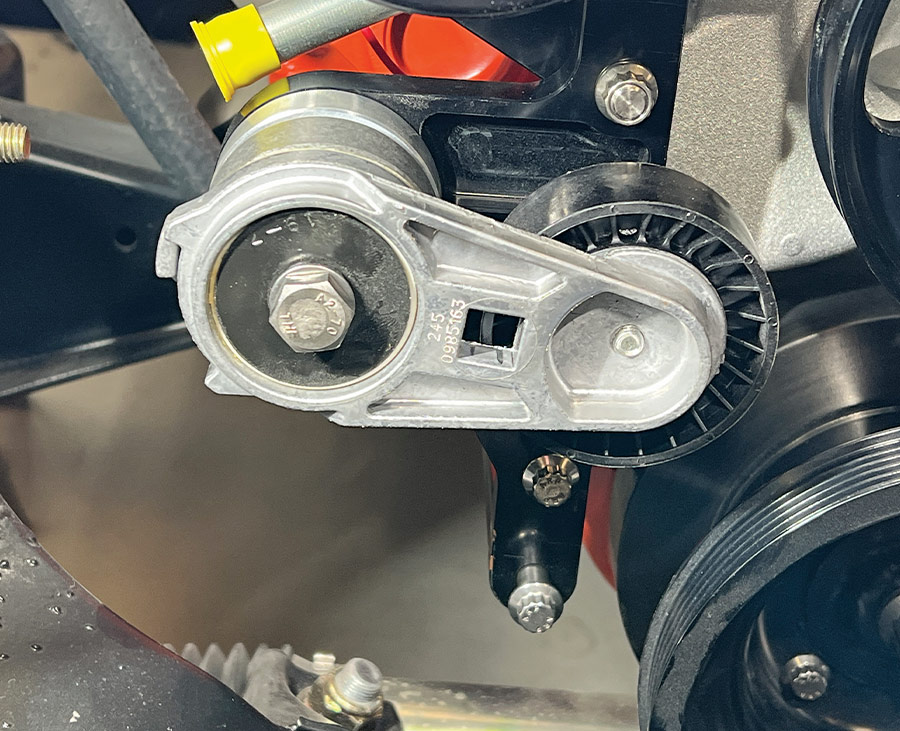
25. The square hole in the spring-loaded tensioner accepts a ratchet or breaker bar. The tensioner is rotated clockwise to install the belt. Here, the lower water pump stud that locates the tensioner is visible (the upper one is hidden behind the A/C compressor).
A close-up action shot of a mechanic installing a high-performance power steering pump with an attached black fluid reservoir onto a Front Runner engine accessory drive bracket
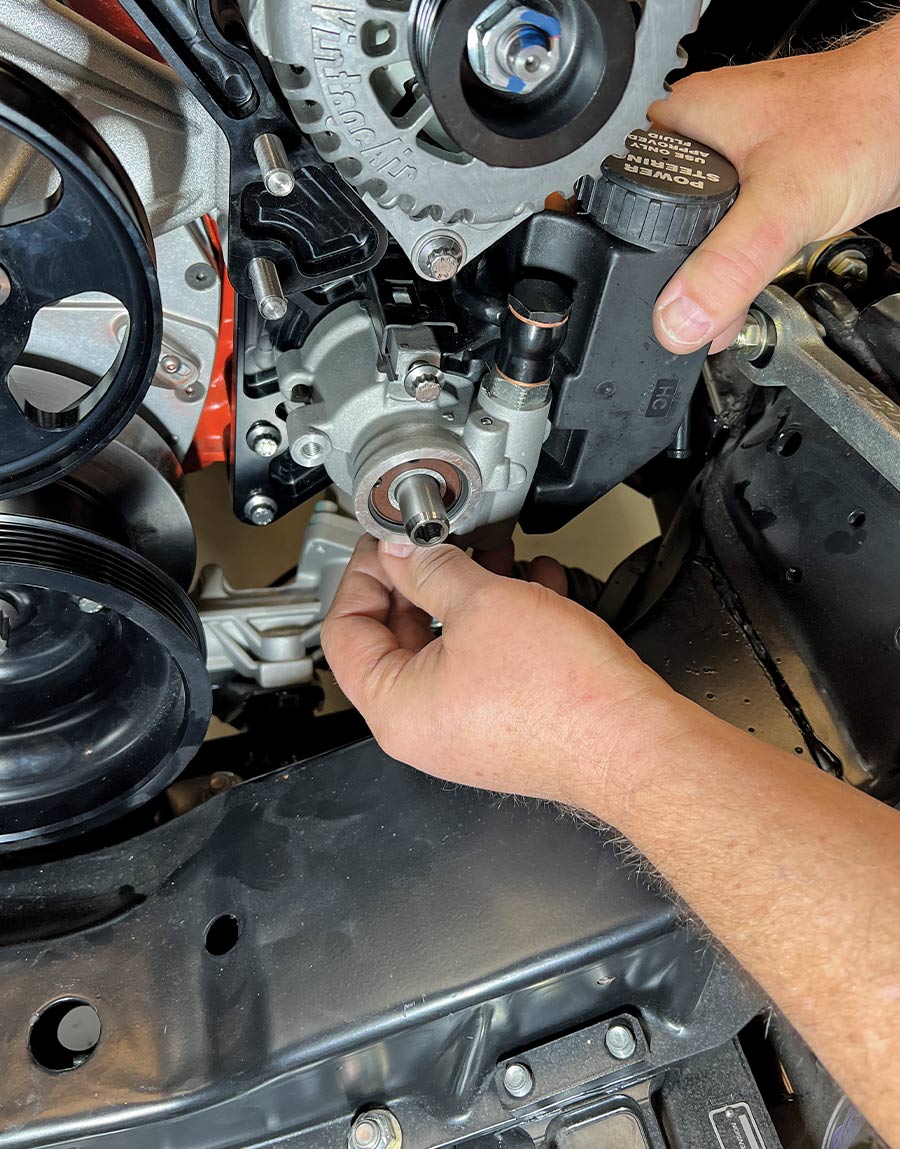
26. Included with the Front Runner kit is a power steering pump with a flow rate of 3.0 to 3.4 gal/min. For early Mustang II rack-and-pinion applications, a lower flow-rate control valve (PN 8520010) is available.
A close-up view of a high-performance power steering pump and an attached black plastic reservoir with a cap labeled "Power Steering Use Only Approved Fluid," installed as part of a Front Runner engine drive kit
27. Power steering pumps have a built-in reservoir by default, while a remote reservoir is available as an option.
A close-up photograph showing the installation of a black anodized power steering pulley onto a pump shaft using a specialized pulley installer tool, a combination wrench, and an adjustable wrench
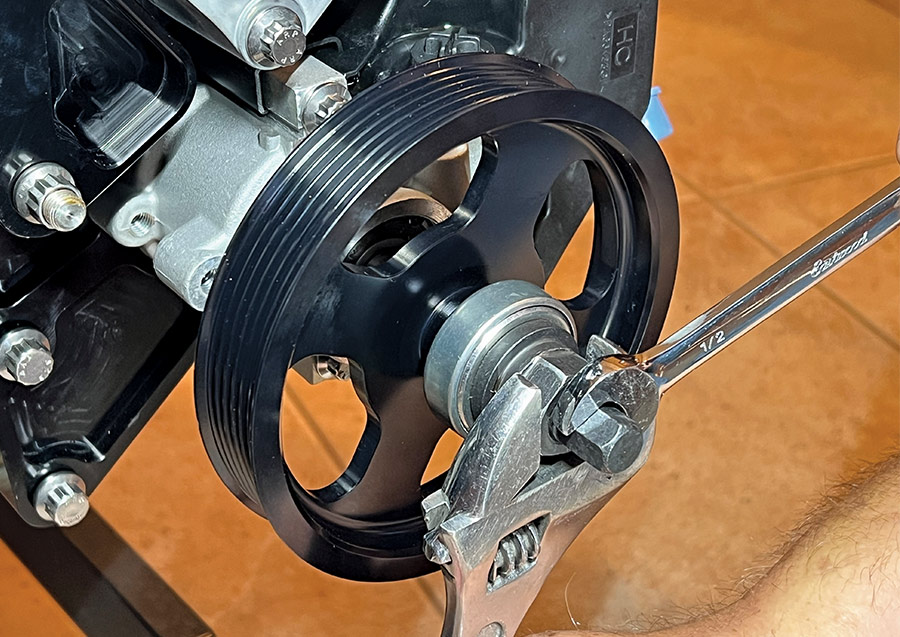
28. When installing the power-steering pump pulley, it is mandatory to use the proper installation tool to install the pulley onto the shaft. These tools are readily available at most auto parts stores. Driving the pulley on with a hammer or attempting to press the pulley on from the front will destroy the pump.
A high-performance Goodyear Multi V-Belt, part number 1060615 (6PK1562), shown in its original blue and yellow packaging, specifically used for serpentine engine accessory drive systems
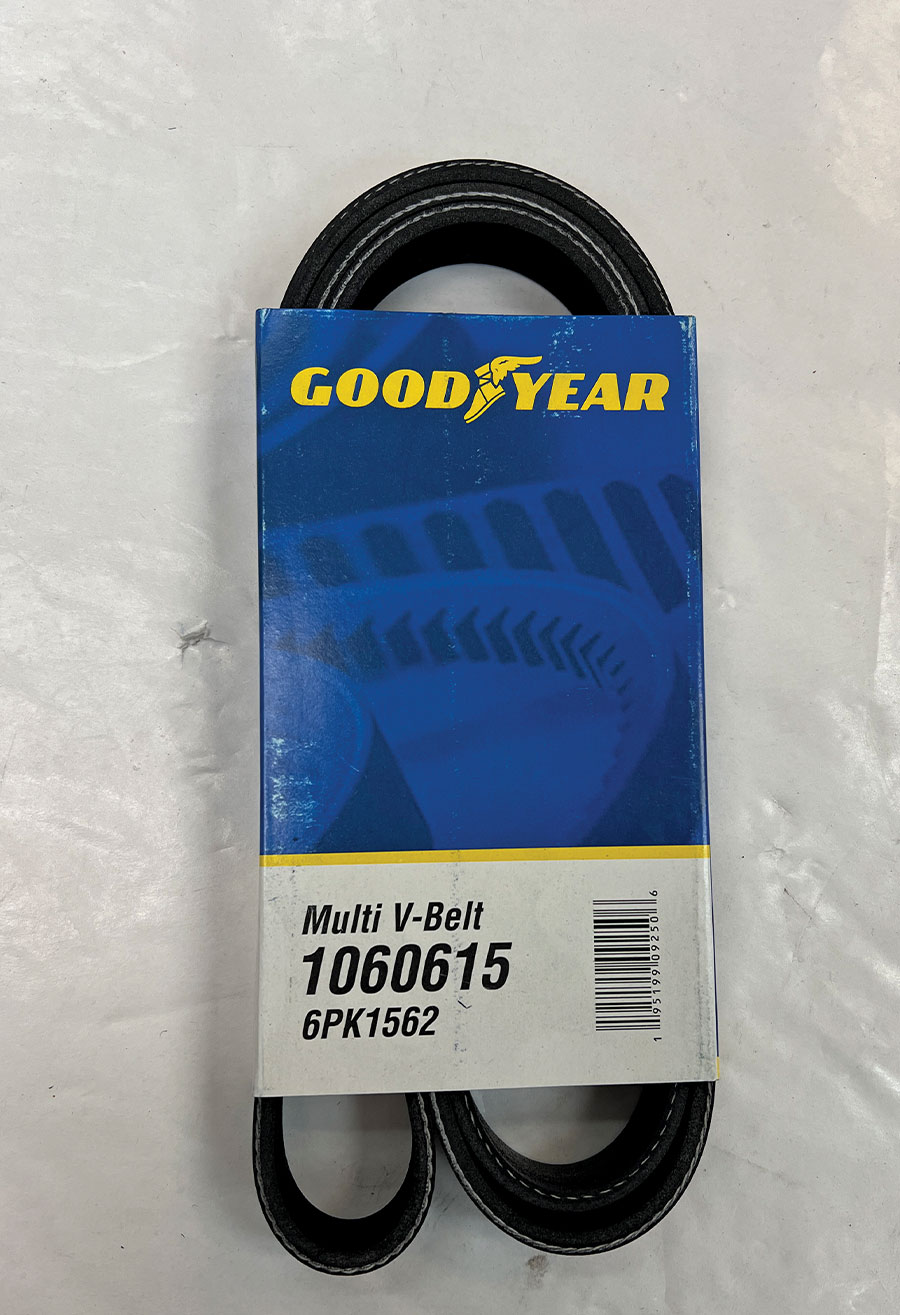
29. A high-performance serpentine drive belt is included with each Front Runner (belts differ between power steering and non–power steering applications).
A wide-angle view of a completed Front Runner engine accessory drive system on a V8 engine, featuring a Goodyear serpentine belt routed through the A/C compressor, alternator, power steering pump, and water pump pulleys
30. Front Runners are available for Chevrolet’s big-block engines, featuring the same options as the small-block kits.
A three-quarter studio view of a modern LS V8 engine featuring a complete Front Runner engine accessory drive system with a black serpentine belt, integrated A/C compressor, alternator, and black anodized pulleys against a white background
31. Vintage Air’s cast Front Runner for LT1/LS applications. This system is the shortest and most compact front-drive setup available, offering more package space for electric fan modules and accessories. Additionally, the low-profile casting clears OEM and most aftermarket throttle bodies without needing a wedge spacer.
A high-performance V8 engine featuring a polished chrome Front Runner engine accessory drive system with a serpentine belt, chrome alternator, and matching polished pulleys against a white background
32. Small-block Ford Front Runner kits feature a one-piece forged aluminum timing cover with built-in accessory mounts.
A Ford Coyote 5.0L V8 engine equipped with a Front Runner engine accessory drive system featuring a clear-anodized billet aluminum bracket, black pulleys, and a serpentine belt, isolated on a white background
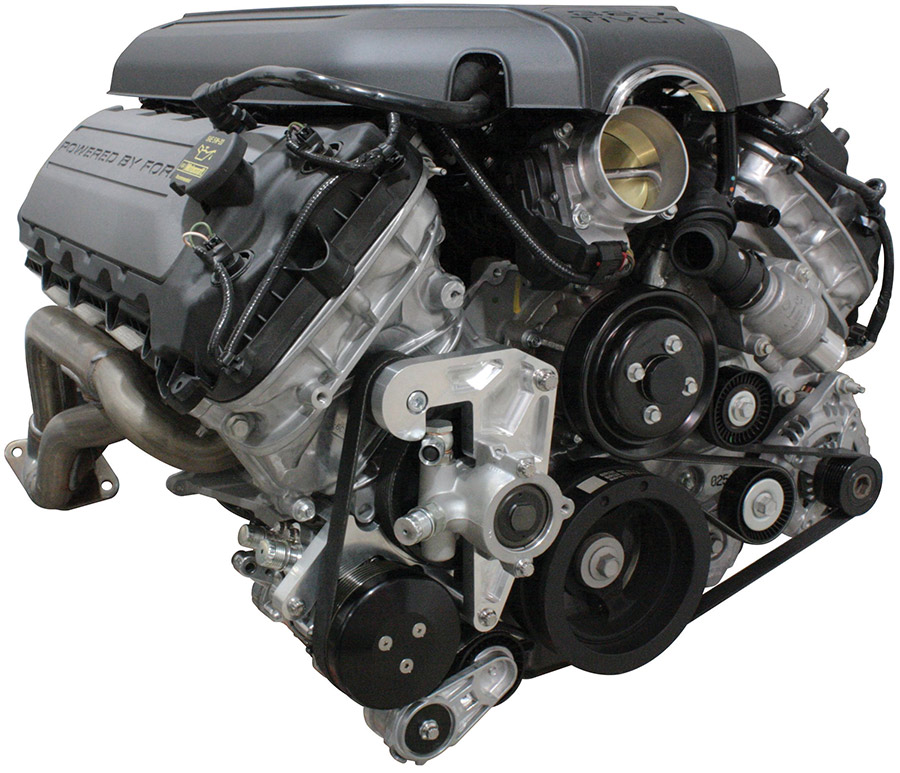
33. Front runners for Ford Coyotes keep the factory Ford alternator and water pump drive on the left (driver) side of the engine. A new precision-machined compressor cradle and power steering pump mount are added to the right (passenger) side.

Modern Rodding
VOLUME 7 • ISSUE 67 • 2026